








Before setting sail from Spain, while I was more or less preparing and planning the route I was going to take, I decided to try to avoid sailing through Southeast Asia at all costs. From what I’d read and heard, it didn’t seem like a particularly pleasant area for sailing. Doing it at night and alone didn’t strike me as a good idea. And here we are, sailing for the second time—this time heading south—through the famous Strait of Malacca.
Sailing through Southeast Asia was a decision I made when I decided I wouldn’t cross the Indian Ocean that year. The cyclone season in the Indian Ocean was too close, and I wanted to take things easy. The other option was to stay near Bali, in a well-protected marina, until the rainy season and low-pressure systems had passed. Staying stationary for that long wouldn’t have been good for either the Sofía or me.
I’m sticking to the same strategy: trying to sail as many miles as possible during the day and resting at night. This way, I reduce the risk of running into drifting fishing nets, fishermen without lights, heavy commercial traffic, and the storms off Sumatra. Just as I did when I sailed north, I try to sail when the current is favorable. In ten days, I reach the maritime border between Singapore, Malaysia, and Indonesia. I’m now in Indonesian waters and sailing toward Belitung, about fifteen days’ sailing by day.
Along the way, I stop for a few days on an island in the middle of the Java Sea. It’s rectangular in shape and uninhabited. I anchor in a bay surrounded by reefs, with a paradise-like beach: palm trees, white sand, crystal-clear water, and not a single sailboat in sight. I think it’s worth spending a few days here.
I sleep well and regain my strength. The morning dawns calm and clear. I make myself a hearty breakfast with coffee and, taking my time, launch the boat into the water to explore the beach. It’s strange because I start to hear chainsaws deep in the forest. I try to follow the sound through the bushes, since there’s no visible trail. Finally, I come across a local couple cutting down trees and sawing them into wooden planks to build a house. That’s what I manage to understand through gestures, since they only speak Indonesian. I help them carry the planks to their boat, and we say goodbye. They’re from an island located four miles west of where I’m anchored.
From the Sofía, I see a floating wooden hut where three men live. I row over in the boat and bring them a few packages of rice. They welcome me warmly and invite me to have some coffee. The hut floats thanks to several 200-liter drums tied beneath its structure. Narrow walkways extend around the house, allowing you to walk along them. Between them, they have huge nets where they raise fish to sell later. We continue to communicate with hand signals. It seems to be a family consisting of a grandfather, a father, and a son—they run the business. The man who appears to be the father brings out some freshly baked buns filled with tuna from the kitchen. They’re piping hot, but they’re delicious. I eat three, and he still offers to make more. They have a satellite internet connection powered by a small transformer and a car battery. They generate electricity using solar panels installed on the wooden and sheet-metal roof.
I gather they’ve just received a shipment from the city because they’re starting to open box after box full of fishing gear. There’s a bit of everything: gear for different types of fishing and equipment designed for catching good-sized fish. In the afternoon, I head back to the Sofía. That night, music can be heard coming from the booth until the wee hours of the morning. The lights stay on until dawn. They must have had a great time.
After three days on this wonderful island, it’s time to move on. My next destination is Belitung, where I must complete the official entry procedures for Indonesia. Before setting sail for the Indian Ocean, I’ll take the opportunity to also complete the official exit procedures so that I can legally leave Indonesia when the time comes.
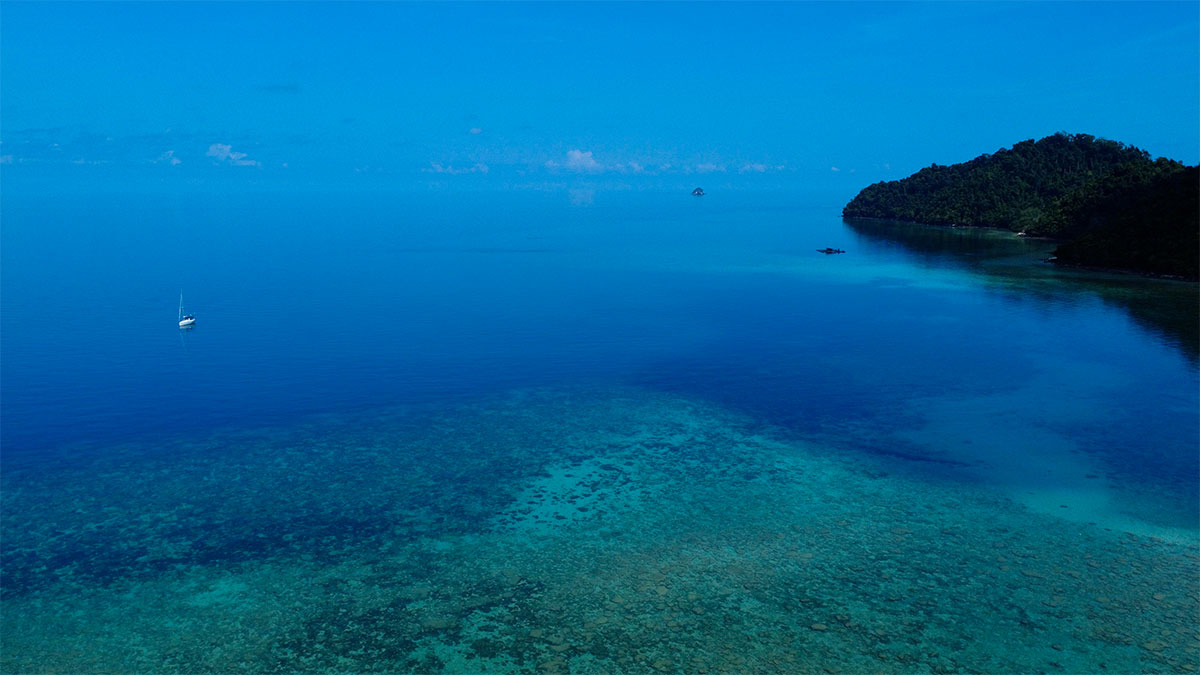
Six days later, I anchored north of Belitung. A few months ago, while sailing toward Malaysia, I anchored in the bay to the northwest. The two bays are less than a mile apart, and yet the color of the water is completely different.
I anchored in four meters of water on a white sandy bottom teeming with starfish. To reach this bay, I had to pass through a beautiful channel between reefs. The anchorage is perfectly sheltered on all sides by islands, reefs, and rock formations. I get out of the boat, start the outboard motor, and head ashore, where I’m meeting my friend Dedy, whom I met during my previous visit. He takes me to immigration, customs, and health services to complete all the paperwork. Afterward, he invites me to eat noodles at a local restaurant. The two of us eat for barely three euros. To wrap up the day, he takes me back to the Sofía.
The next day, I meet up with Dedy again, and this time we’re going to stock up the boat. Our first stop is the traditional market, near the fishing port. The market is a surprisingly orderly chaos. Among the fruit and vegetable stalls, motorcycles zip back and forth, sharing barely half a meter of street space with those of us walking on foot. It seems like everything operates in perfect balance. The ground isn’t paved, and it hasn’t rained in hours, so dust and sand are constantly swirling up, creating a hazy atmosphere. At many stalls, you have to wake up the vendor, who’s sleeping on a wooden plank at the back of the stall. In the meat section, cut-up chickens hang from hooks surrounded by flies, while in the back room, other chickens scurry about, oblivious to their fate. In the fish section, there seems to be a bit more order. All kinds of fish rest on ice or stainless-steel trays. The floor is covered with wastewater from the stalls where the catch is cleaned and filleted. I leave the market with potatoes, carrots, onions, lettuce, avocados, bananas, and pineapple for a ridiculously low price.
The second stop is the supermarket, where I buy milk, eggs, cheese, and bread. The third is the gas station, where I fill up the Sofía’s spare diesel cans. The fourth stop is a warung, a typical Indonesian restaurant. It operates like a buffet with dozens of dishes to choose from and, once again, at very low prices. The fifth and final stop is Belitung’s most traditional café, the authentic spot where locals gather before starting their workday to have their coffee. The flavor is unique: very roasted with a slight hint of vanilla.
I return to the Sofía with my homework done. Thanks, Dedy. I spend the next few days in Belitung servicing the engine, completing some maintenance work, exploring the area, and resting. Before long, I’ll set sail again to bring my voyage through Asian waters to a close.


