








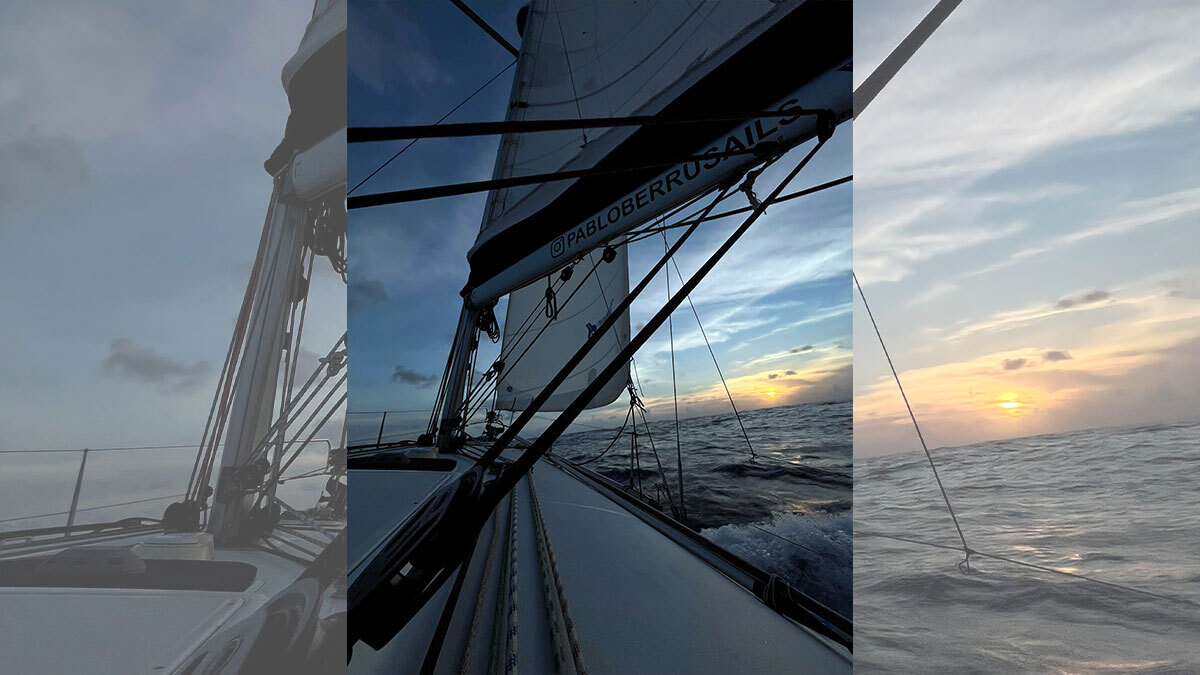
After waiting several days for a good weather window, the Sofía and I set sail for Cocos (Keeling) Islands, an island 640 miles southeast of Indonesia that belongs to Australia. I’m nervous and anxious because over the last few days, the weather has been changing daily, which means the situation isn’t very stable. Still, I’m setting sail because the forecast calls for good winds and relatively little rain for the area. The CAPE index, which indicates the likelihood of storms forming, is high for the first few days. I don’t think I’ll get a better window than this, so I decide to take advantage of it. At 7:00 a.m., I weigh anchor, and the Sofía sets course for Cocos Keeling.
We spent the entire morning motoring due to the lack of wind. It was a clear, very hot day; the thermometer inside the cabin read 34 °C. In the afternoon, the wind picked up. First 15 knots, and an hour later, it settled at 20 knots. I hoist the mainsail with two reefs and unfurl half the genoa. I feel the Sofía pick up speed, quickly covering miles at 7 knots. The current gives us an extra push. I get goosebumps; I’ve been waiting for this moment for a long time: ocean sailing with plenty of miles ahead of us so the Sofía can ride the waves freely.
I’m restless at night; I hope there aren’t too many showers or any thunderstorms—which are typical of this area. Against all odds, the night is clear, and I can see the constellations of Orion, the Southern Cross, and the Big Dipper. With no moon, the stars look incredibly bright and serve as my guide to know I’m on the right course. Around 3:00 a.m., I start to see several green lights on the horizon. Neither the radar nor the AIS detects them yet; they’re more than 30 miles away. I shorten my rest periods to 20 minutes. The AIS detects a cargo ship near the suspicious lights. I go down to the cabin and contact the cargo ship via radio. The captain tells me the green lights are squid fishermen. The merchant ship has passed within a mile of us without any problems. I maintain my course, and in a few hours, I leave them astern; everything returns to calm, and dawn begins to break.
The second day passes quietly. I take the opportunity to take a bearing with the sextant, and then I have breakfast of freshly baked bread with tomato and cheese. I connect to the satellite internet to check the weather. The wind has shifted to the northeast and isn’t in our favor. It should be blowing from the southeast so we can sail on a direct course. We let ourselves be carried by the northeast breeze, which gradually dies down until we have to run the engine all night long. I don’t like the idea of spending the night with the noise of the engine, but the sails are flapping violently because there isn’t enough wind, and the waves are rocking the Sofía from side to side. Tonight is quite stormy; showers come one after another. The wind is very variable in intensity and direction. I’m playing around with the genoa: I unfurl it a bit when a shower comes to pick up speed, and when it passes, the wind dies down and I roll up the genoa to run on the engine alone. That’s how the twelve hours of darkness pass. At 4 a.m., with two hours to go before sunrise, I decide to run on engine power alone and try to get some rest. I’m exhausted. Between my body not yet having adjusted to the ocean rhythm and the constant downpours, I haven’t slept a wink.
It’s dawn on the third day. Since I set sail from Indonesia, the current has been pushing us toward the Cocos (Keeling) Islands, helping us gain an extra 1 to 2 knots. I do the math, and the estimated day of arrival will be Monday. However, the calculations made before setting sail—which didn’t take the current into account—indicated that I would arrive on Wednesday, two days later. The Sofía covers about 150–160 miles per day. Around 11 a.m., the wind picks up again, and I hoist the mainsail and genoa. We’re back on course. A squall before sunset completely changes the situation. As soon as I see the squall approaching from astern, I reduce the sail area to a minimum. The wind picks up from 17 knots to 30. The wind direction shifts to the northeast. I decide to keep the wind on the stern even if we veer off course by 40 degrees. The Sofía, in the rain and with poor visibility, picks up speed until reaching 8 knots. It’s like watching a horse run, expending all its energy, which suddenly explodes and begins to unleash all its power. I decide to furl the genoa and sail with just two reefs in the mainsail. Everything is under control. I let the downpour pass, and after about an hour, everything settles back into place. The wind returns to 17–20 knots from the southeast. I unfurl the genoa to its full extent and keep the mainsail with two reefs. We’re sailing steadily and on course again, without dropping below 6 knots! It starts to get dark; I fill my stomach with some freeze-dried risotto and begin to rest in between.
The fourth day brings us the best conditions of the voyage. Clear skies, steady winds, and no sign of showers. As we approach the Cocos (Keeling) Islands, the influence of the Indonesian weather diminishes and we enter the southeasterly trade winds of the Southern Indian Ocean. The day passes very quickly, and in a few hours, the final night of this first leg of the Indian Ocean will begin.
The last night is relentless. Very similar to the night of the second day. Lots of downpours, rain, very shifting winds, and very little rest. I push through to get through the night. I’m just 50 miles from my destination, and now is not the time to slack off or relax. As soon as you let your guard down, trouble comes knocking. The entire deck of the Sofía is completely soaked from the continuous nighttime downpours. I take the opportunity to collect fresh water with buckets. Dawn begins to break, and around 8 a.m., I shout, “Land ho!” The island’s coconut trees look tiny on the horizon; birds surround us, flying just above the sails and the surface of the sea, riding the waves like surfers.
The entrance to Cocos Keeling Atoll is a bit tricky because you have to navigate around quite a few reefs. I’m lucky—the sky isn’t very cloudy, which gives me excellent visibility to avoid running aground on a reef. I lower the sails and, with the engine running, weave my way around the rocks to reach the anchorage. The wind is blowing at 20 knots, but thanks to the protection of the lagoon, the sea is as flat as a pancake. The depth drops from 3,000 meters to just 60 meters; the change in the color of the sea is mind-blowing. Every shade of blue—it feels like I’m sailing in a swimming pool. Four dolphins escort me all the way to the anchorage. After a five-day voyage, I drop anchor surrounded by reefs in 4 meters of water. Sharks welcome me and swim around the Sofía. Just 50 meters away is a paradise-like beach: white sand, coconut palms, and crystal-clear water. The Sofía is the only sailboat at anchor, and it looks like I’ll have this whole paradise all to myself.


