








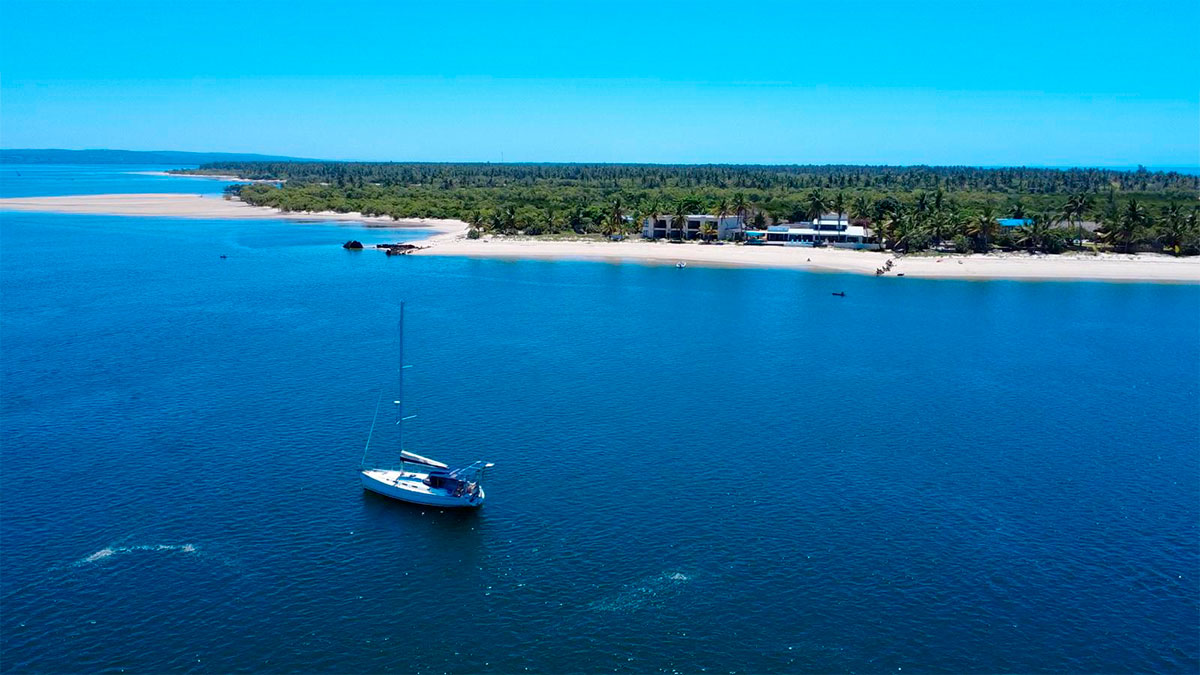
As the sun rises, I wake up and make myself a nice cup of coffee. I go out on deck and start to clearly see the area around the anchorage. Yesterday, when I arrived, it was starting to get dark. The silence is absolute, and I feel like my body has rested. After a seven-day voyage from Madagascar, sleeping straight through has done me a world of good. I’m enjoying it on deck, watching the sun rise over the beach in the distance.
I’m anchored in 13 meters of water, just 200 meters from the beach. The tides here are about three or four meters high and create very strong currents. From the deck, I gaze out at the white-sand beach with coconut palms in the background. At one end of the beach lies a shipwreck that has been there for 90 years. Beyond the wreck, the beach ends and a mangrove forest begins, right at the mouth of a river. At the other end, the beach stretches out of sight, bordering part of the channel leading into the anchorage. The entire channel is full of sandbars that, at low tide, turn into small, idyllic islands for a few hours, until the tide comes back in. Over time and with the current, these mounds of sand shift position. On the opposite side of the beach, sandbars are beginning to form. I can’t wait to explore this entire area.
The Sofía and I are in what, theoretically, would be a good anchorage should a low-pressure system arrive from the south. To the north, we’re protected by the river mouth; to the east, by the beach; and to the south and west, by the sandbars and the entrance channel. The swell shouldn’t be a problem if the wind picks up, which is most likely. It’s true, though, that we’re quite exposed to the wind, because the surrounding terrain isn’t high enough to create a leeward area. With this seabed, we should have good holding.
Yesterday afternoon and throughout most of the night, more sailboats arrived, all headed for South Africa, taking advantage of the favorable weather window in the northern region. We organized a dinner at the resort on the coast. Along the beach, hidden among the coconut palms, there are several villas that belong to the resort. Everything seems very quiet; there’s no sign of any guests. In the central part of the beach is the area with the bar, restaurant, and pool. It looks like something straight out of a postcard. It’s idyllic. In the background, the Sofía is anchored. I’m in Mozambique… My head is spinning.
The next day, everyone heads off to South Africa to get there as soon as possible. I don’t want to rush things, so I decide to stay here a few more days, until the next window of opportunity. Right now, I really feel like staying at an anchorage with incredible scenery to rest and explore for a few days. And to buy some diesel.
The nearest gas station is an hour and 30 minutes away from where the Sofía is anchored. I quickly strike up a friendship with the resort manager, and she helps me organize the trip. The off-road route is beautiful. A sandy path, which looks like it was taken straight from the Sahara, runs the length of the peninsula, lined with coconut palms and mangroves. Along the way, hidden among the vegetation, are small villages of about 10 houses. They’re built from logs and have roofs made of interwoven coconut leaves. In the middle of each cluster of houses is a dirt clearing, as if it were the village square and center. Everything is perfectly situated.
During the hour-and-a-half drive to the gas station, we stop along the way, and Alfonso picks up children and puts them in the back of the pickup truck to take them closer to school, since it’s an hour’s walk away.
I like the gas station—it’s very vintage. However, the pump is long enough to fill the jerry cans from the trunk, which are now being watched over by the kids. Everyone pitches in, opening and closing the jerry cans as they get filled.
On the way back, we stopped at the market so I could buy some fresh food. Without any cash, everything gets complicated. Even so, I managed to get potatoes, onions, eggs, yogurt, some cookies, and delicious tomatoes.
Morrumbene is a village consisting of a single paved main street, where locals sell various fruits and vegetables from small wooden stalls on both sides. Around the main street, you can walk along the endless dirt paths lined with local homes. The houses are built in the same style but with different materials, such as sheet metal, concrete, or wood.
As soon as we leave the main road and begin the more off-road section—following the opposite route from before—we’re treated to a panoramic view of the peninsula. The brown trail winds its way through thousands of coconut palms, and in the distance, the anchorage comes into view, completely bathed in the color of the ocean. Alfonso suggests we stop to take in the views while we cool off with a coconut.
Diesel mission accomplished, and I’m starting to like Mozambique way too much.


