








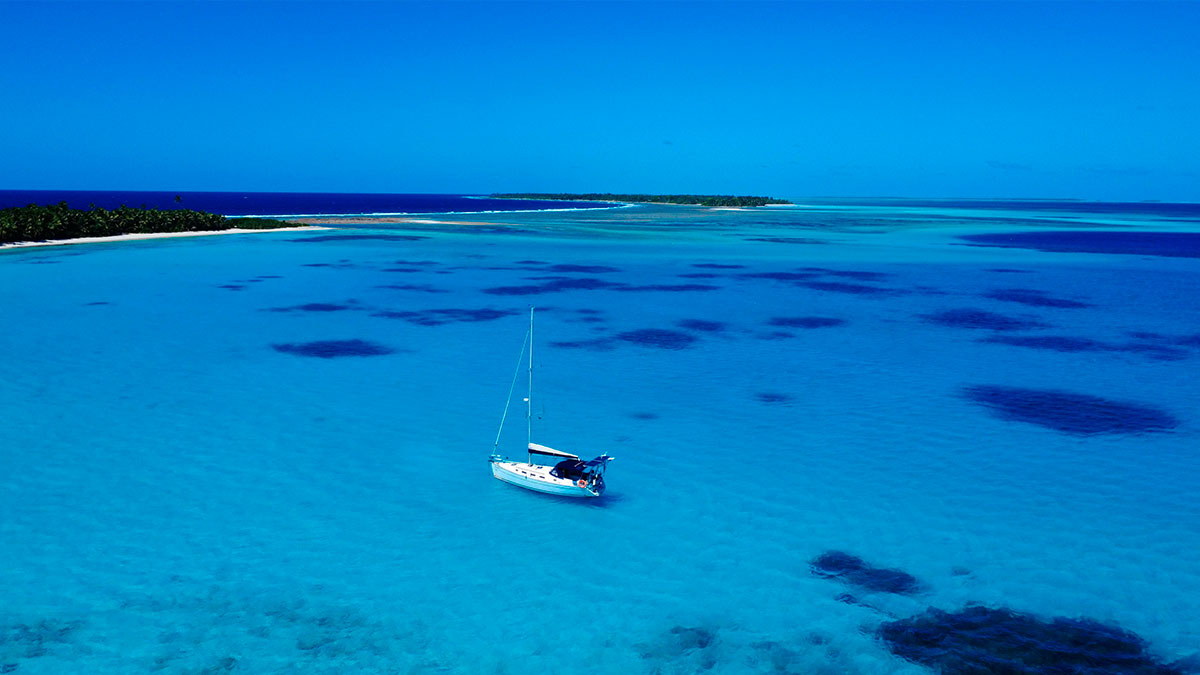
I’m happy to be waking up in Cocos Keeling. It’s an atoll in the Indian Ocean, which makes its inner lagoon perfect for anchoring. No matter how strong the wind blows, the sea inside the atoll is flat; there are no waves. I’m sheltered by a white-sand beach lined with coconut palms of all sizes. I don’t see anyone on the beach, and the Sofía is the only sailboat at anchor. I’m in 3.5 meters of water, with 30 meters of anchor chain. You can see the seabed from the deck; you can even follow the chain with your eyes until you spot the anchor. Blacktip sharks cruise past the stern during the day. During the hottest part of the day, I swim with them around the boat. I watch their shy behavior: they keep their distance, and as soon as I try to get closer to them, they disappear from view with just two flaps of their fins.
Hermit crabs rule the beach. They’re everywhere—both along the shore and further inland, among the coconut trees. They come in all sizes and shapes. Despite carrying their homes on their backs, they move with great agility; however, their movements are very slow, except for the reflexive action they take to retreat into their shells for protection. Several afternoons I go for a walk on the beach, and there’s always a moment to sit in the shade of a coconut palm, observing each of their movements and behaviors. To approach them, you have to take short, slow steps. One false move and they go into defense mode, retreating into their shell with the “door” closed. Once inside, they use a part of their body that’s very hard to block the entrance to the shell they’re dragging along. This keeps predators out.
To see them emerge from their shells, you have to stand still near them. They begin to extend their tiny filaments, which they use as antennae, and with these they detect whether there is any movement. If there isn’t, they leave their shells and continue on their way. On occasion, I’ve seen several of them change shells. As they grow, their home becomes too small for them. They walk along the beach until they find a new, suitable shell. Then, taking their time and free from threats, they make the move—slowly but surely.
Between this beach and the next one, there’s a channel through which water flows into the lagoon. It’s like a short river, three meters deep, that runs from the open Indian Ocean into the lagoon. The current is quite strong; there are even signs before you reach it to warn of the danger. I walk along the beach toward the outer edge of the atoll. I reach the beginning of the channel where the incoming current starts and wade into the water with my snorkel mask on. The current carries me into the lagoon as I watch all kinds of fish swimming among the corals, white-tipped sharks lying motionless behind a rock, and many starfish. When I see that I’m level with the beach, I get out of the water and do it all over again. It’s like having an amusement park all to myself. I usually go in the mornings, when the sun lights up the water and the visibility is incredible.
I’m spending several days on the following task: getting the Sofía seaworthy again. The idea is to get her ready to set sail for the Seychelles. The crossing to our next destination is quite a serious undertaking, as it’s about 2,650 miles—roughly 23 days of sailing. The Sofía is undergoing a thorough inspection: engine, sails, mast, rudder, and propeller (while in the water), steering system, interior, electronics, and an endless to-do list. At least I’m working from paradise.
Two weeks into my stay in this part of the Indian Ocean, Victor arrives—a Frenchman who is sailing around the world, following the route taken by Charles Darwin. He’s a great guy, and I have dinner with him several nights aboard his sailboat, a 12-meter steel sloop.
Only two islands in the atoll are inhabited, and you can travel between them on a ferry that departs every half hour. Since I’m in no hurry to leave, I’m going to explore both islands. Home Island is the capital of Cocos Island and is home to the Coco-Malay population. There’s a mosque on the southern side of the island that stands out among the houses. Its golden dome and white walls are visible from anywhere on the island. The streets are laid out in a grid pattern, and the few vehicles here are ATVs or 4×4 golf carts. The atmosphere is very peaceful, and there is complete silence.
West Island is home to the airport, a supermarket, and the only bar within a 640-kilometer radius. It strikes me as odd that the airport isn’t fenced off—there’s just a sign indicating that it’s a restricted area.
The plan was to stay for three weeks, but in the end I enjoyed the atoll for a month and a few days.


