








I set sail from Belitung with the plan to reach the Sunda Strait—between Java and Sumatra—in seven days. It marks the boundary between the Java Sea and the Indian Ocean. From there, I’ll set sail to cross the Indian Ocean.
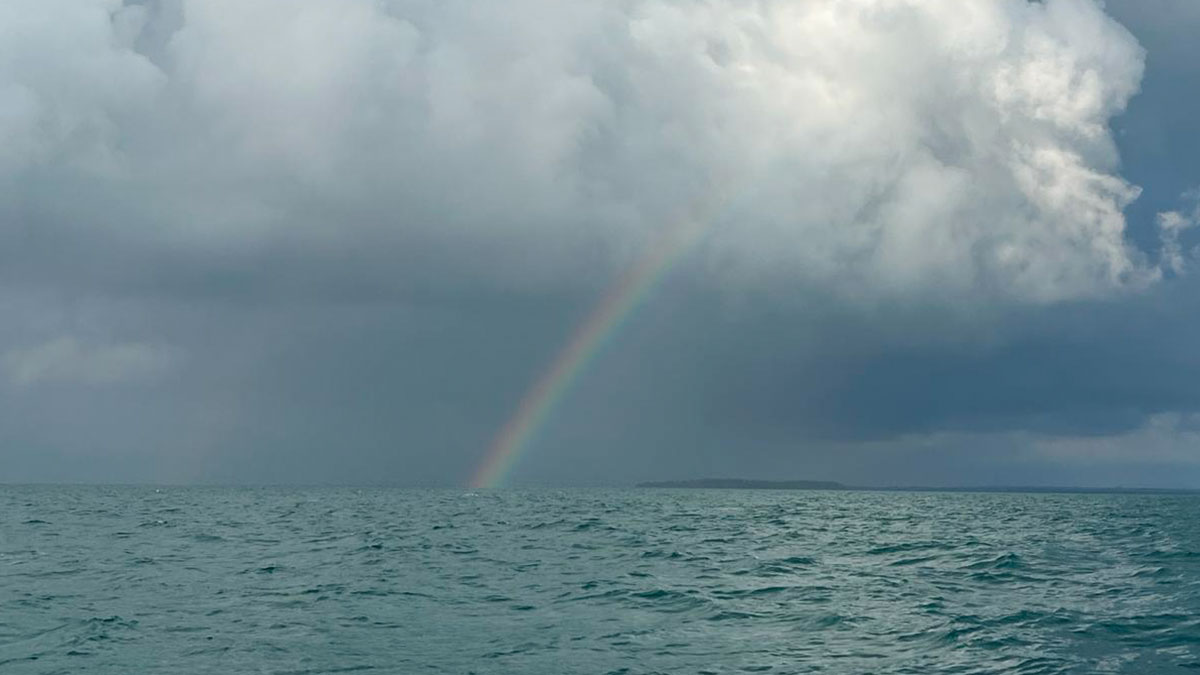
With a few showers on the horizon and a gray day ahead, I leave the northwest coast of Belitung behind. After weighing anchor, a rainbow appears ahead of the Sofía. I hope it’s a sign that everything will go well. Fifteen miles into the voyage, a cumulonimbus cloud behind the Sofía begins to grow and turn a dark gray. Suddenly, a spiral of water begins to form, stretching from the cloud until it touches the surface of the sea. In barely twenty seconds, a whirlpool forms.
I quickly lower the mainsail and the genoa and secure everything tightly on deck. I rev the engine to full speed and watch it. It’s truly incredible—a perfect shape. It seems to be moving south, while we’re sailing west. We should end up out of its path. Just to be safe, I keep the engine running for forty-five minutes, until the whirlpool disappears. The Java Sea reminds me that I still have seven days left in its territory.
I sail cautiously, and on the sixth day of daytime sailing, I drop anchor about twenty-five miles north of the Sunda Strait, off the coast of Sumatra. Tomorrow, with the current in our favor, we will cross the strait and be in the Indian Ocean. We set sail at 6:00 a.m., when the sun has not yet risen, though there is already enough light to navigate. We must reach the narrowest part of the strait around noon to take advantage of the favorable current, which reverses direction approximately every six hours.
We arrived on time, and the Sofía began to pick up speed until she reached eight knots. Our calculations were spot on. There’s no wind, so I’m motoring, using only the mainsail for assistance. An hour before reaching the anchorage, we encounter a fairly heavy squall approaching from the starboard bow. It starts to rain, and the wind dies down. Conditions remained like this for about twenty minutes until, suddenly, a 26-knot gust hit us from the starboard side, as if a wrecking ball had struck us from the side without warning. Luckily, I had the entire sail lowered and securely fastened. The wind shifted and came from the bow. We motored along at about three knots to ride out the squall and reach the anchorage with good visibility.
Today we’re anchored in the northern bay of an island called Sebuku. The bay is surrounded by reefs on both sides, and in the center, a small beach is home to a tiny wooden pier that shelters a couple of fishing boats from the swell. As I enter the anchorage, I look through my binoculars and see several fishermen sitting on a log on the beach, children running alongside a dog, and several wooden houses with their typical tin roofs.
It looked bigger on the chart. I’m anchored in twelve meters of water, with reefs about seventy-five meters away on both sides. The squall has left quite a bit of swell, and anchoring is uncomfortable. Plus, the weather forecast has changed, and they’re predicting twenty-knot winds from the north for the next three days. According to this morning’s update, there should have been a southerly wind. Since the bay is open to the north, conditions will worsen. That’s why I decide to continue sailing the next day and look for a more sheltered anchorage.
I set sail and, six hours later, dropped anchor off the west coast of Java, in a bay called Carita. It’s quite a bit larger than the previous one and is teeming with tourists: speedboats towing banana boats and jet skis everywhere. I anchored in four meters of water, near a port—if you can call it that. I came all the way here because I want to be comfortable and well-protected for these last few days, to finish getting the Sofía seaworthy before setting sail for the Indian Ocean.
Thank you, Southeast Asia, for treating me with the same respect that I have for you.
It’s true that, before setting sail from Spain, I was absolutely determined not to enter your waters. I didn’t think I was capable of facing everything you held within you. However, the moment I decided to venture into your world and sail through it for six months, everything changed. Every obstacle you threw in our path—and that the Sofía and I managed to overcome—gave us more strength to face the next one. And so, in just six months, we’ve crossed the Java Sea and the Strait of Malacca twice.
Dodging fishing nets and fishermen, avoiding plastic, logs, and trash of all kinds, navigating through extremely heavy maritime traffic, weathering daily storms, or literally freeing myself from a fisherman’s nets—these have been the most common challenges in my day-to-day life as I’ve crossed your territory. I like to think that everything has happened for a reason. In each of the incidents I’ve encountered, I’ve learned to find a solution on my own using the resources available on board.
Thank you, Southeast Asia, for letting me continue my journey just as you allowed me to embark on it—though now I’m quite a bit more seasoned. And a special mention to you, Strait of Malacca. Thank you for not forcing me to face any of your dreaded Sumatras.
As I gaze out at the Indian Ocean, I’m putting together a to-do list so I can get the Sofía fully seaworthy and set sail as soon as a good weather window opens up.


