








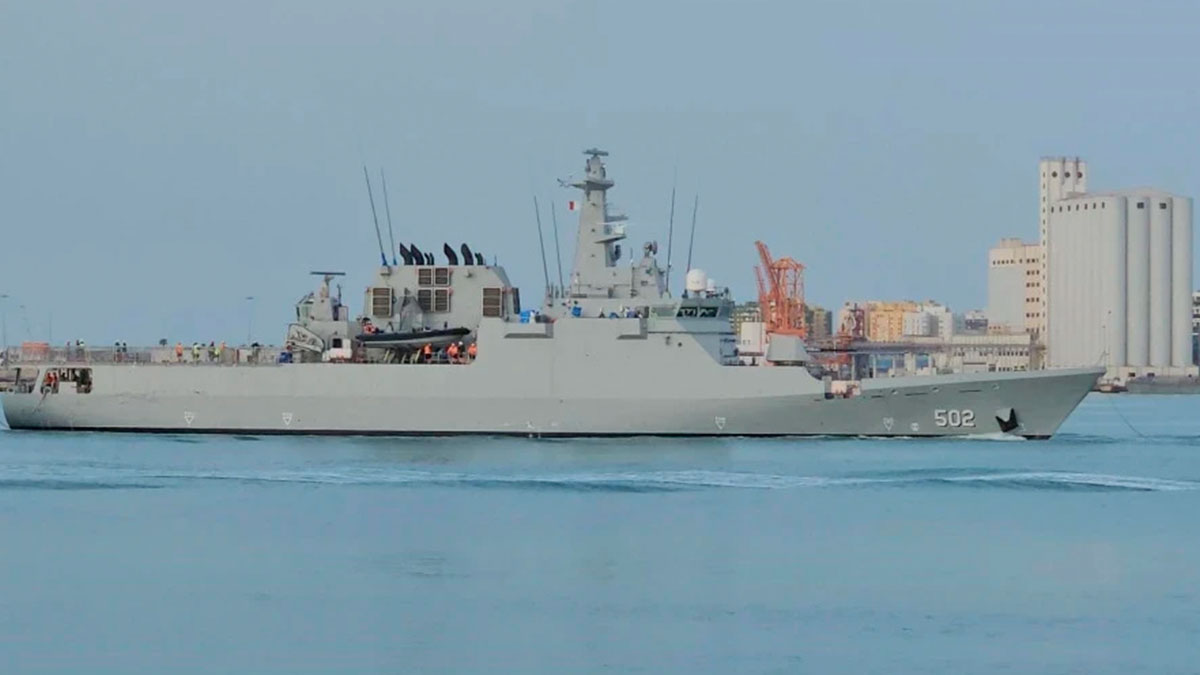
Over the past three years, the waters off Cádiz have been the setting for one of Spain’s naval programs with the greatest international scope. This Thursday, in San Fernando, Navantia formally handed over the Moulay Hassan I to the Royal Moroccan Navy—an 87-meter-long offshore patrol vessel that marks the return of military shipbuilding for Rabat to Spanish shipyards after more than four decades.
The transfer took place upon the signing of the delivery milestone, without an official ceremony. The Spanish state-owned company has noted that the manner in which each delivery is carried out is determined in consultation with the client and that, in this case, the contract did not provide for a delivery ceremony. The transaction also coincides with a particularly sensitive moment in relations between Spain and Morocco, marked by the situation in Ceuta.
87 meters of Spanish naval engineering
The Moulay Hassan I is Navantia San Fernando’s 565th vessel. The ship is 87 meters long and 13 meters wide, with a full-load displacement of approximately 2,020 metric tons and a crew capacity of up to 60 people.
Its maximum speed is around 24 knots, and its design is intended to allow for extended periods at sea with a relatively small crew. The vessel features a deck for helicopter operations and the capacity to carry high-speed RHIB-type boats.
More than just a matter of size, the project focuses on versatility. Navantia’s family of patrol vessels is designed to combine maritime surveillance, protection of exclusive economic zones, monitoring of maritime activities, and security and rescue operations with high operational availability.
Navantia has not publicly disclosed the exact weapon configuration of the ship delivered to Morocco. The platform’s design allows for various system configurations, but the model’s potential capabilities should not be confused with the specific equipment installed on this particular vessel.
Three years of work in the Bay of Cádiz
Behind the Moulay Hassan I lies a major industrial operation as well. Navantia estimates that the program generated more than one million work hours and created approximately 1,100 direct, indirect, and induced jobs during the three years of construction.
The first steel plate was cut in July 2023. The keel arrived in September 2024, and on May 27, 2025, the patrol boat was launched in San Fernando at a ceremony attended by Spanish officials and representatives of the Royal Moroccan Navy.
From that point on, a new phase began: port trials, sea trials, and testing of the various systems before reaching the final milestone of delivery.
Furthermore, the contract does not end with the construction of the hull. The agreement includes spare parts, tools, technical documentation, and training in Spain for personnel from the Royal Moroccan Navy—a package designed to support the ship as it enters service and facilitate its maintenance.
A contract that revives a relationship from the 1980s
The arrival of the Moulay Hassan I in the Moroccan fleet also has historical significance. The last warship built in Spain for Morocco was the corvette Teniente Coronel Errahmani, delivered in 1983 by the then-Empresa Nacional Bazán, the predecessor of today’s Navantia.
The next chapter in this ship’s history will no longer be written at the Navantia shipyard, but at sea. With the signing of the delivery certificate, the Moulay Hassan I is formally transferred to the Royal Moroccan Navy and is now awaiting the Moroccan authorities’ decision on its departure from the San Fernando shipyard.
Its arrival in the Moroccan fleet marks the culmination of an industrial program that has been in development for years and ushers in a new era for a platform designed to remain at sea for long periods, combining autonomy, surveillance, and multi-mission capabilities.

