








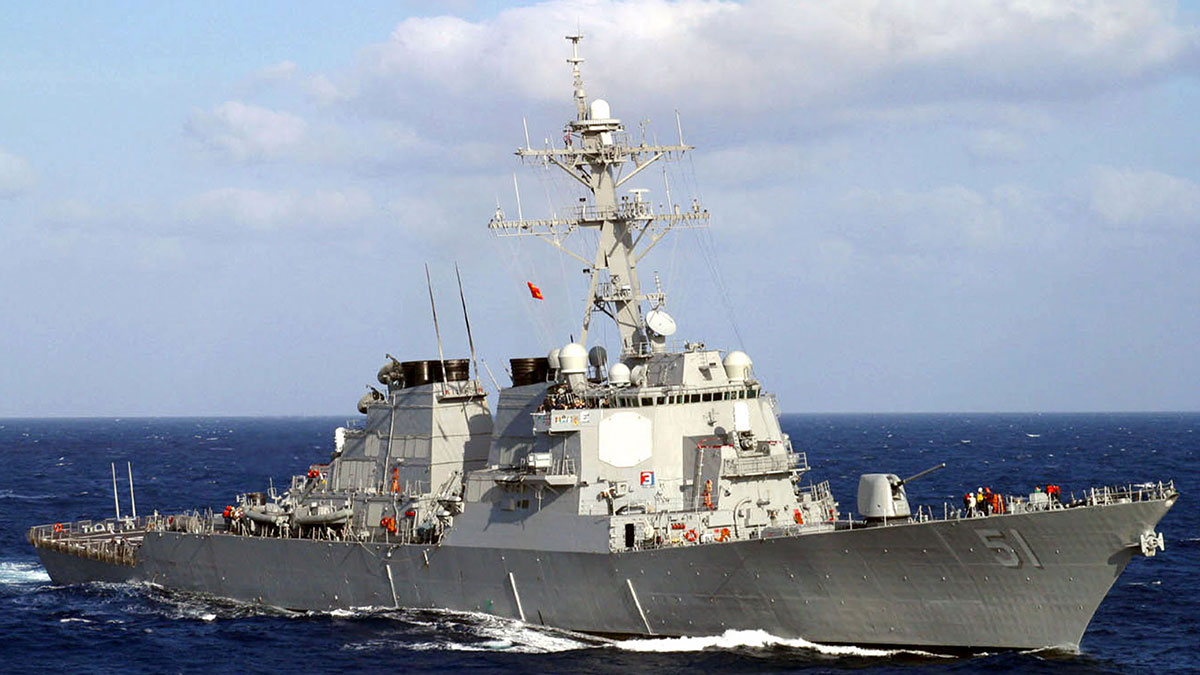
The guided-missile destroyer USS Arleigh Burke (DDG-51) has entered dry dock at the Navantia facility in Cádiz to undergo scheduled maintenance and modernization work. This is the first time a destroyer of its class has undergone this type of operation in the Sixth Fleet’s area of responsibility since the ships permanently deployed in Europe arrived on the continent.
The ship, the lead vessel of the class that bears its name, is one of five U.S. destroyers based at the Rota Naval Station. Military and civilian personnel from the Regional Deployed Maintenance Center, the destroyer’s crew, and industrial teams from the Spanish shipyard are participating in the work.
Vice Admiral J. T. Anderson, commander of the Sixth Fleet, called it a “key milestone in expanding the U.S. Navy’s deployed maintenance capabilities in Europe.” Until now, maintenance and technical support for NATO missile defense ships deployed in Europe were carried out almost exclusively at the Rota Naval Base itself. The U.S. Navy has not provided details on the technical scope of the work, its duration, or its cost.
A Vote of Confidence for Navantia
According to published reports, the project represents a vote of confidence by the Sixth Fleet in Navantia’s technical capabilities, shipyard infrastructure, and the professionalism of its civilian staff. For the state-owned company, this step goes beyond a one-time collaboration: it is a practical demonstration of its potential to take on more work related to the U.S. destroyers stationed in Rota, a fleet that will expand to include vessels such as the USS John Basilone. With large-scale dry docks and workers who are already familiar with the intricacies of these complex combat systems, Navantia is positioning itself for future bids and long-term contracts with the Pentagon.
The operation is based on a framework contract worth up to 822.4 million euros, valid through January 2028, for the maintenance of the units deployed in Rota. Navantia estimates that the program could generate more than 1,000 direct jobs annually. In July, the U.S. Naval Supply Systems Command also issued a market inquiry to identify companies capable of providing hull maintenance, combat systems maintenance, and dry-dock services in Rota, though no contracts have been awarded at this time.
The Bay Area’s supporting industry is also keeping an eye on the operation. Four companies from El Puerto de Santa María (Sea Master Consulting & Engineering, Elymtec Electromecánica, COINNDE, and Reparaciones Navales del Estrecho) could be part of the supply chain, although there is no record of them having been contracted for this project. A preliminary estimate, based on a project costing between three and ten million euros, puts their potential revenue at around 500,000 euros. This is a hypothesis, not a confirmed figure.
Rota Adds Its Sixth Destroyer
The USS Arleigh Burke is part of Task Force 65, which contributes to NATO’s integrated air and missile defense architecture, with an area of operations stretching from the Arctic Circle to the Cape of Good Hope. The Sixth Fleet is part of the U.S. Naval Forces in Europe and Africa, headquartered in Naples.
The five destroyers in Rota will soon become six. The USS John Basilone (DDG 122), a Flight IIA destroyer launched in 2022 and commissioned in November 2024, is expected to dock around October 15, according to unofficial sources, as neither the U.S. Navy nor the Ministry of Defense has confirmed the date. Its arrival completes the expansion from four to six destroyers agreed upon in 2022 and formalized in 2023. About 300 sailors will disembark, joining the nearly 8,000 Americans at a base currently under construction.


