








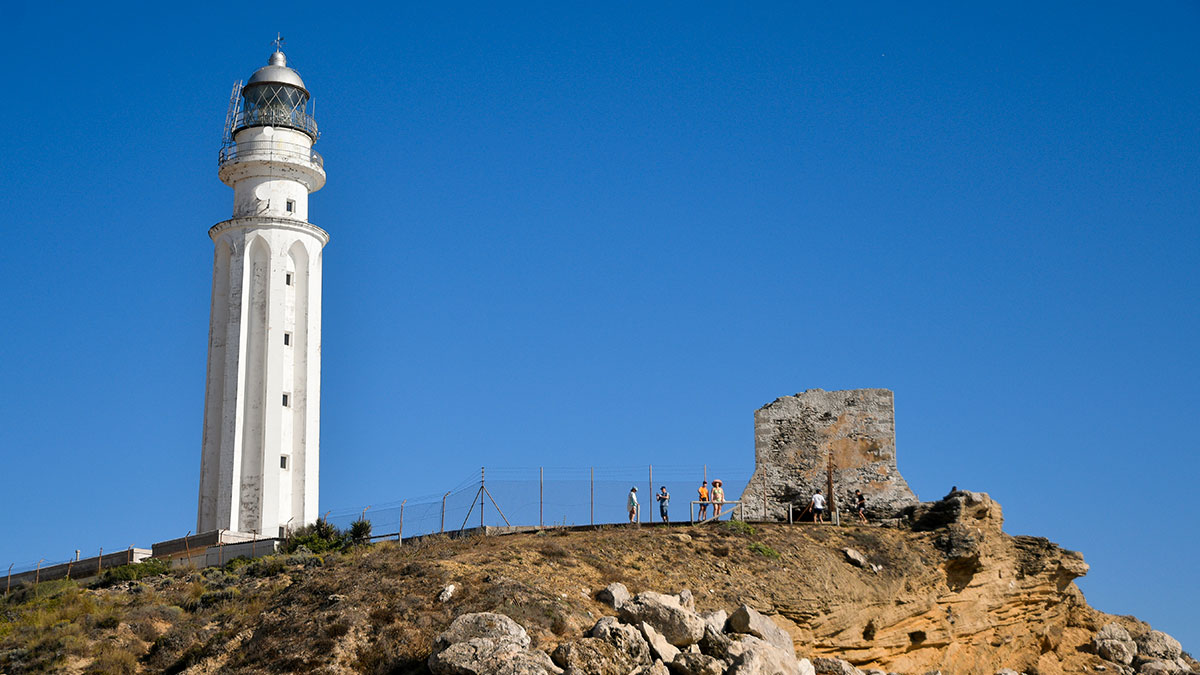
The Cadiz coastline has gained a new Site of Cultural Interest. On Tuesday, October 20, the Council of Ministers, at the proposal of Culture Minister Ernest Urtasun, approved the designation of the Trafalgar Lighthouse as a Site of Cultural Interest (BIC) in the “Monument” category. This is the highest level of protection provided for under the Spanish Historical Heritage Law.
Perched atop the Trafalgar sandbar, the lighthouse is located in Caños de Meca, in the municipality of Barbate, facing the waters where the naval battle of the same name took place in 1805. The surrounding area has been protected since 1989 as the La Breña and Barbate Marshes Natural Park.
A unique 19th-century tower
The Trafalgar Lighthouse was built in the late 19th century. It was designed by engineer Eduardo Saavedra y Moragas (1829–1912), in collaboration with Rafael Navarro, Antonio de Palacio, and Manuel García, students at the School of Civil Engineering. It was built as part of the 1847 General Plan for Maritime Lighting along the Coasts and in the Ports of Spain and Adjacent Islands and was lit for the first time on July 15, 1862.
Its truncated conical masonry tower stands over 35 meters tall and is arranged around a central courtyard, a layout that is uncommon among Spanish lighthouses. Over the years, modifications have been made to adapt it to modern navigation technology, but the Ministry maintains that these have barely altered its original design.
Visible up to 40 miles
These modifications have brought about several improvements, especially for mariners. The original light had a range of approximately 19 miles (about 35 kilometers, in nautical miles). It was later modified, and the beam was extended to nearly 40 miles (about 74 kilometers). From a technological standpoint, the lighthouse is, according to the statement, “a unique historical testament to science and technology applied to maritime navigation.” It has also remained in continuous use since its construction.
Its strategic location has made it, from the very beginning, a key element for navigation and access to the Strait of Gibraltar. By 2017, it had already been included in the Catalog of Lighthouses of Heritage Value in Spain, compiled as part of the National Industrial Heritage Plan.
A protected lighthouse that is still in operation
The declaration seeks to protect the property’s historical, scientific, and technical values without interfering with its functions as a maritime navigation aid. It will not affect the maintenance, upgrading, or installation of the elements necessary for its operation as a maritime navigation aid. Nor will it affect new technical equipment essential to the Spanish Port System’s navigation and marine weather services, or its adaptation to future technological advances.
The lighthouse is under the jurisdiction of the Bay of Cádiz Port Authority and Puertos del Estado, both of which report to the Ministry of Transportation and Sustainable Mobility, and provides an important public service for maritime safety.
From a hospitality project to maximum protection
The statement comes after years of controversy. In December 2023, the Port Authority granted an administrative concession to Pentágono Colón SL to open a hospitality business in the area below the lighthouse. The initiative sparked protests from citizens and environmentalists. Groups such as El Faro no se Vende, SOS El Palmar, and Ecologistas en Acción advocated for keeping the space as a public facility. The protests brought together hundreds of people, and a petition campaign garnered nearly 10,000 signatures.
Ecologistas en Acción and its local chapter, Enebro, have hailed the protection as “an achievement” of “popular and environmentalist mobilization,” while the Barbate City Council has viewed the designation positively but warns that it must not remain merely a formal recognition. It calls for investments and concrete actions to restore the site.
For its part, the Port Authority has also welcomed the recognition and wishes to ensure legal certainty in future proceedings. According to *La Gaceta de Cádiz*, the agency is processing the concession for the facilities as part of the *Faros de España* program, which aims to open these sites to the public. It has requested an opinion from the Ministry of Culture regarding the legal framework for this concession following the declaration. It also plans to carry out a comprehensive renovation funded through the “two percent for culture” program. The agency believes that historic preservation and sustainable tourism are not incompatible. The future of the site’s use as a hospitality venue, therefore, has not yet been definitively ruled out.


