








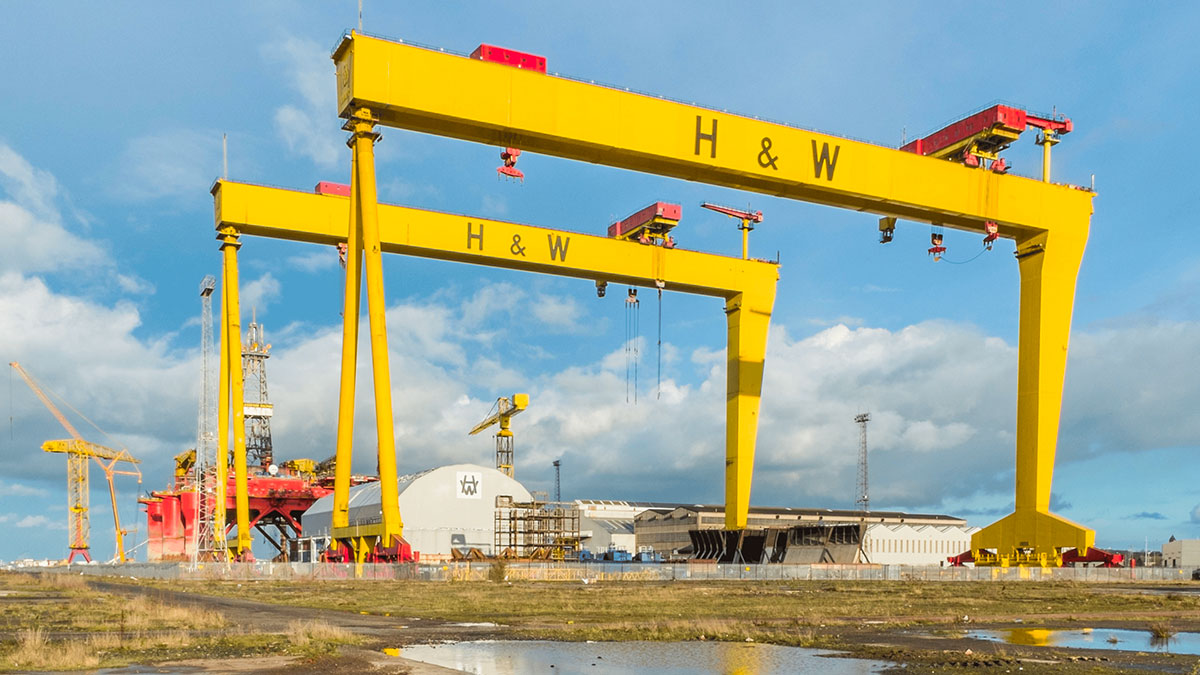
Navantia UK, the British subsidiary of the Spanish group Navantia, has inaugurated the Resurgent Hall, a new manufacturing facility at the Harland & Wolff shipyard in Belfast (Northern Ireland). The ceremony, held on November 2, was presided over by Luke Pollard, the British Minister for Defense Readiness and Industry.
The facility provides an additional 5,000 square meters of manufacturing space and is equipped with robotic plasma cutting machines, a new automated panel production line, and refurbished cranes. These facilities will enable the construction of ship blocks and sections with greater efficiency and precision, and will play a central role in the Royal Navy’s logistics support ships.
The Resurgent Hall is the most significant event scheduled in Belfast. It is part of an investment of nearly 100 million pounds (120 million euros) in the city since Navantia acquired Harland & Wolff in January 2025, following the company’s bankruptcy—a firm that was initially supposed to be its local partner on this project. That amount is part of a 157 million-pound (188 million-euro) plan to modernize Navantia UK’s four facilities: Belfast, Appledore (England), and Methil and Arnish (Scotland). Navantia UK is also refurbishing the Samson and Goliath cranes, the shipyard’s two most iconic yellow structures, which dominate the Belfast harbor landscape.
Three Ships for the Royal Fleet Auxiliary
The project that justifies the expansion is the Fleet Solid Support (FSS) program, with a budget of 1.6 billion pounds (1.919 billion euros). It calls for the construction of three large logistics ships for the Royal Fleet Auxiliary (RFA), the British Navy’s auxiliary service: RFA Resurgent, RFA Reliant, and RFA Resourceful. They will supply ammunition, spare parts, supplies, and provisions to Royal Navy ships, including aircraft carrier strike groups, enabling them to maintain operations for extended periods without returning to port.
Work is already underway. Steel cutting began at Appledore in December 2025, and the keel of the RFA Resurgent was laid in September 2026. Appledore is manufacturing the bow sections for all three ships, while Belfast will handle the main fabrication, final assembly, systems integration, and testing. The three ships are scheduled to enter service in the early 2030s.
Employment and New Assignments
Navantia UK currently supports more than 1,300 jobs and more than 340 apprentices at its British facilities, and has set a goal of reaching 750 apprentices by 2030, with training programs in welding, manufacturing, engineering, design, and digital production. In Belfast, the British government estimates that more than 900 skilled jobs and apprenticeship positions are linked to the shipyard’s modernization and the FSS program.
Donato Martínez, the head of Navantia UK, stated during the inauguration: “Shipbuilding is returning to Belfast. We are transforming Harland & Wolff into one of the most advanced shipyards in Europe.” For his part, Pollard emphasized that “the 157 million pounds sterling that Navantia has invested in its UK shipyards demonstrates what sustained investment in shipbuilding delivers: good jobs, growing skills, and the support vessels our Navy needs.”
The company is already looking beyond the FSS. This expansion, combined with the fact that its four plants now have British certification, will enable it to compete for new contracts from the Ministry of Defense in the coming years. “Belfast is at the heart of this recovery, and the FSS program is the first of many projects we want to build here for the Ministry of Defense,” Martínez said.
The context is favorable. London has committed to increasing defense spending from the current 2.6% of GDP to 3% by 2030, and its Defense Investment Plan calls for investments totaling 298 billion pounds (357 billion euros) over the next four years. Defense spending in Northern Ireland also grew by 63% in real terms in the 2025–2026 fiscal year, reaching the highest level on record.


