







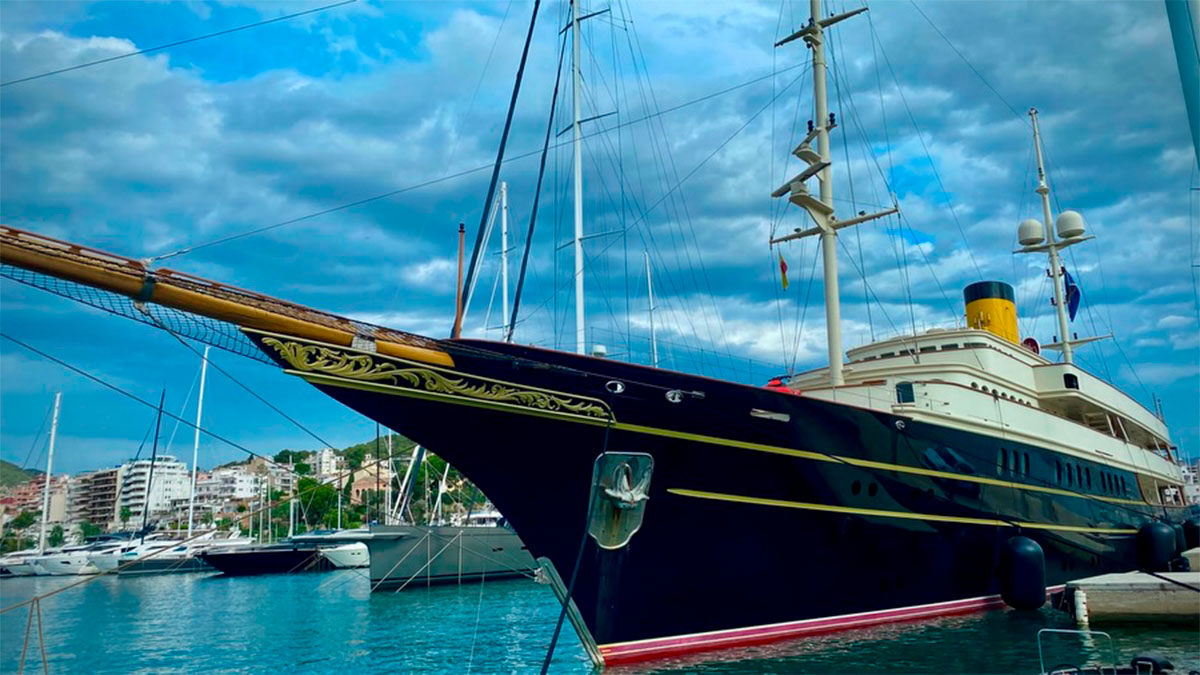
A stunning silhouette, with a look from a bygone era, has been turning heads in the Bay of Palma since last weekend. It is the impressive Nero, a magnificent 90-meter replica of the legendary Corsair IV, the yacht that Bath Iron Works launched on May 21, 1930, for J.P. Morgan II.
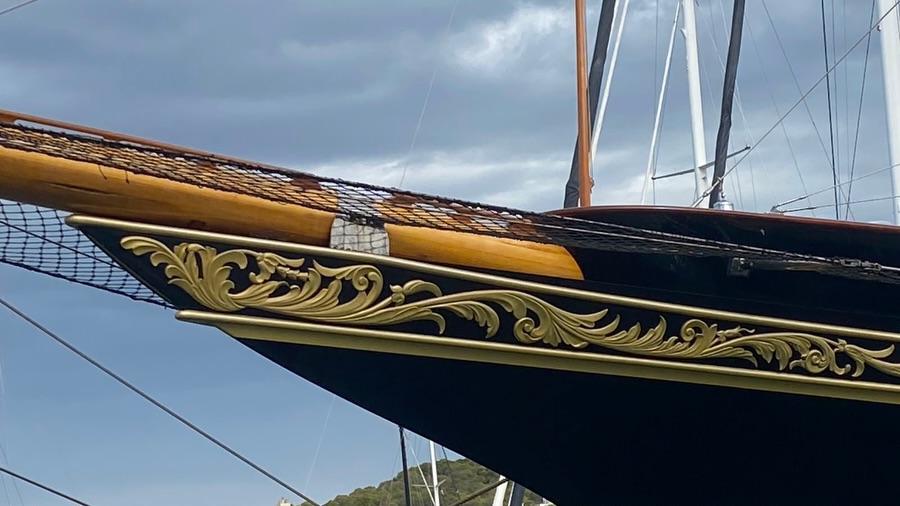
Its classic silhouette—with a black hull, clipper bow, transom, two masts, and a traditional funnel, stands in stark contrast in the Mallorcan harbor to the avant-garde design of contemporary superyachts, whose modern lines prioritize technology and onboard entertainment over period aesthetics. The proof? The images shared on social media of the renovated Club de Mar – Mallorca.
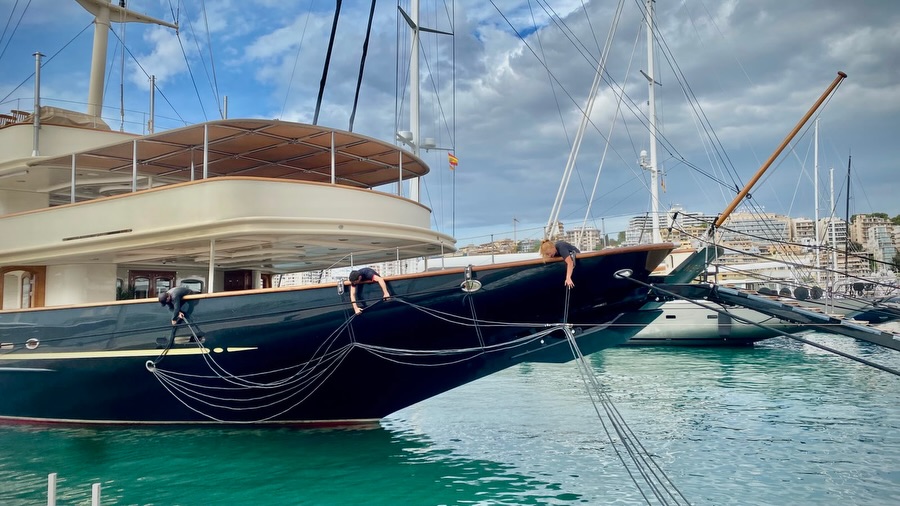
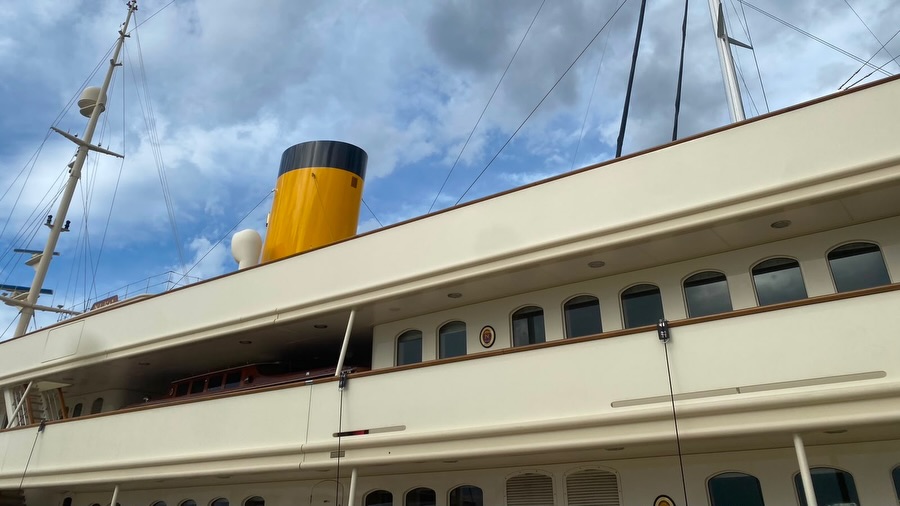
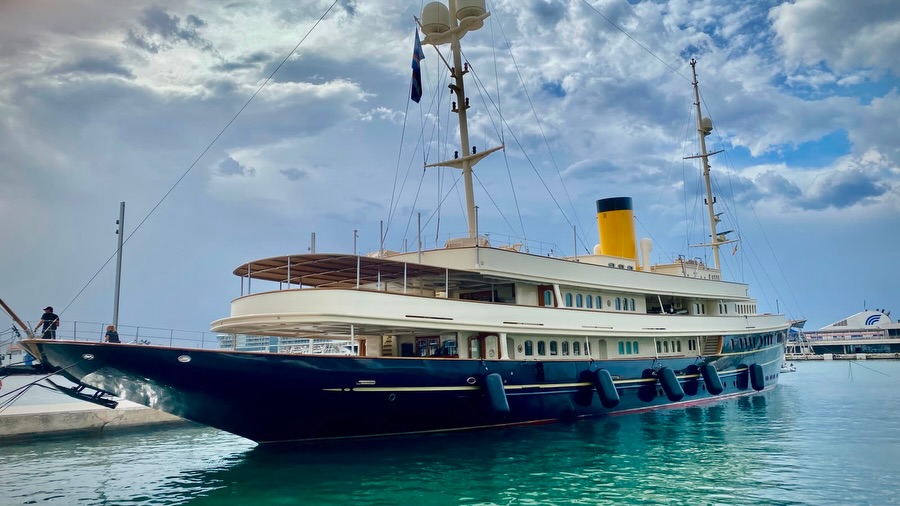
With capacity for 12 guests and 20 crew members, the Nero faithfully recreates the nautical dream that J.P. Morgan brought to life nearly a century ago: an Art Deco-style cocktail bar identical to that of the original yacht, a movie theater, a traditional open-air dining area on the aft deck, and a more formal dining room inside, as well as hot tubs and a beauty salon. Its appearance is also reminiscent of the old 19th-century steamers of the Mallorcan company Isleña Marítima, with their elegant seafaring style.
The Corsair IV, which served as the inspiration for the Nero, was not a one-off whim, but rather the culmination of a tradition spanning three generations of the Morgan family. The patriarch, J. Pierpont Morgan, had already invested millions of dollars in two luxury yachts—the Corsair and the Corsair II—before his son, J.P. Morgan Jr., commissioned the Corsair III and, finally, the Corsair IV. It was precisely at the launch of the Corsair III in 1898 that a journalist asked the patriarch how much it would cost to operate a vessel of that magnitude. His reply was: “Sir, if you have to ask that question, you cannot afford it.” Over time, the phrase would become an aphorism about luxury and financial discretion, and it would be quoted again—now as a family legend—in connection with the Corsair IV.
Designed by Henry J. Gielow Inc. of New York in close collaboration with J.P. Morgan II himself and Captain W.B. Porter, who had been the skipper of the Corsair III for years, the new yacht was built at Bath Iron Works in Maine at a cost of $2.5 million—equivalent to about $60 million today. At the time of its delivery, it was the largest private yacht ever built in the United States.
Officially classified as a twin-screw schooner, the Corsair IV was registered at 2,181 gross tons (471 net tons), and its steel hull measured 343 feet 6 inches in length overall by 42.5 feet in beam, with a draft of 18 feet. Powered by two General Electric turboelectric engines producing 6,000 CV, it reached a cruising speed of 17 knots and was noted for its extraordinary maneuverability. Naval writer Erick Hofman described it as “the crowning achievement at the end of the steam yacht era.” Morgan II affectionately nicknamed her “Princess of the Sea” and enjoyed her for much of the 1930s, even as the Great Depression forced other major shipowners to moor their vessels; the Corsair IV itself had to remain out of service in 1935, although it returned to sailing the following year.
From a recreational yacht to a warship
Just as had happened with the Corsair II in 1917, World War II changed the fate of the Corsair IV. In 1939, it was sold to the British Navy for the symbolic sum of one dollar and entered service, armed with a 6-pounder gun, with the Fleet Air Arm in Bermuda beginning in August 1940.
Released from its military duties in December 1948, the yacht was completely refurbished for a new life as a luxury cruise ship, with a planned route between Southern California and Mexico in the winter, and as far as Alaska in the summer months. However, fate had a tragic ending in store for her: on her maiden voyage under this new flag, the Corsair IV ran aground off the coast of Acapulco on November 12, 1949, was declared a total loss, and was subsequently scrapped. Fortunately, the entire crew and all passengers were evacuated without injury.
A British Businessman’s Obsession
Nearly half a century after it sank, the Corsair IV found an unusual second life. British entrepreneur Neil Taylor was fascinated by the yacht’s history, features, and tragic end, and in the early 2000s he set out to find a used hull that could be restored with a similar design. When that search proved fruitless, Taylor made a radical decision: to found his own company, Corsair Yachts, and personally oversee the design and construction of a replica from scratch.
The contract was awarded to the Chinese shipyard Yantai CIMC Raffles Shipyard, which in 2008 delivered the 90-meter superyacht named Nero. The inability to recover the original vessel for restoration thus led to the idea of recreating it from scratch—a challenge that earned it the award for best classic superyacht at the time of its launch. Interestingly, Taylor’s creation did not remain in his possession: a year after its delivery, it was put up for sale and has changed hands several times since then.
Currently, the Nero is managed by Yacht Charter Fleet, a company that offers it for charter and emphasizes that the yacht “embodies all the glamour of the golden age of sailing.” Unlike the turbo-electric system of its predecessor, the Nero features conventional propulsion via two Caterpillar MAK 9M20 diesel engines, which allow it to reach a top speed of 17 knots and a cruising speed of 13 knots. Among its six cabins, the master suite stands out, featuring its own private bathroom, study, and lounge, while the deck offers a 5.7-meter swimming pool, a hot tub on the terrace, a fully equipped gym, and an inflatable slide with direct access to the sea.