







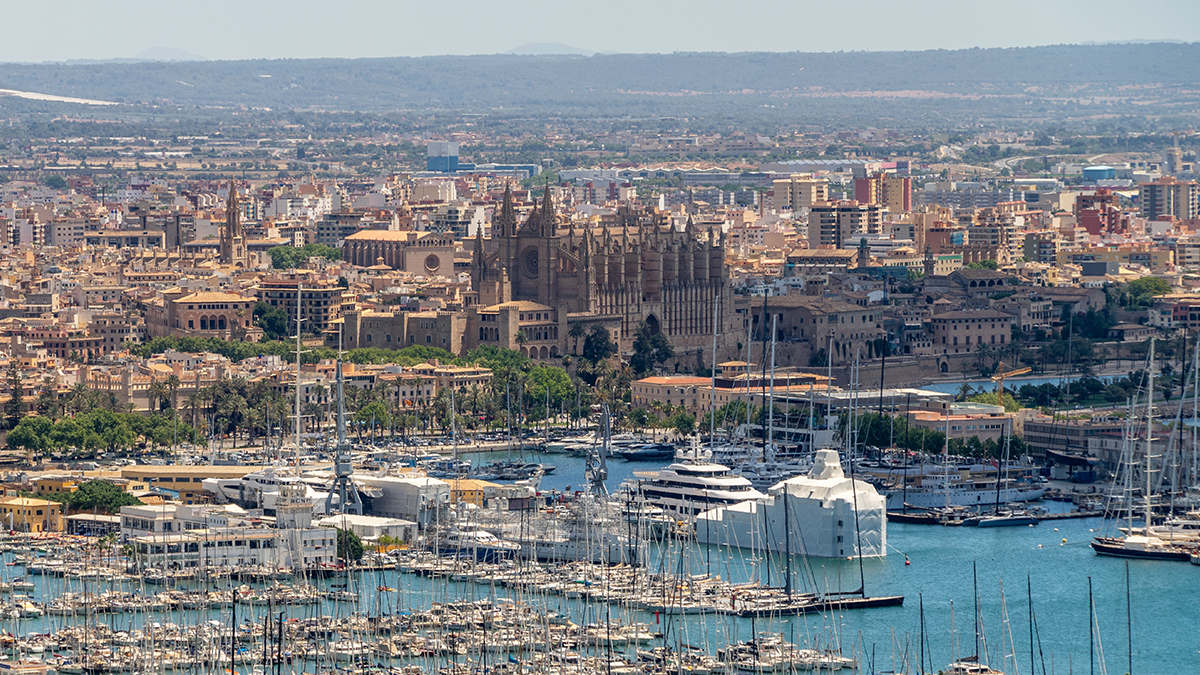
Access to housing has become one of the main economic imbalances in the Balearic Islands. Rising prices in the residential market, combined with population growth and tourism-related pressure on the region, are increasing the financial burden households must bear to purchase a home. In Palma, purchasing a 75-square-meter property now requires the equivalent of 7.2 years of average family income, compared to the 4.8 years needed in 2015.
The data is part of the report *Protect and Build. Toward a New Deal for Housing in Spain, prepared by the think tank Fundación Avanza in collaboration with the Friedrich Ebert Foundation. The study includes a specific analysis of the Balearic Islands and ranks the urban area of Palma among the regions where access to homeownership has deteriorated the most among those analyzed.
The publication of the document coincides with a period of growing social mobilization around the housing issue. A 24-hour general strike is scheduled for this Wednesday, November 11, to demand measures to address the housing crisis and the rising cost of living. The call for the strike is also having an impact in the Balearic Islands, where various labor unions and social groups have voiced their demands regarding access to decent housing. This coincidence highlights the significance the housing issue has taken on in the economic and social debate.
The data on the Balearic Islands real estate market included in the report reflect the scale of the problem. Between 2015 and the second quarter of 2026, home prices in the Palma metropolitan area rose by 187 percent—the largest increase among the areas analyzed. Rents, meanwhile, rose by 145% during the same period. In 2023, the cost of renting a 75-square-meter home accounted for 32% of the average household income in Palma and reached 36% in the outskirts.
Tourism and demographic pressure on the residential market
The report attributes this trend to a combination of population growth, tourism, and land-use constraints. In 2025, the Balearic Islands received 15.7 million foreign tourists, compared to the 10 million recorded in 2000. Since that same year, the resident population has increased by 42%.
This trend places housing beyond the realm of real estate and makes it a factor that influences the functioning of the Balearic economy. In a region where tourism and services play a decisive role, housing costs influence businesses’ ability to attract workers and retain their workforce. The difficulty in finding housing at prices compatible with local wages can limit labor mobility and increase hiring challenges, especially in sectors with high demand for workers.
The problem also affects young people’s ability to become independent and pursue their career goals on the islands. Nationwide, the report notes that the rate of young adults leaving their parents’ homes among those aged 18 to 34 stood at 31.3% in 2025, 17 percentage points below the rate recorded in 2010. Furthermore, in July 2026, 43% of the population identified housing as Spain’s main problem.
According to the study’s authors, the solution cannot be limited to increasing the number of available properties without considering their location and intended use. The report warns that the expansion of scattered housing on rural land is not a structural solution, as it leads to higher costs for transportation, water supply, energy, and sanitation, without guaranteeing that the new buildings will be used as primary residences or affordable rental housing.
IBAVI, at the heart of the proposal for the Balearic Islands
In contrast to this model, the Avanza Foundation advocates for more compact urban growth, linked to public transportation, employment centers, and essential services. Its proposals include the allocation of public land, setting mandatory quotas for affordable housing in new developments, and strengthening public housing initiatives.
In this regard, the report highlights the role of the Balearic Housing Institute (IBAVI), whose experience it considers a model for combining architectural quality, sustainability, and social function. According to the document, the challenge lies in expanding its capacity for action and moving from one-off developments to larger-scale projects.
Among the opportunities identified are the transfer of land from the Consell de Mallorca to the IBAVI to build 300 public housing units in Palma, as well as the potential of public land such as that in Son Busquets. The study proposes exploring a program that would enable the construction of between 1,000 and 1,500 public housing units annually across the islands, supported by structural funding and operators with sufficient capacity.
The Balearic Islands’ proposal is part of a broader national strategy. The report advocates increasing the social housing stock to 10% of the total residential housing stock within fifteen years. To achieve this goal, it estimates that it would be necessary to add approximately 1.69 million additional social and affordable housing units to the existing stock.
The document notes that Spain has built approximately 6.5 million affordable housing units since 1960, but currently has only 318,000 of them remaining in public ownership. To reverse this trend, it proposes that housing units built, acquired, or renovated with public funding or on public land permanently maintain their social function and not end up entering the open market.
20.3 billion euros annually to transform housing policy
The transformation proposed by the think tank also requires a change in the funding model. The report estimates that Spain would need to mobilize approximately 20,300 million euros annually for fifteen years to achieve its goals, an amount equivalent to 1.3% of the country’s GDP.
Not all of this would be public spending. Between 4,000 and 6,200 million euros annually would come from strictly public capital, while the rest would be financed through debt on favorable terms and regulated private capital.
To support this investment, the Avanza Foundation proposes five permanent mechanisms: an independent regulatory body and an accreditation system for affordable housing providers, a sector-specific guarantee fund to facilitate credit, a stable mandate for the Official Credit Institute (ICO) to finance social housing, a revolving fund that allows for the reinvestment of resources recovered from previous developments, and ten-year program agreements between the central government, the autonomous communities, and accredited providers.
The study also includes measures to improve the stability of the rental market, increase price transparency, and review real estate taxation. These include exploring a reform of the property tax (IBI) that distinguishes between the value of the land and that of the building, accompanied by compensatory reductions in personal income tax on earned income, particularly for middle- and low-income earners.
The proposal is complemented by greater coordination among government agencies to plan residential development from a metropolitan perspective, linking new housing to transportation, employment, and public services.
Mikel Berra Sandín, a fellow at Fundación Avanza, an architect and urban planner with a degree in Urban Planning from MIT, summarizes the study’s approach by emphasizing the need to tailor new development to residential needs: “We need to build more, but it’s important to decide what we build: we have to build for living.”
The analysis raises a particularly important question for the Balearic Islands: how to maintain the islands’ economic and tourism momentum without allowing access to housing to become an obstacle for those who work, start businesses, and build their lives there.