








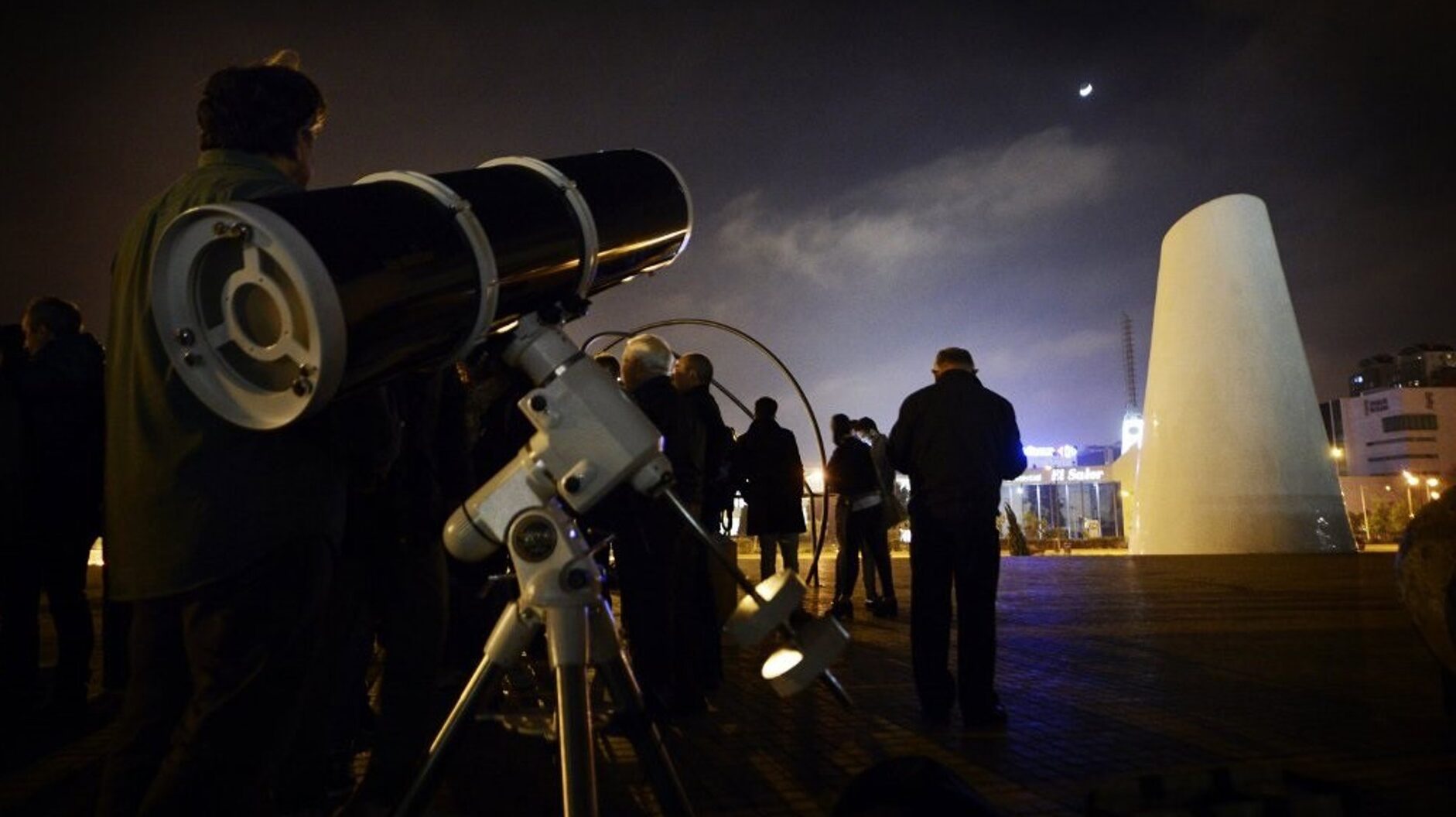
Astronomers and amateur astronomers in the Balearic Islands are ready to observe the total solar eclipse that will take place on the afternoon of Wednesday, August 12, and which is expected to be a spectacle straight out of a movie, although it lacks scientific appeal. The Foundation of the Institute of Astronomy and Astronautics of Mallorca (Fiaam) has been one of the organizations leading the planning for this event, covering everything from scientific aspects to safety recommendations, as well as educational initiatives and advice.
Its scientific director, Salvador Sánchez, was part of the team that, in April 2025, presented a report to the regional government with recommendations to address not only this imminent eclipse, but also the two scheduled for 2027 and 2028. Speaking to Europa Press, he explained that, initially, the government was “stunned because it didn’t know what to expect.” It was decided to create an inter-institutional committee, and he stated that many of the decisions made bear the seal of approval from the Fiaam.
Sebastià Barceló, who has a doctorate in astrophysics and is a research associate at the University of the Balearic Islands (UIB), is another of the experts who has participated in the coordination committee created by the regional government. “Those of us who have participated in the committee, especially from an astronomical perspective, have done so to ensure that the eclipse can be observed safely,” he told this news agency.
At the same time, both Fiaam and the university have organized public awareness workshops to ensure that members of the public can observe the eclipse not only safely but also with a solid understanding of the phenomenon. Experts have also been working hard to address all inquiries raised by the hospitality sector, tour guides, and teachers.
Not much science, but it will be “a scene straight out of a movie”
All this so that we are ready at 7:35 PM on August 12, 2026, when the Moon will begin to cover the Sun’s surface. The eclipse will continue to progress gradually until 8:32 PM, when day will turn to night. “If the clouds don’t get in the way,” said Sánchez, “it could be the ‘most spectacular solar eclipse seen in centuries.’ You can see the stars, and when it’s over, there will be a sunset. A scene straight out of a movie,” he stated.
This spectacular nature, he explained, contrasts with the limited “scientific interest” of the phenomenon. The reason is that it will take place when the sun is two and a half degrees above the sea, which rules out the possibility of carrying out “precise measurements.” Since “there will be little science,” the goal of Fiaam’s team—many of whom have already observed other eclipses in Germany, Sweden, Iceland, and South Africa—will be “to capture spectacular and unique images of the event.”
“And for dessert, we hope to capture complete sequences of the green flash: the refraction of the last ray of light as the sun sets over the sea,” added the scientific director. Any member of the public can capture this phenomenon if they take a burst of photographs, Sánchez noted. Less likely is the possibility that, at the moment the Moon completely covers the Sun, some Perseids or “tears of St. Lawrence”—which are common at this time of year—will be visible. “They could be visible, but it’s very difficult, because they are best seen after midnight,” noted the astronomer, who will have his camera ready just in case.
Barceló, who has been waiting for an event of this magnitude ever since he realized he wanted to pursue astrophysics, noted that observing the eclipse from the Balearic Islands will provide little scientific insight. “It’s true that the relativistic effects won’t be clearly visible and it will be difficult to measure the differences between the stars due to this effect, but it will provide a reference point for future eclipses,” he explained.
Although the main focus will be on the visual effect, some interesting conclusions can be drawn by measuring the solar corona, a region that has not yet been studied and is very interesting. This is an area where the UIB is conducting research, although they will not initially use the data from this eclipse for that purpose. In any case, experts have explained that both members of Fiaam and university researchers will be stationed at various points in the Balearic Islands to try to obtain the best possible records of an eclipse that is unlikely to occur again for more than a century.
Some will be in an area designated by the Estellencs authorities, where the FIAAM will install a hydrogen-alpha telescope that, among other things, will provide a live broadcast. Others will be spread out at key points in the Serra de Tramuntana, such as Sóller and Formentor, as well as throughout the Es Trenc Natural Reserve.
The phenomenon seen from Menorca and Ibiza
Although Mallorca will be the island where the eclipse can be observed in the best conditions, astronomy enthusiasts from Menorca and Ibiza have not wanted to be left behind. The Ibiza Astronomical Society, founded in 1956 and currently with about 180 members, has spent almost a year preparing itself and the people of the Pitiüses Islands for this Wednesday’s total solar eclipse.
“We have been constantly talking about this topic in schools; for a few months there has been an almost excessive outreach activity,” the group’s spokesperson, Pedro Pérez, one of the people responsible for giving these talks, told Europa Press. Some members of the group will stay in Ibiza to observe a phenomenon that is “unremarkable from an astronomical point of view but fantastic from a social perspective” and will try to record the atmospheric conditions at that moment – one of the “high points” of the eclipse. One of their colleagues, a Frenchman, will send data to Paris.
Others, taking into account that the largest of the Pitiousa Islands is not one of the best places to observe the phenomenon and given the prediction that the island could be overwhelmed, have decided to travel to Galicia or León. “From a tourist’s point of view, this is one of the best places in the world to see the eclipse. But, from a scientific point of view, that’s not the case,“ Pérez emphasized.
Javier Ares, founder of Polaris Menorca – a company dedicated to raising awareness and offering stargazing experiences – has also been preparing for this moment for some time. For the past two years, he has been traveling around Spain giving training sessions on how to observe an eclipse – which will be a first for many, but not for him.
Together with their team and clients, they will install four telescopes on a plot of land on the coast of Ciutadella, the exact location of which they prefer not to reveal to prevent it from becoming too crowded. They won’t be collecting much data, he told this news agency, but they will strive to make the most of the visual aspect of the phenomenon. While Galicia will be the “gateway” to the eclipse in Spain, the Balearic Islands will be the last place where it can be clearly observed. “It will be a sunset that you either see once in a lifetime or you don’t,” he declared.


