






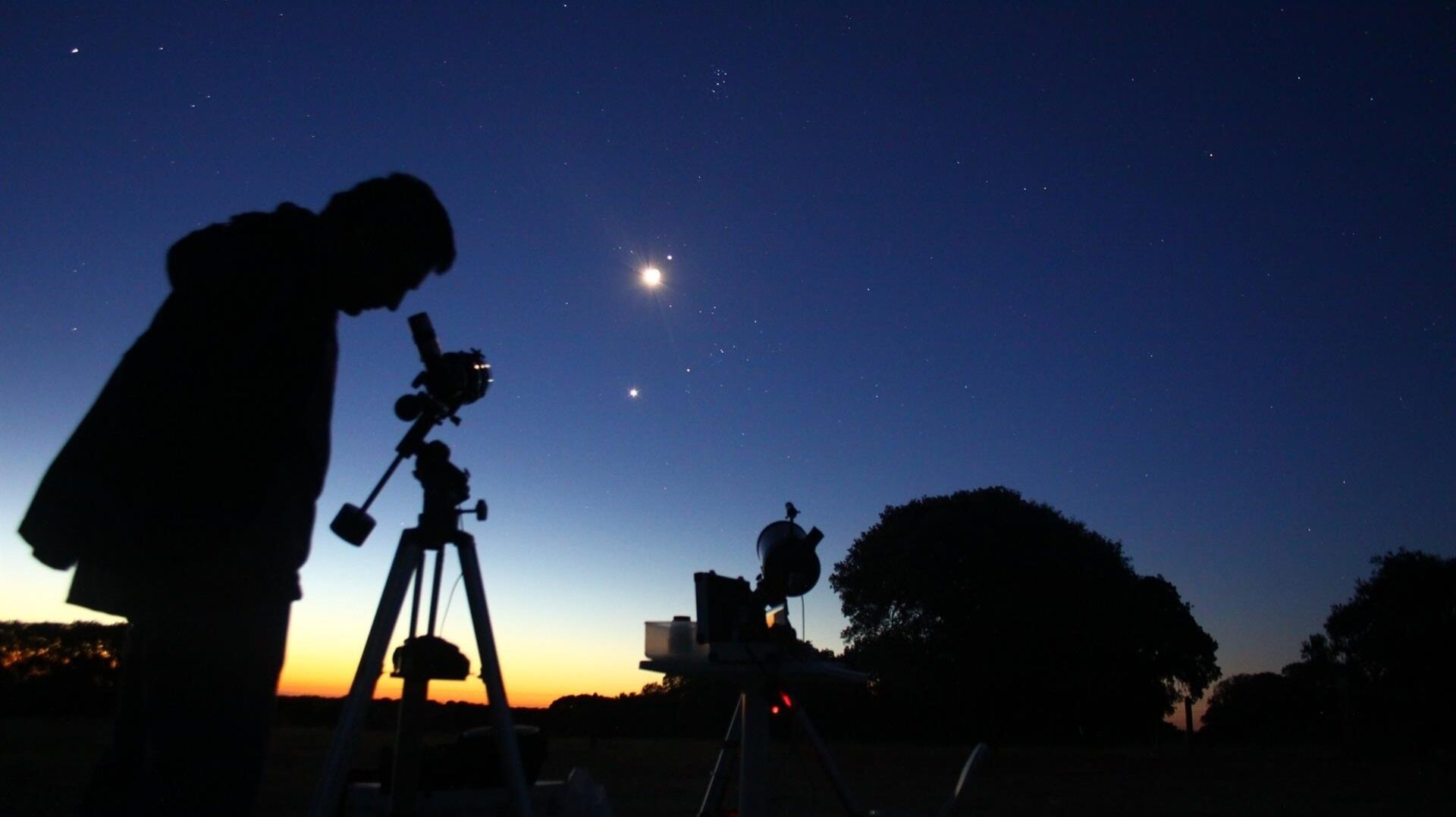
Óscar Martín, owner of the company Startrails, is one of more than 100 eclipse chasers in Spain. They are people passionate about this type of phenomenon—not necessarily astronomers—who travel all over the world to witness them in their totality. This expert has traveled thousands of kilometers around the world to witness up to twelve total solar eclipses in places like Australia, China, Egypt, French Polynesia, Indonesia, Kenya, Argentina, and the United States.
He also enjoyed this unusual astronomical event over the North Atlantic in 2015. To do so, he and other eclipse chasers chartered an Airbus A320, paying about 6,000 euros per ticket, on a trip whose sole purpose was to witness a total solar eclipse. “It’s incredible; even after 12 eclipses, I still get emotional and cry: your eyes fill with tears when it happens. It’s an enormous feeling, a once-in-a-lifetime experience. With all those emotions building up, you burst out in emotion, you get moved, you scream and jump for joy,” Martín said in an interview with Europa Press, adding that “millions of foreigners will come to Spain.”
“This feeling is something you only understand once you’ve seen a total solar eclipse,” adds the expert, who recommends enjoying it “with family” because it’s something “to share.” “Most of the people who go to see eclipses are ordinary people: families, couples, friends…,” he explained. The eclipse chaser advises that on August 12, people in Spain should enjoy the eclipse without taking photographs because, in his words, “it’s a very beautiful, very brief thing, and any photograph will be a waste because the image won’t turn out well.” “No photos or videos,” he insists.
However, for scientific reasons, he does bring equipment to capture eclipses. In fact, on August 12 he will be equipped with up to 20 cameras fitted with sensors and photometers, which he has been programming for the past six months so they “take pictures automatically” and he can enjoy the experience.
To observe the eclipse, Óscar has chosen Osorno, in Palencia, as the location, where he has reserved an exclusive area for himself and his companions. On the day of the event, he will host other eclipse chasers and his family, who will join him for the occasion. “It’s a bit overwhelming because I normally travel alone or with a few eclipse-chasing friends, but since it’s in Spain this year, I feel morally obligated to invite other people from various countries to see it with me. In Osorno, it will be like a town party but for the eclipse, and as a show of our gratitude, we’ve helped with some advice,” he said.
The ideal spot: any place without clouds in the middle.
When asked about the ideal spot to watch the eclipse on August 12, he maintained that “there is no better place” and recommended “any place where you can see the eclipse and there are no clouds.” The expert chose Osorno because “it is strategically well-located, halfway between all the other locations,” so that, in case of clouds, people can travel “in any direction.” In addition, he added, the place he has reserved “is very close to the highway, very well-connected, and on elevated ground.”
Each place to watch the eclipse has its own charm. “In Galicia, the Sun is much higher in the sky, so photographers who want higher-resolution images with a clearer view of the Sun should go there, while those looking for a more postcard-like photograph—something beautiful—will have a spectacular view of the eclipse over the sea in the Balearic Islands,“ he explained. Although people think you have to go to the places where the eclipse lasts longer, Óscar says that “it’s not necessary.” “Each place is unique and has its own special characteristics,” he noted.
Regarding the consequences for the eyes of looking directly at the eclipse without protection, he has stated that “looking at a solar eclipse is as dangerous as on a normal day.” “People get confused or tend to think that looking at the eclipse will make you blind, but that’s not the case: you go blind looking at the Sun. On the day of an eclipse, people are tempted to look at it directly, but you must use special glasses and avoid any homemade methods like CDs or X-rays; they must be filters for ultraviolet radiation, which is what burns the eye,” he warned.
More than 7 euros for a pair of glasses is a rip-off.
At that moment, Martín pointed out that the price of certified glasses for observing the eclipse ranges from 3 to 7 euros. “Any price higher than that is a rip-off, and any lower price usually doesn’t meet safety standards.” However, the eclipse can be viewed without protection during totality; therefore, those in areas outside the path of totality should always wear protective glasses.
During the total phase, you must take off your glasses, or you will miss the eclipse. You can observe with your naked eyes, with binoculars, or a telescope – whatever you want. To start watching, put on the glasses, which are designed to let you see the Sun, and the moment it completely disappears, you can look without them. “To put them back on, before the totality ends, you’ll see the brightness start to increase slightly on one side of the Sun; that’s when you should put the glasses back on,” he explained.
The expert warned that if sun exposure is prolonged, “you could be left blind forever,” but clarified that “the eclipse is not dangerous” and urged people not to “panic” and to “follow the safety measures.” Although he acknowledged that authorities “are now organizing” to prepare for the eclipse, he lamented that “at first they weren’t doing anything.” “I think we’ll be okay, but it could be done better. The problem I see is that no one is expecting the number of people who will come; they won’t realize it until they’re here,” he said.
Among the incidents that can arise as a consequence of the eclipse, he noted that the greatest danger is fires, due to the number of people who will be in rural areas, as well as the large crowds. “If people don’t follow the rules and behave responsibly, we are likely to see more deaths from fires because millions of people will travel to rural areas, and any carelessness—any cigarette butt or piece of glass they leave behind—could start a fire,” he warned.
Avoid the round trip
For this reason, the eclipse chaser has recommended observing it at the official viewing points where there are ambulances or fire trucks, and where there is no risk of getting trapped or facing a fire. “There are people who come from outside the city and don’t understand that we are in an extreme fire risk,” he said.
He also noted that on August 12 there will be heavy traffic – hours and hours of delays – on almost all highways, especially on the return trip. For this reason, he has advised people to leave early – the day before, if possible – and not to leave immediately after the eclipse. “Try to spend the night and make the most of the meteor shower, get some rest, and that way you’ll avoid all the traffic.”
He has also asked people to bring food and drink in case they get trapped in their cars, and to carry their cell phones and power banks with them in case of an emergency. “On that day, all the eyes of the world will be on Spain; depending on how we manage it, people will speak more or less favorably about our country, our tourism sector, and the ‘Spain’ brand. It is the ideal time to promote the depopulated areas of Spain,” he noted.