








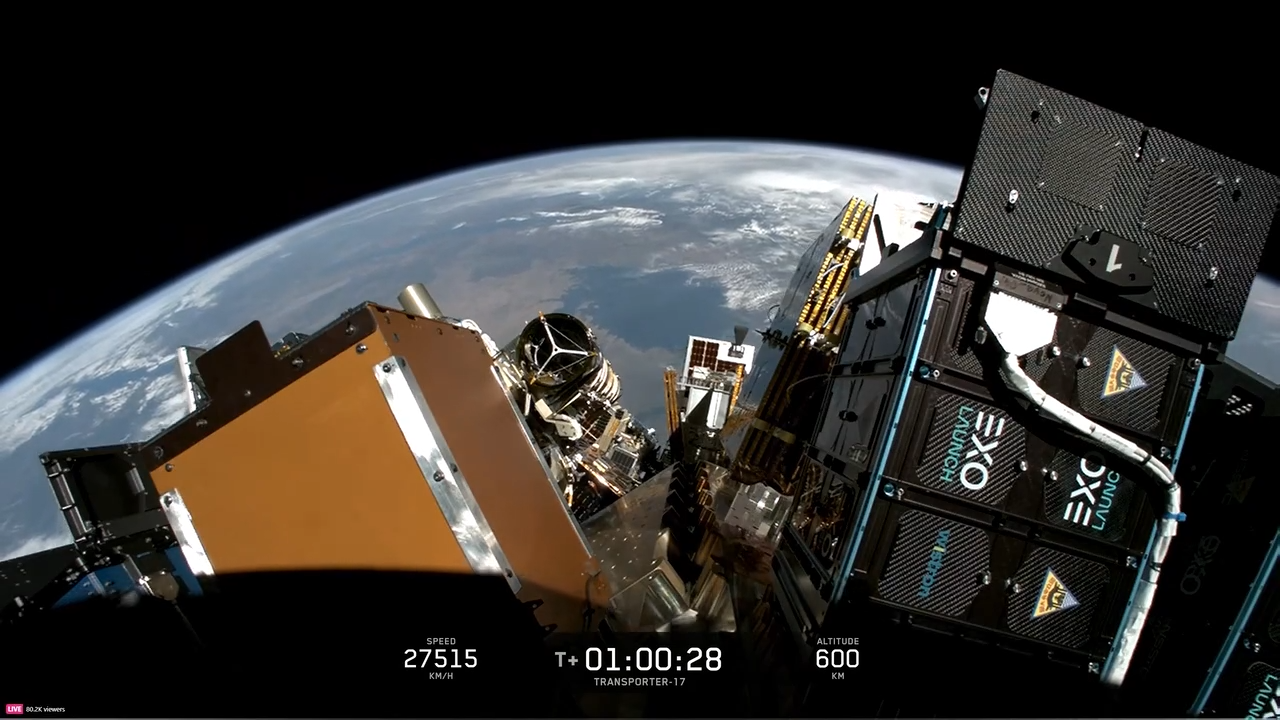
Posidònia, the first Balearic satellite in a project developed by Open Cosmos and co-financed by the regional government with European funds, is now in orbit and will provide strategic data to improve land management, emergency response, climate change monitoring, and data-driven decision-making.
The satellite was successfully launched aboard the Falcon 9 rocket as part of SpaceX’s Transporter-17 mission. Another of the company’s satellites, the Greek Hyperion GR-1, was also placed into orbit during this same launch. The launch, which took place from Vandenberg Space Force Base in California, went off as planned at 9:10 a.m. on July 7 (Spanish time).
The launch of Posidònia represents a twofold strategic breakthrough because, on the one hand, it puts the Islands on the space technology map for the first time, and on the other, it integrates the archipelago into a next-generation global infrastructure designed to transform access to Earth observation data.
“Posidònia represents much more than a technological breakthrough. It demonstrates that the islands can lead high-value-added projects linked to the new economy, generating knowledge and driving technology-intensive sectors,” said First Vice President and Regional Minister of Economy, Finance, and Innovation Antoni Costa.
This initiative is part of the regional government’s strategy to transform the islands into a leading hub of innovation in the Mediterranean, capable of attracting investment and developing projects with international impact. The project was unveiled in January 2025, and since then, the regional government has supported every phase of its development. In February 2025, the president of the regional government, Marga Prohens, together with Open Cosmos CEO and founder Rafel Jordà, kicked off the countdown to the launch.
Finally, in May of this year, Vice President Costa visited Open Cosmos’ facilities at ParcBit to check on the satellite’s final status before it was transported to the launch site.
New Management Tools
The information provided by Posidònia will offer new tools to improve public management. The data collected will contribute to climate change monitoring, environmental protection, emergency management, infrastructure planning, and the analysis of tourist flows, facilitating more efficient, sustainable, and evidence-based decision-making.
This project also strengthens the Balearic Islands’ position in the European aerospace sector and establishes ParcBit as an attractive hub for high-tech companies. Open Cosmos’s establishment in the Balearic Islands and the development of Posidònia demonstrate that collaboration between government, business, and research institutions can generate transformative projects with international reach.
Posidònia is now part of the initial deployment of Open Constellation 1.0, a next-generation Earth observation satellite constellation that will provide useful information about the Earth in less than four hours and, in emergency situations, in as little as 30 minutes, whereas previously, operational information was typically provided within 48 hours or even days. This capability represents a qualitative leap forward compared to traditional systems and will significantly improve the management of and response to critical situations.
A key milestone
The new constellation is also significantly increasing the amount of data it can collect; once complete, it will be capable of capturing up to three million square kilometers of Earth observation data per day, with the capacity to make multiple daily passes. Rafel Jordà stated that the launch of Posidònia marks a key milestone, as it not only represents the deployment of the Balearic Islands’ first satellite into orbit but also one of the first steps in the rollout of Open Constellation 1.0.
Jordà added that this new infrastructure will allow for much faster access to critical information and improve the ability to respond to challenges related to climate change. “Thanks to Posidònia, the Balearic Islands will be able to better manage their territory and the impact of tourism, as well as respond more quickly to risks such as fires or floods,” he added.
For his part, Prohens emphasized that the launch of Posidònia represents “a historic milestone that demonstrates the regional government’s firm commitment to innovation, sustainability, and public-private partnerships.”


