








“It’s a historic opportunity,” says astronomer Rafael Bachiller, director of the National Astronomical Observatory and the Royal Observatory of Madrid, and chair of the Scientific Committee for the Trio of Eclipses. In just three years, we’ll be able to enjoy three solar eclipses from Spain: two total eclipses (August 12, 2026, and August 2, 2027) and one annular eclipse (January 26, 2028), “something very rare within a single territory—as if the heavens had chosen us,” explains the coordinator of *Eclipses* (Geoplaneta), a collaborative book that analyzes the impact of these cosmic coincidences on art, science, and even history—as was the case during the conquest of the Americas, when, in 1504, on his fourth voyage, Columbus and his crew ran aground in Jamaica.
They depended on the help of the indigenous population, which threatened to withhold it. “Columbus, like any excellent navigator, carried astronomical tables with him. From these, he discovered that a lunar eclipse was approaching. He took the opportunity to warn the indigenous people that their god would make the Moon disappear if they cut off their supplies. We can imagine the effect when the eclipse began at the time Columbus had predicted, and our moon took on that characteristic reddish hue. Shortly before the phenomenon ended, Columbus announced that the punishment would cease.”
“Beyond whatever ethical implications one might ascribe to this story, it is an anecdote that illustrates the enormous practical value astronomy has had for centuries,” continues the award-winning researcher. Like Columbus, 21st-century sailors can also benefit from the celestial spectacle on August 12. “The sea can be an extraordinary place to observe it. The absence of obstacles offers clear horizons and a sense of immensity that is hard to match from land. Furthermore, a boat allows you to move into the zone of maximum visibility if weather conditions warrant it,” says the science communicator.
In the Balearic Islands, keep an eye on the Tramontana Mountains
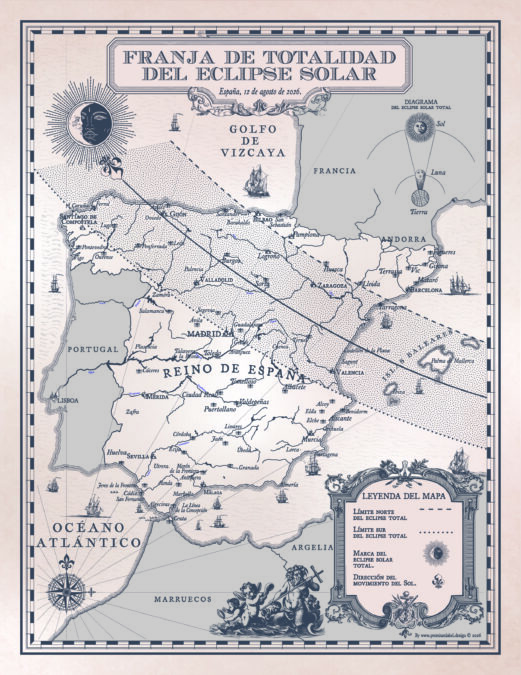
“Rather than specific coordinates, I’d recommend looking for areas with a high probability of clear skies and plenty of room to maneuver. Sometimes, chasing the blue sky for just a few kilometers can make the difference between a memorable experience and a disappointment,” he notes. Although the spectacle will be impressive along the coast between A Coruña and Vizcaya, the Balearic Islands are expected to see the highest concentration of boats: “Since the sun will be very low on the horizon at sunset, it’s extremely important to choose a viewing spot with a clear western horizon. The Sierra de Tramontana will block the view of the eclipse from some areas of Mallorca, which is why numerous viewing events have been organized from yachts, cruise ships, and boats of all kinds,” he notes.
Sunglasses: A Must-Have
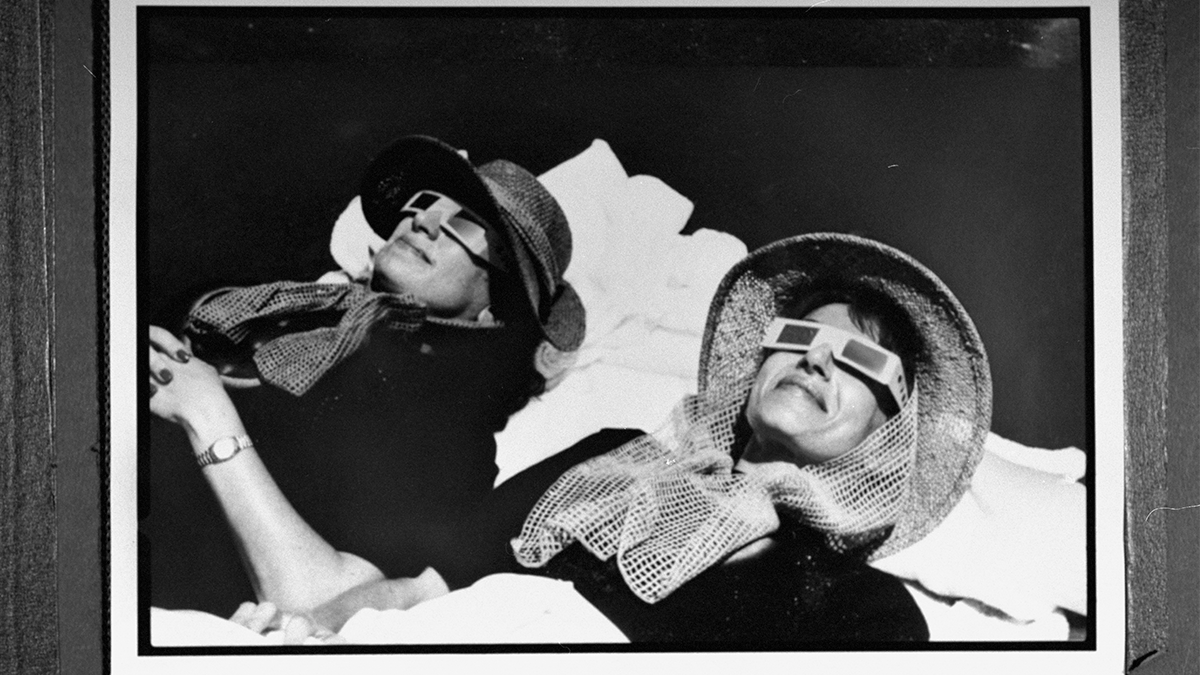
The astronomer reminds us, on the one hand, that certified eclipse glasses are essential and, on the other, that “a total eclipse transforms the light, the landscape, the temperature, and the behavior of animals. It is a deeply sensory experience that is amplified when we experience it as a group.”
THE FULL INTERVIEW IS IN ISSUE 7 OF NAUTIK, NOW ON SALE.