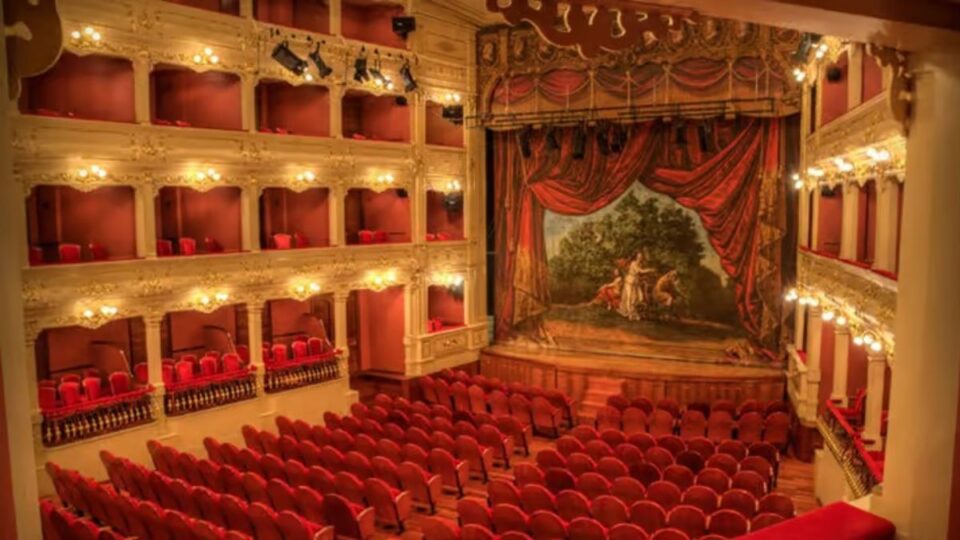







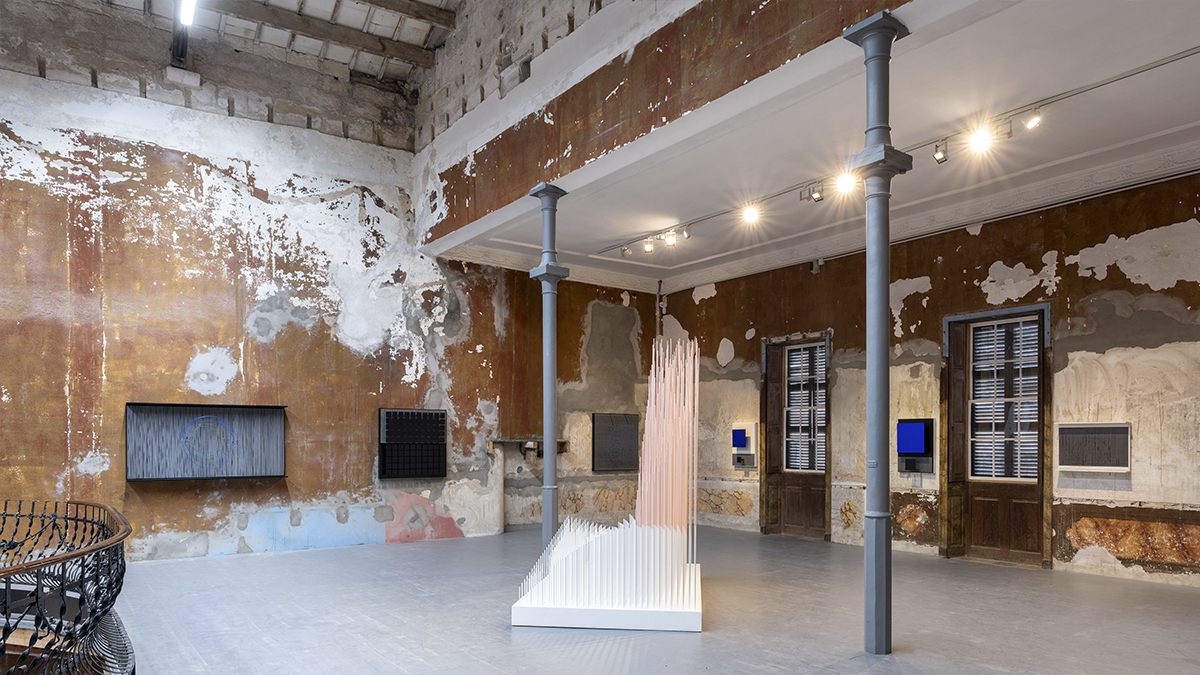
Mahón, the capital of Menorca, has been a key cultural hub throughout Spanish history. For example, its Teatro Principal, built in 1829, is the oldest opera house in the country, having opened eighteen years before Barcelona’s Gran Teatro del Liceo and twenty-one years before Madrid’s Teatro Real. But for just over five years now, Menorca has also been a key destination for tourists seeking more than just sun and beaches in secluded spots. And much of the credit for the island’s role as a cultural catalyst goes to the Cayón brothers, who in July 2018 opened the gallery bearing their surname… three years before the Hauser & Wirth center was established in the former naval hospital on the “Island of the King.”
The former Victoria Theater
It was love at first sight: the Cayón brothers, Adolfo and Clemente (there is a third Cayón brother, Juan, who heads the numismatic division, the original branch of the family business founded in 1956 by their father, Juan Ramón Cayón), had been spending their summers in Menorca since the turn of the century, and over the years, in 2016, they became interested in a historic building in Mahón. It was the former Victoria cinema, a centrally located building at number 24 on Carrer de San Roc, just fifty meters from the San Roque Gate, built in 1359 and the only remaining vestige of the medieval city’s old wall.
The cinema closed its doors on December 31, 2006, after nearly ninety years of operation in what had once been the mansion of the Barons of Las Arenas. Abandoned ever since, the building—covering 865 square meters with a generous twelve-meter ceiling height—was in a state of semi-ruin, but in the imagination of Adolfo and Clemente Cayón, it was the magical place they had dreamed of since founding the first space of the art gallery bearing their surname in Madrid in 2005, and after subjecting it to a thorough renovation, preserving the original appearance of the space as much as possible, on July 18, 2018, the gallery’s Menorcan branch—which by then already had another large exhibition space in Madrid and one more in Manila, opened a year earlier—was inaugurated with an exhibition by the American minimalist artist Fred Sandback.
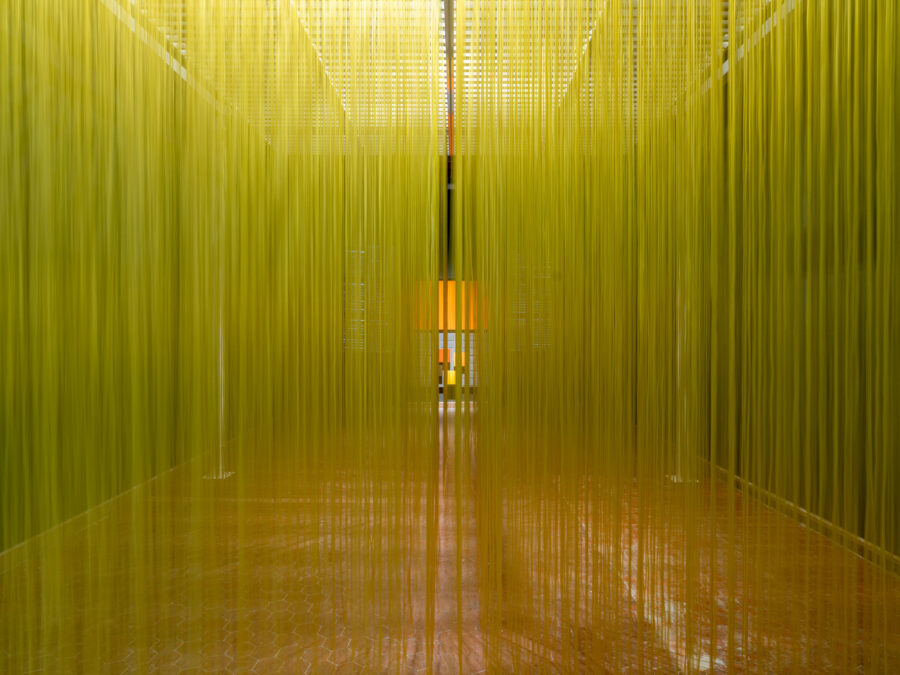
Since then, the gallery has held one exhibition per year during the summer, from June to September, except in 2019, when it presented two concurrent exhibitions in different spaces within the gallery: one featuring South Korean artist Minjung Kim, and another that created a dialogue between the styles of American artist Stanley Whitney and French artist Yves Klein. In 2020, due to the lockdown caused by the Covid-19 pandemic, a digital exhibition was presented that brought together several artists whose works had woven together the gallery’s exhibition program over the past few years. In 2021, over twenty works by Carlos Cruz-Diez were displayed in the first exhibition of the Venezuelan artist’s work since his passing in the summer of 2019 at the age of 95. In 2022, it was the turn of American artist Joel Shapiro, and in 2023, Joan Miró. Now, in 2024, and through August 29, visitors can see one of the largest exhibitions ever held in Spain of the work of the Venezuelan artist Jesús Rafael Soto—one of the world’s leading exponents of kinetic art—featuring more than forty works spanning various periods of his career: from 1951 to 2004, just a few months before his death on January 14, 2005, at the age of 81. The exhibition will continue starting September 12 at the Madrid venue, located at Calle Blanca de Navarra 7 and 9, featuring works different from those on display in Mahón. The exhibition to be shown soon in Madrid will be titled “La T,” a title that refers to the T-shaped metal elements that characterize the fourteen works comprising the exhibition and which are considered the artist’s most vibrant, subtle, and ethereal pieces.
From Cubism to Kinetic Art
Born in Venezuela in 1923, Soto began with Cubism, but after settling in Paris in 1950—where he exhibited alongside Alexander Calder and Jean Tinguely—he gradually shifted toward Constructivism, initially, until 1956, when he began to develop his own vision of kinetic art, based on the idea of surprising the viewer through the art of vibration. Sometimes the vibration was in the eye of the observer: a matter of sensations triggered by their own movement in front of the painting. And sometimes it was physical: the painting included elements that vibrated in response to the wind, a footstep, or a touch. Added to this was an element of real depth, as opposed to simulated depth; the materials were placed one on top of another; some transparent, others not.
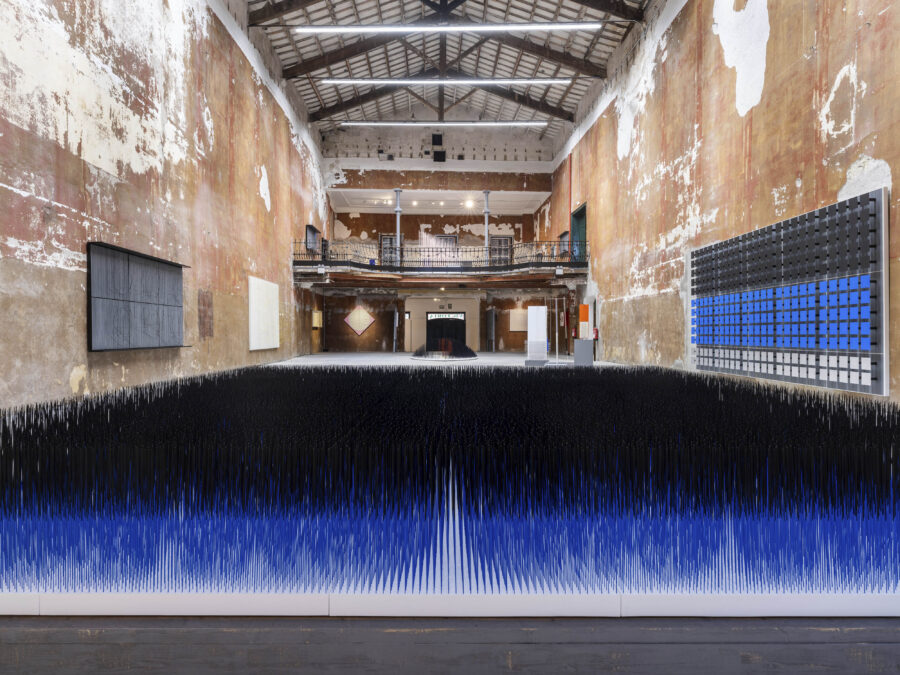
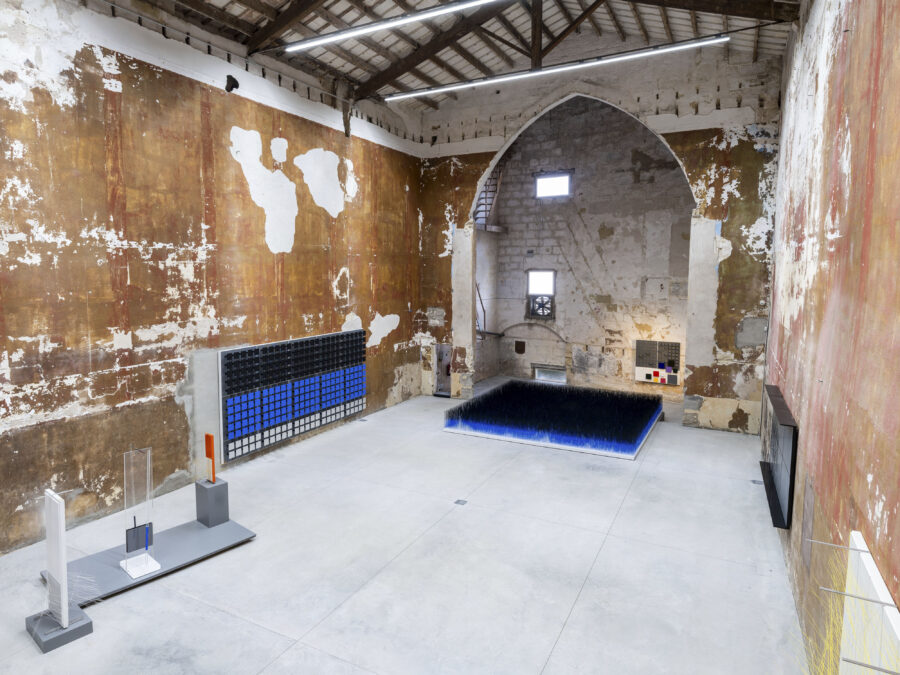
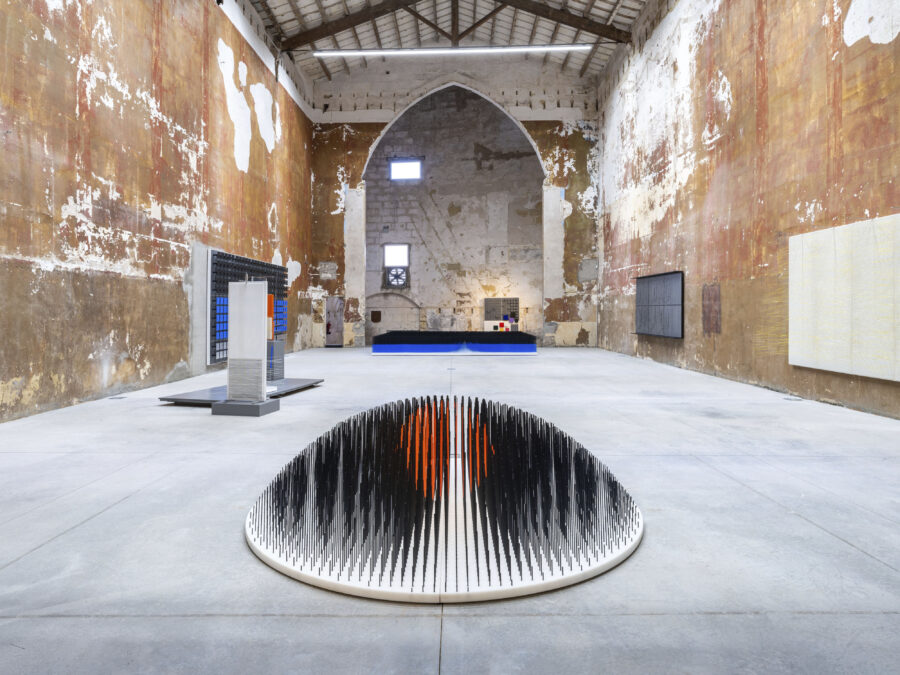
Soto managed to make different parts of his paintings offer different experiences. Some moved, while others remained still. Some glowed, while others shone. There were variations in speed and texture within a single image.
The exhibition in Mahón features works ranging from early, small-scale pieces (120 x 1360 x 6 cm) such as “Muro óptico,” a painting from 1951, or “Gran pasta” (100 x 100 x 16 cm) from 1959, as well as some of the artist’s most recent creations, such as “Small Black Writing,” a hybrid of painting and sculpture created in 2004, in addition to sculptural pieces like “Pink and White Elliptical Progression” (260 x 243 x 150), from 1974, or the spectacular “Blue and Black Extension,” from 1982, composed of 36,000 rods, or one of the 25 “Penetrables” works he created throughout his career beginning in the 1960s: a blend of geometric abstraction, minimalist sculpture, and playground, these simple grids of colored PVC tubes (in this case, yellow) were typically suspended from freestanding frames: it is the viewers themselves who activate the perceptual labyrinth of vibrant light and color by playing (“penetrating”) among the tubes, as the artist intended with this type of work, which Soto always considered ephemeral, yet which have managed to survive wear and the passage of time.