







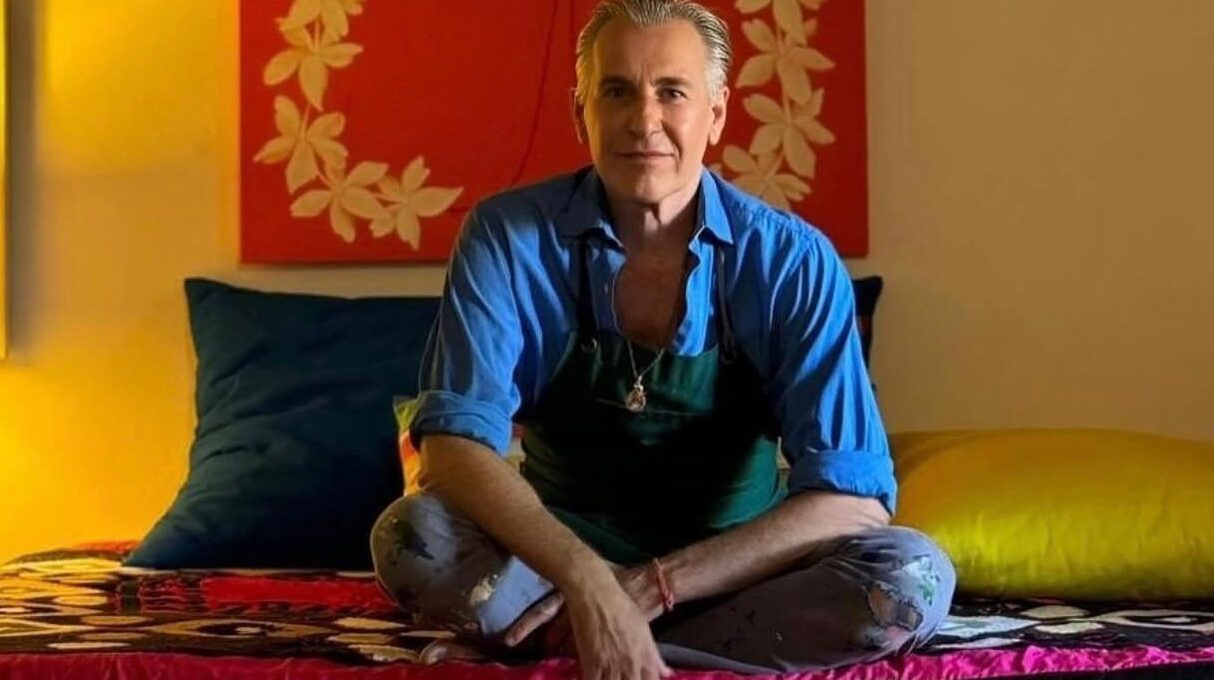
Víctor Hugo “Grillo” Demo (Rafaela, Argentina, 1956) is an Argentine painter based in Ibiza who has dedicated both his artistic and personal life to developing his own way of understanding art, through a commitment to the projects that appeal to him, rather than producing or creating out of a mere need to paint or sell. Over the course of four decades, he has built a personal visual universe through painting, collage, and objects that engage with the island’s memory, its symbols, and its colors. Jasmine is the emblem of his visual language, which is reflected in art, crafts, and design.
How did the collaboration on the Gessamí (jasmine) project with Elisa Pomar come about?
I’ve always been interested in Ibizan traditions and jewelry; they represent an unparalleled part of the island’s cultural heritage and ancestral legacy. I’ve been curious about everything related to them, and I’ve always bought small pieces of jewelry that I ended up giving to my friends because they loved them so much for their originality, shapes, and beauty.
Did you know each other before starting this collaboration?
I’ve known about Elisa’s little shop in La Marina for years, and I’ve been captivated by her designs and pieces—so much so that there was a time when I’d stop by her shop every time I went down to Eivissa. I didn’t have a specific project in mind, and Alberto Amador suggested the idea of doing something with Elisa. We met, talked about tradition and how to revive the heritage of jewelry-making. She came to my house to see my studio and get a feel for my world, and a collaboration naturally developed that has resulted in this collection of small, original pieces of jewelry, as well as my artistic contribution to the shop—a series of drawings and paintings of mine that inspired Gessami.
What is the goal and scope of this project?
We’ve put together a selection of unique pieces in a short amount of time and in the sweltering heat. I don’t like working in July and August, but we managed to give the idea creative form and present this small collection, which has a broader purpose. Starting in September, we’ll expand on the concept with other installations of mine in the store and new creations to take this collaboration further.
Have you gone from being a painter to a jeweler?
I like to do whatever I’m asked to do, but I’m a painter. This isn’t the first time I’ve worked with jewelry; I did it with Carolina Herrera a while back because her creative icon is also jasmine, just like mine.
It all began in the ’70s with an exhibition of collages at the opening of El Hotel de Pacha, surrounded by illustrious friends such as Mario Testino, Kate Moss, Jade Jagger, Naomi Campbell, and Elle McPherson. Later, he met Madonna, Elton John, Damien Hirst, and Princess Gloria van Thurn und Taxis, who supported him in his career and on his path to fame. How did that happen?
-In the art world, you need support when you’re starting out to make a name for yourself, and I was lucky that Mario Testino—who’s family—Jade, Kate, Gloria von Thurn und Taxis, Madonna, and others appreciated my work and bought my paintings. When Madonna bought my three paintings at the David Gil Gallery in London, everything took off. These people make your art known immediately and allow you to engage with culture on a whole new level. I’ve never set out to sell my work; people have almost always bought it because they knew my world, my garden, my way of working, my life—and that makes a vital difference. That led to a friendship that introduced me to other great artists like Julian Schnabel and Anish Kapoor through my exhibitions in New York, London, and other destinations, as well as collaborations with publishers, prominent collectors, and international publications. I’ve maintained that initial circle of friends from Ibiza, which has expanded to include other figures over the course of four decades.
What are his most recent international projects?
I haven’t exhibited in a while because I don’t feel the need to show what I do; rather, I hope that I’ll be offered opportunities or projects that appeal to me so I can get started. After the pandemic and my mother’s death, I went through an emotional slump for several years, and it was hard for me to rediscover my creative spirit. I overcame that, and in May I exhibited at the Spazinoto Art Gallery in the town of Noto, Sicily, with the “Gersumino a Noto” collection, alongside the launch of a catalog written by Mario Testino and Jan Olosen that recounts the essential meeting of sensibilities. Noto is the “Golden City” of the Baroque, and I’ve managed to translate that emotional intensity into a contemporary language: one in which ornamentation is never superfluous, but rather the very essence of the sacred. I’m not in a rush during my creative process because I like to live in my own world, tend to my garden, spend time with my friends, and reflect art as I experience it—at a leisurely pace. I create just a few unique pieces over time; the idea of mass production and painting solely to sell or market my work terrifies me.
Is art still a haven for commercialism and illicit money?
When someone buys art, it’s because they like what they see, it appeals to them, it sparks their imagination, and they want to own it so they can contemplate it and enjoy it with pleasure and passion. I can’t understand buying art as an investment; I would find it terrible if someone purchased one of my works to commodify it or make money.
How do you define yourself as an artist?
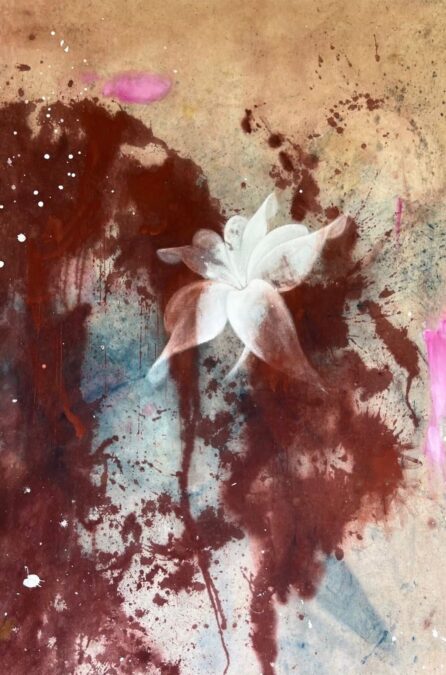
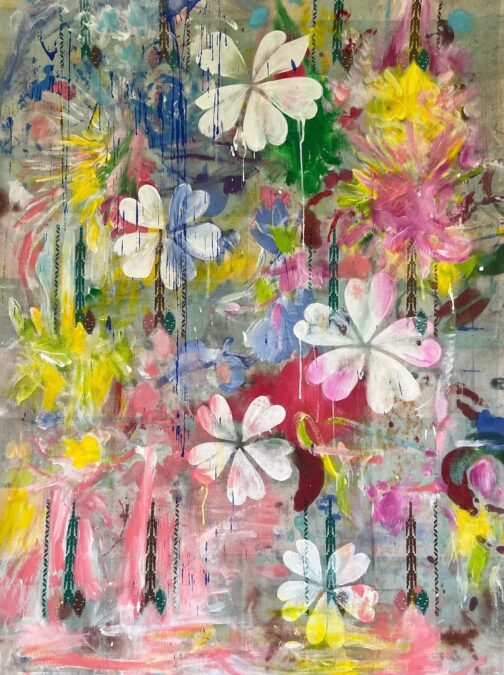
I find it hard to talk about myself and what I paint. It should be others who define my status as an artist. I don’t limit myself to a single style, though I do have an icon—the jasmine—which I reflect in all my work. It is the emblem of my floral language; it is an iconic flower because of its aroma, its fragrance, its beautiful and fragrant blossoms, and its many uses. It’s bucolic and inspiring; it has many nuances; it blooms and wilts from day to night in a special way; and it’s a way of expressing life and art as a source of inspiration. At the exhibition in Noto, they described me as a contemporary Baroque artist.
How do you view contemporary art?
Art is like an anesthetic for the world’s pain; it will always exist. We cannot live without art—it is a unique expression of the human spirit. Every era has its own defining style; the current, or contemporary, style is interesting. I’m quite traditional as an artist and I stick to my traditional creative approach. I neither like nor understand artificial intelligence; I recognize that it’s a tool that can help the world in other ways, but I’m not interested in AI as an artist.
It’s been a while since you’ve had an exhibition in Ibiza. Why is that?
The circumstances haven’t worked out yet, but I plan to hold an exhibition in Ibiza at some point because it has been my source of creativity and inspiration. The Mediterranean is the most wonderful place on Earth; I love this island, and I think I live in one of the best places in the world. I enjoyed it to the fullest during the good years. However, I’m no longer interested in the nightlife scene. I overindulged in the nightlife and its pleasures, and now I prefer to enjoy the daytime, my home, my garden, and my friends. It’s a more inspiring life.
Is the atmosphere you experienced in Ibiza in the ’70s and ’80s one-of-a-kind?
Every era has its own story. You have to live in the moment—and these moments are always unique. When you encounter something for the first time, it makes an impression on you; the second time, you’re already familiar with it; and by the third time, it no longer catches your attention. Moments aren’t repeated—they transform or change. A young person in Ibiza today will experience it differently than we did in the ’80s, but they’ll enjoy it and find it just as extraordinary. What we experienced in the ’70s and ’80s was an explosion of creativity and beauty in art, music, and fashion, in which drugs played an important role. As soon as I arrived, I went to a Bob Marley concert and was captivated by the island’s atmosphere, its people, and its landscapes…
He has fulfilled many dreams. What dream remains for him now?
I dream of living the life I have now—in my home, my garden, and through my painting—and of staying healthy so that it can continue this way for a long time to come.


