








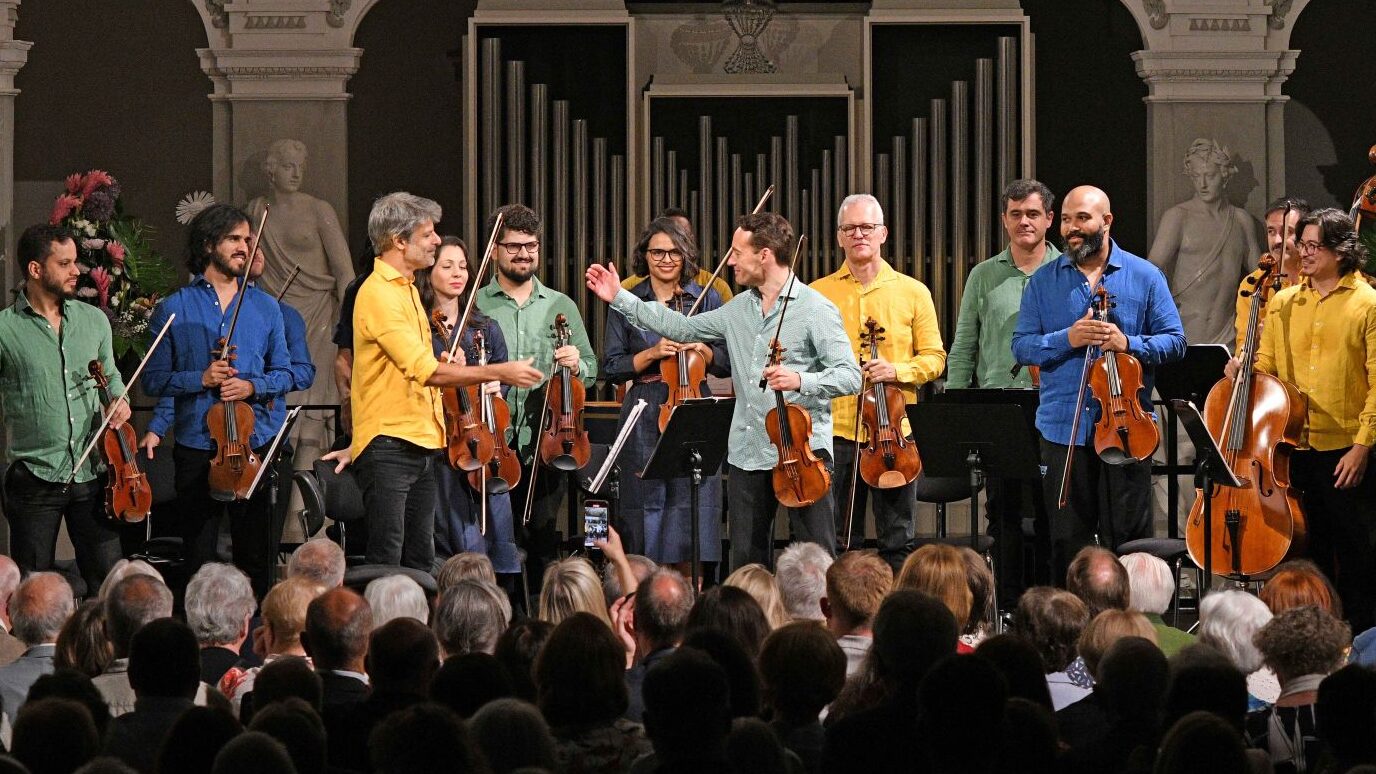
Every summer, Ibiza demonstrates that its cultural identity extends far beyond the major electronic music events that have made it an international icon. Amid Renaissance walls, cobblestone streets, and one of the best-preserved historic districts in the Mediterranean, the island has also found room for a musical program that engages with heritage, artistic excellence, and innovation.
That is precisely the niche occupied by Ibiza Conciertos, a festival that, in just eight editions, has established its own distinct identity within the European classical music circuit. Its approach does not involve replicating the traditional symphonic concert format, but rather creating experiences where the classical repertoire engages with other musical languages and reaches new audiences without compromising interpretive rigor. In this sense, the 2026 edition marks a turning point.
From August 29 to 31, the Dominican Cloister, in the heart of Dalt Vila—a UNESCO World Heritage Site—will be the setting for an unprecedented encounter between two musical traditions separated by thousands of kilometers, but united by their ability to reinvent themselves: the great European school and the musical world of Brazil.
The driving force behind this initiative is German violinist Linus Roth, the festival’s artistic director and one of the most respected figures on the international scene. A two-time ECHO Klassik Award winner and recognized both for his interpretations of the great repertoire and for reviving unjustly forgotten composers, Roth has conceived an edition that transcends conventional programming to become a cultural journey across continents.
A Dialogue Between Musical Traditions
For the first time, the festival will welcome the Orquestra Johann Sebastian Rio, a Brazilian ensemble that has revolutionized its country’s classical music scene by combining the classical repertoire with the rhythmic richness of samba, choro, and bossa nova. The result is not a superficial fusion, but rather a dialogue between musical traditions that share a common language: that of emotion. The program consists of three separate concerts, each with its own distinct identity.
On August 29, audiences will attend the Ibiza premiere of SamBach: From Bach to Brazilian Sambas, a project that has already toured major European festivals and offers a reinterpretation of Johann Sebastian Bach’s Violin Concerto through arrangements inspired by the Brazilian musical tradition. The balance between Baroque architecture and the spontaneity of samba gives rise to a surprisingly natural work, in which both worlds engage in a dialogue without losing their authenticity.
The second day, August 30, will be dedicated to Antonio Vivaldi. His famous Four Seasons will be performed alongside works for string orchestra by key Brazilian composers such as Heitor Villa-Lobos, César Guerra-Peixe, Ernani Aguiar, Sivuca, and Gadelha, tracing a musical journey that connects 18th-century Venice with the contemporary creativity of Rio de Janeiro.
The festival will conclude on August 31 with a complete immersion in Brazilian music. Far from being limited to a themed concert, the program features arrangements created specifically for this edition and offers a journey through some of the genres that have defined the cultural identity of this South American country, ranging from the refinement of concert music to the expressive power of samba and choro.
One of the highlights of this year’s festival will be the 1703 “Dancla” Stradivarius, an instrument that Linus Roth plays courtesy of the L-Bank Baden-Württemberg Music Foundation.
One of the most valuable violins in the world
His presence adds a symbolic element to a festival that seeks precisely to build bridges between tradition and innovation: one of the world’s most valuable historical violins engaging in a dialogue with some of Latin America’s most iconic rhythms.
More than a fusion, this project presents a dialogue between two musical traditions that have evolved independently but find common ground in harmonic sophistication, improvisation, and the ability to move the audience.
Led by violinist and conductor Felipe Prazeres, the Orquestra Johann Sebastian Rio has become one of the most innovative projects on the Brazilian music scene. Its history combines performances at iconic venues such as the Theatro Municipal in Rio de Janeiro, the Sala Cecília Meireles, and the Cidade das Artes with collaborations with artists such as Gilberto Gil, Alceu Valença, Domenico Nordio, Marco Pereira, and Linus Roth himself. Its philosophy is based on a simple idea: to break down the barriers between classical music and the general public without compromising artistic excellence.
Social Dimensions
Ibiza Conciertos’ growth can also be attributed to its social impact. Throughout the year, the association carries out music therapy projects and free concerts for hospitals, nursing homes, and people with disabilities, in collaboration with organizations such as the Ibiza and Formentera Association Against Cancer (IFCC). This line of work views music not only as cultural heritage, but also as a tool for well-being, inclusion, and social transformation.
With the support of the Eivissa City Council and the Consell d’Eivissa, tickets for the 2026 edition are now available through the festival’s website. The organizers are also offering a three-day pass with a 20% discount and a special rate for residents of Ibiza and Formentera.
On an island accustomed to setting the pace of the European summer, Ibiza Conciertos invites you to experience a different rhythm: one that emerges when classical tradition and Brazilian creativity discover they speak the same language


