








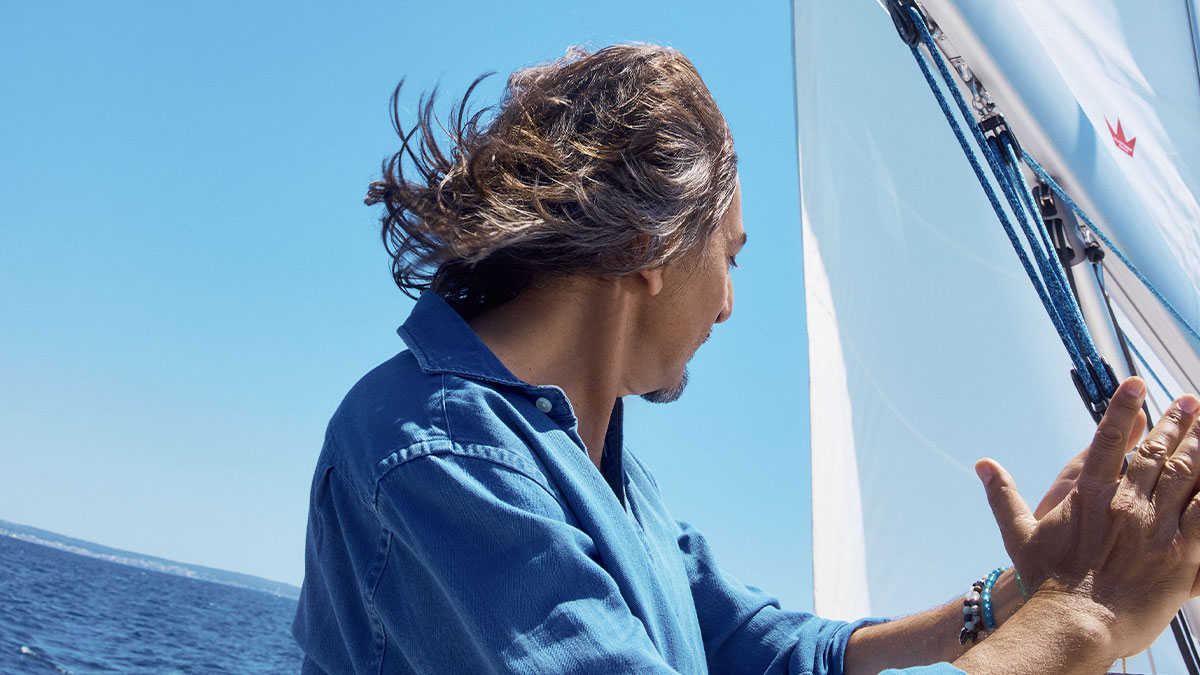
As soon as Antonio Carmona (Granada, 1965) came on board, he asked, “Do you have a speaker to play music?” At that moment, we knew this artist wasn’t going to be just another crew member. We set sail on a Dufour 44 from Yates Mallorca with a singer who has truly broken the mold, who has taken flamenco to the next level, and who has shattered all conventions with a fusion of styles that has propelled him to the very top.
Now, she’s making a comeback with her new album, *Baro Drom*, which in the Romani language means “Exodus.” “It’s been a huge musical exodus. I’ve made music and produced with some truly great people,” she explains about this album. A highly anticipated comeback after eight years of silence: “I haven’t promoted an album this hard in years. It’s been very tough, but also very rewarding. Reconnecting with all the people who love me, with the media… People were eager to see me and find out what I’d been up to.”
The album highlights his collaboration with rappers Bigflo and Oli in La Paz: “They’ve given me a way to refresh my music. We went into the studio, and it’s so rewarding to work with people who have such a different musical vision.” A message that’s more important than ever today: “With all the wars going on in the world, at least through our music we can send a small message.” Looking to the future, he reveals his big unfulfilled dream: “I’m working with an artist named José. He’s a Galician composer. I’d love to dive into that world.”
While sailing along the Balearic coast, Carmona recalls his first encounter with the sea: “We used to spend our summers in Málaga, because my father organized festivals throughout Andalusia. After an 8-hour drive in a 600 from Madrid, we’d see the sea, and my brother and I would try to lean out the window to feel that first blast of sea air.”
Today he lives in Cádiz, a refuge he loves but one that reveals complex realities to him: “I live in Cádiz, and there’s nowhere else quite like it. But you also see that flow of people coming here to make a life for themselves. Sometimes a cayuco appears with children and women. That’s where the inspiration for ‘Para que tú no llores’ with Alejandro Sanz came from—a way to explain that human movement that, in the end, is an exodus. We, the Romani people, come from India; we’ve migrated all over the place.”