







I’m starting my third week in Mozambique, and it hasn’t even crossed my mind to weigh anchor and head south—at least not yet. In a few days, there’ll be a good weather window to head to South Africa, but given everything I’ve experienced in this remote spot, I’ve decided to let it pass. I’ll take advantage of the next one… It’s special when you find a place like this—the stars align, and you find your anchorage.
Honestly, it’s nowhere near the perfect anchorage because it’s not sheltered from the south wind, even though the seabed offers good holding and there aren’t any waves. What has captivated me about this remote corner of Mozambique is the tranquility and friendliness you feel here. From the very beginning, I’ve felt welcome and well taken care of. Every interaction I’ve had with the locals has taught me something or given me a new perspective. I’ve spent many hours strolling along the arid, dry path that leads to the village. I love observing how they live, how they organize themselves, what customs they have, how they spend their free time, and, in general, learning about different ways of life. Broadly speaking, everything seems to follow a certain pattern, but if you dig a little deeper, you realize how important it is to pay attention to the details.
At dawn, the local fishermen are already out in their boats with their fishing gear in the water. The gear consists of a very thin line with a hook at the end; they wind the line around a plastic bottle. At noon, when they’ve caught a few fish, they usually come over and offer me what they’ve caught. They don’t want money in exchange, but, to be honest, I feel bad about it. We’ve set up a series of exchanges: carapao (a fish typical of this area) for cans of chickpeas, squid for hooks and fishing line. They often bring coconuts to the boat, and I give them pasta, rice, and various types of canned food. I think we’re boosting trade at the anchorage. The Sofía is becoming the hub of activity in the area. Whenever they can, they also bring fresh fruit and vegetables to the negotiations. On these occasions, the transactions are larger because these types of goods are hard to come by.
Both the fish and the fresh ingredients are of very high quality, and in the evenings, I enjoy cooking different dishes—which, to me, are quite elaborate. To most people, they’d probably seem like simple, basic dishes. I put on some music and get to work in the kitchen, then we have dinner at the table on deck under the moon and stars.
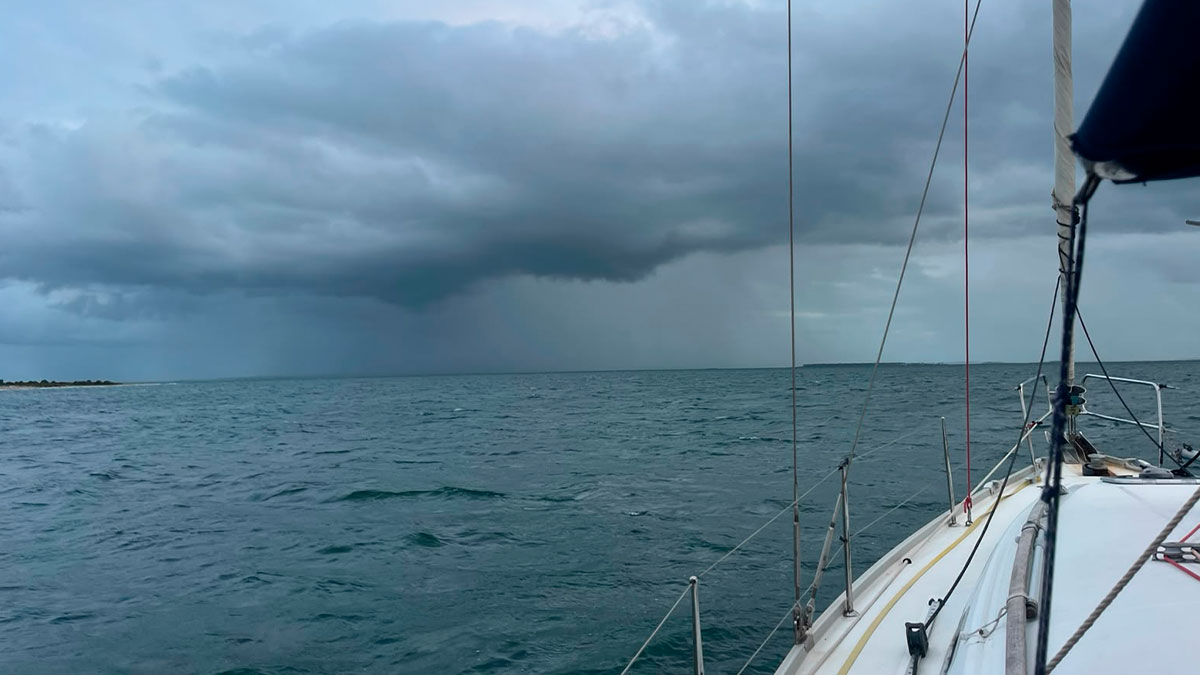
Naturally, these moments—among many others—make everything make sense and make the tough times feel worthwhile. This week we’re expecting two weather fronts in the area that will bring winds of up to 35 knots and rain. Fortunately, there’s no forecast for thunderstorms at the moment, but that could change at any time. Since the anchorage is spacious and the holding is good, I decide to do without the second anchor. I remain anchored with 70 meters of chain at a depth of 13 meters. You can feel the front approaching because the sky is bringing a different kind of cloud, the temperature drops suddenly, the wind shifts direction, and, all of a sudden, the atmosphere changes. It smells like rain. I love that smell.
In just a few hours, the wind has already picked up to 30 knots, and the Sofía is holding up well. Obviously, there’s no shopping today. Closed due to bad weather. Luckily, I’ve stocked up a little on board and have enough provisions to last until the weather calms down. I spend the day baking bread, doing a bit of cleaning, tidying up, and reading quite a bit on deck, sheltered from the rain. At night, while I’m preparing dinner, I see the sky lighting up intermittently. I go out on deck, and a thunderstorm is passing by on the starboard side. Based on the wind direction, it should pass us by without affecting us. I turn on the radar to make sure of the direction it’s moving in and breathe a sigh of relief. I eat dinner while watching the lightning strike the surface of the sea. The thunder takes a while to reach us because the storm is far away, out of harm’s way. I have the privilege of dining while watching a light and sound show that’s exclusively for me and the Sofía.


