







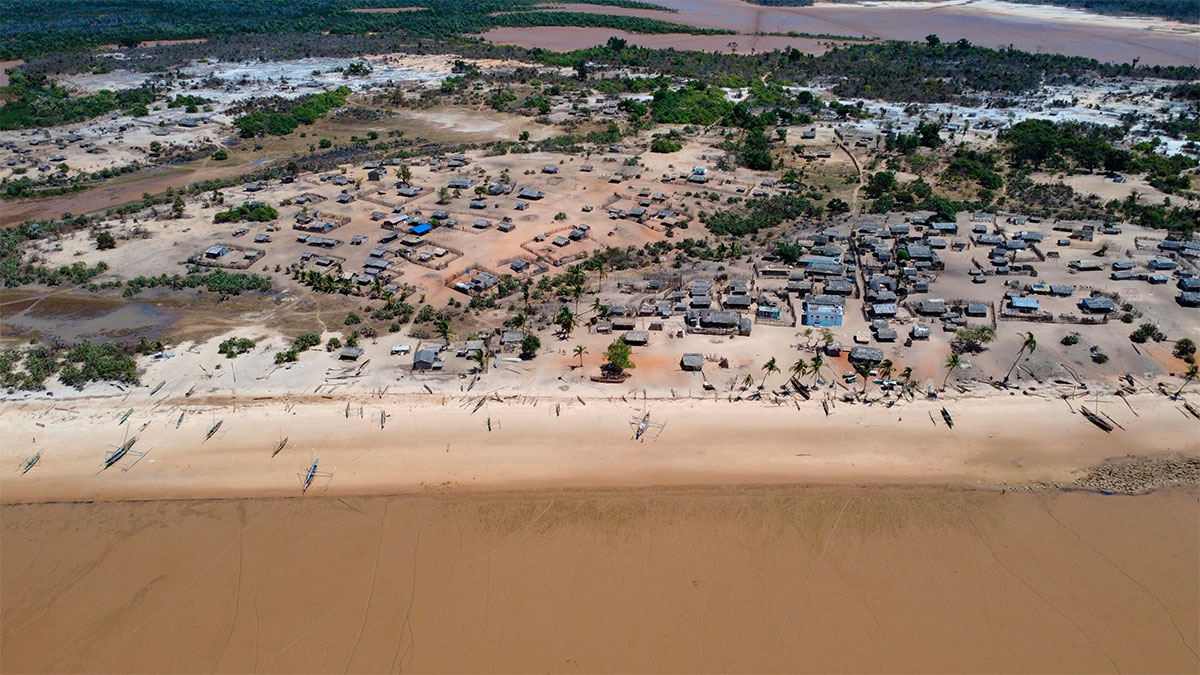
Ever since I set sail from Spain—even before I started planning the whole adventure—one of my greatest dreams was to sail the Sofía to Madagascar. The sun rises at 6 a.m., and I’m already on deck with my coffee. I wake up to dawn in Madagascar… I’m anchored near the mouth of a river, and the water is tinged with brown. On one side of the river mouth is a beach that stretches all the way to the entrance of the bay. At high tide, the beach disappears. On the other side is a village called Baly.
Ever since the sun rose over the horizon, fishermen have been passing by the Sofía and watching in amazement. From the curiosity I see on their faces, I gather that very few sailboats anchor in this area. I’m curious to go ashore and visit the village. I finish my coffee, have oatmeal with milk for breakfast, and launch the dinghy into the water.
It’s a sunny day with a breeze from the northeast. I head to the beach at low tide and leave my boat on the sand. I walk toward the river’s mouth and see dozens of fishermen casting their nets and filling their boats with fish. On the shore, there’s a fisherman sitting on the sand. He watches me closely, so I decide to go over and introduce myself. His name is Jeannoel; he’s 28 years old and lives in the village of Baly.
In Madagascar, they speak Malagasy and French. I brush up on my rusty French, and we’re able to understand each other, although gestures, facial expressions, and drawings in the sand are all part of the conversation. He explains that he’s waiting for a friend to go fishing. Jeannoel’s boat doesn’t have a sail, but his friend’s does. He sails close to the shore until the boat runs aground. He shows me everything he’s already caught and how they maneuver with the sail.
They build their own boats from a tree trunk. They carve it into the shape of a hollow half-cylinder, attach a thick branch as a mast, and use a sheet as a sail. They’re every bit as skilled as professional naval architects. Before I say goodbye to them, they invite me to visit their village, and we agree to meet at 10 a.m. the next day. Before returning to the Sofía, I take a long walk along the shore until the tide comes in. I spend the afternoon doing chores on board and resting.
At 10 a.m., Jeannoel is waiting for me right on time on the shore, in front of his village. It’s low tide, and to reach the shore, I have to drag the boat through the mud for about 200 meters. It’s not easy at all because with every step I take, I sink up to my knees. It feels like quicksand. Jeannoel sees that I’m having a hard time getting there and comes to my aid. We make much faster progress, and finally, we reach the beach covered in mud. We wash up as best we can, and he introduces me to his friends.
We walked along the shore, weaving our way around dozens of fishing boats. Each one is decorated differently: some with the FC Barcelona crest, others with the Real Madrid crest, and many more painted in different colors. They come in all shapes and sizes. He introduces me to a group of young people who are repairing a fairly large boat. He explains that a cyclone swept through this area in February and destroyed everything. They’re working on rebuilding boats and houses.
Then we go to get water 1 km away, where the well that supplies fresh water to the village is located. Before drinking it, they have to boil it to prevent infections. He shows me his house and introduces me to his whole family: his wife, children, brother, and nephews. His parents live quite far away.
The houses are built from branches tied together, and the roofs are made of tree leaves arranged so that, when it rains, as little water as possible seeps in. Inside, there is only a mattress where Jeannoel, his wife, and their son sleep, and an area where they build a fire to cook.
Returning to the shore, where I had left the boat, we walked past the various houses in the village, all of which looked very similar. Some people were growing vegetables, and others had fish drying in the sun. I said goodbye to Jeannoel and his family.
Today is a reality check. As I return to Sofía, I can’t stop thinking about the hardships they must face, living solely on the resources their environment provides and, on top of that, living in an area affected by hurricane season.


