







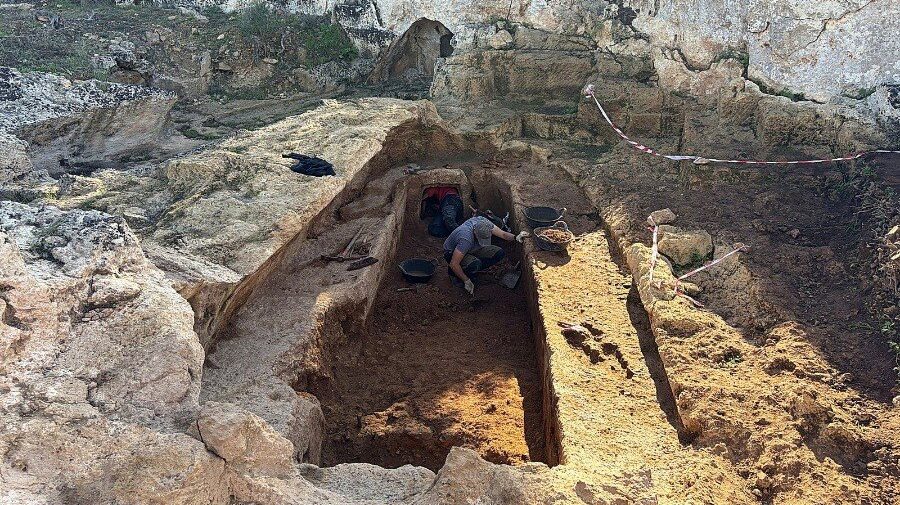
Excavations at the Son Sunyer necropolis in Palma have uncovered human remains and prehistoric pottery.
PALMA, 30 (EUROPA PRESS)
A research team from the Spanish National Research Council (CSIC) has discovered human remains and archaeological artifacts dating back about 3,500 years, a discovery that opens new avenues for the study of funerary practices and prehistoric communities in Mallorca.
The work was carried out during the excavation campaign this October at the Son Sunyer necropolis in Es Pil·larí (Palma), according to a press release from the CSIC.
The work focused on hypogeum SSU9, an artificially excavated funerary cave in the rock that was discovered in 2024 and whose excavation began in 2025.
Until now, many of the Mallorcan hypogea studied had suffered later alterations and reuses, which made it difficult to recover information about their original funerary use.
According to Pau Sureda, a researcher at Incipit-CSIC and co-director of the excavations, the importance of the discovery lies in being able to document Bronze Age remains in their archaeological context, using modern excavation techniques.
Although the materials show "a certain degree of alteration," their study will allow researchers to address questions that have so far proven difficult to investigate in this type of site.
During the 2026 campaign, researchers confirmed that beneath the already documented medieval occupation layers, archaeological deposits corresponding to the prehistoric use of the necropolis are still preserved.
Among the materials recovered are human skeletal remains, pottery sherds, and other objects associated with funerary practices.
Evidence of child burials has also been identified, which will raise new questions about the composition of the communities and the participation of their members in funerary rituals.
Jordi Hernández, a researcher at the Catalan Institute of Classical Archaeology and co-director of the excavation, notes that the bones appear scattered and disarticulated, a circumstance that "could be related to the way the burials were managed."
The researchers suggest that the deceased were initially buried in stone benches or niches carved into the walls and that, later, some remains were moved to the central area to make room for new burials.
This hypothesis suggests that certain areas of the hypogea could have functioned as ossuaries, where the remains of previously buried individuals were kept.
NEW RESEARCH OPPORTUNITIES
The CSIC has highlighted that the recovery of these materials will allow for new scientific analyses to establish the chronology of the burials and to obtain information about the people who used the necropolis.
Among the planned studies are radiocarbon dating and the analysis of human remains, which could provide data on the age, diseases, diet, and genetic characteristics of these populations.
Although the burials are initially estimated to be about 3,500 years old, researchers note that future dating will allow the site's period of use to be established with "greater precision."
The excavation has also revealed a niche located beneath one of the stone benches of the hypogeum, a layout that differs from what is commonly seen in other known funerary structures in Mallorca.
The Son Sunyer necropolis consists of nine hypogea, or artificial caves, excavated into the rock. These structures were used as burial sites during the Bronze Age and feature various architectural configurations, such as chambers, corridors, benches, and niches.
The complex is located next to the former Pla de Sant Jordi wetland, an area where prehistoric communities may have distinguished between living spaces and those designated for burials.
Over the centuries, the necropolis has undergone various occupations and reuses. Researchers have documented materials from the Talayótico and medieval periods, as well as evidence that the site was used as a sandstone quarry during the 16th and 17th centuries, an activity that partially destroyed some of the original structures.
The current campaign, with fieldwork scheduled to conclude this Friday, October 30, builds on research conducted at Son Sunyer since 2020, which has been reinforced since 2024 with the participation of Incipit-CSIC.
The new findings will advance our understanding of Bronze Age funeral practices in Mallorca and will open new lines of research on the communities that inhabited the island during this period, they concluded.


