






After four months of one of the most complex underwater archaeological excavations ever carried out in Spain, the Council of Mallorca on Monday completed the full recovery of the remains of Ses Fontanelles, a fourth-century AD Roman merchant ship. It is considered one of the most significant discoveries in the western Mediterranean for several reasons, including its exceptional state of preservation.
The operation, which has brought together specialists from the University of the Balearic Islands (UIB), the University of Barcelona and the University of Cádiz, marks the conclusion of the site’s recovery phase, but also the beginning of a long scientific process aimed at reconstructing how people navigated and traded on the Mediterranean’s maritime routes more than 1,700 years ago.
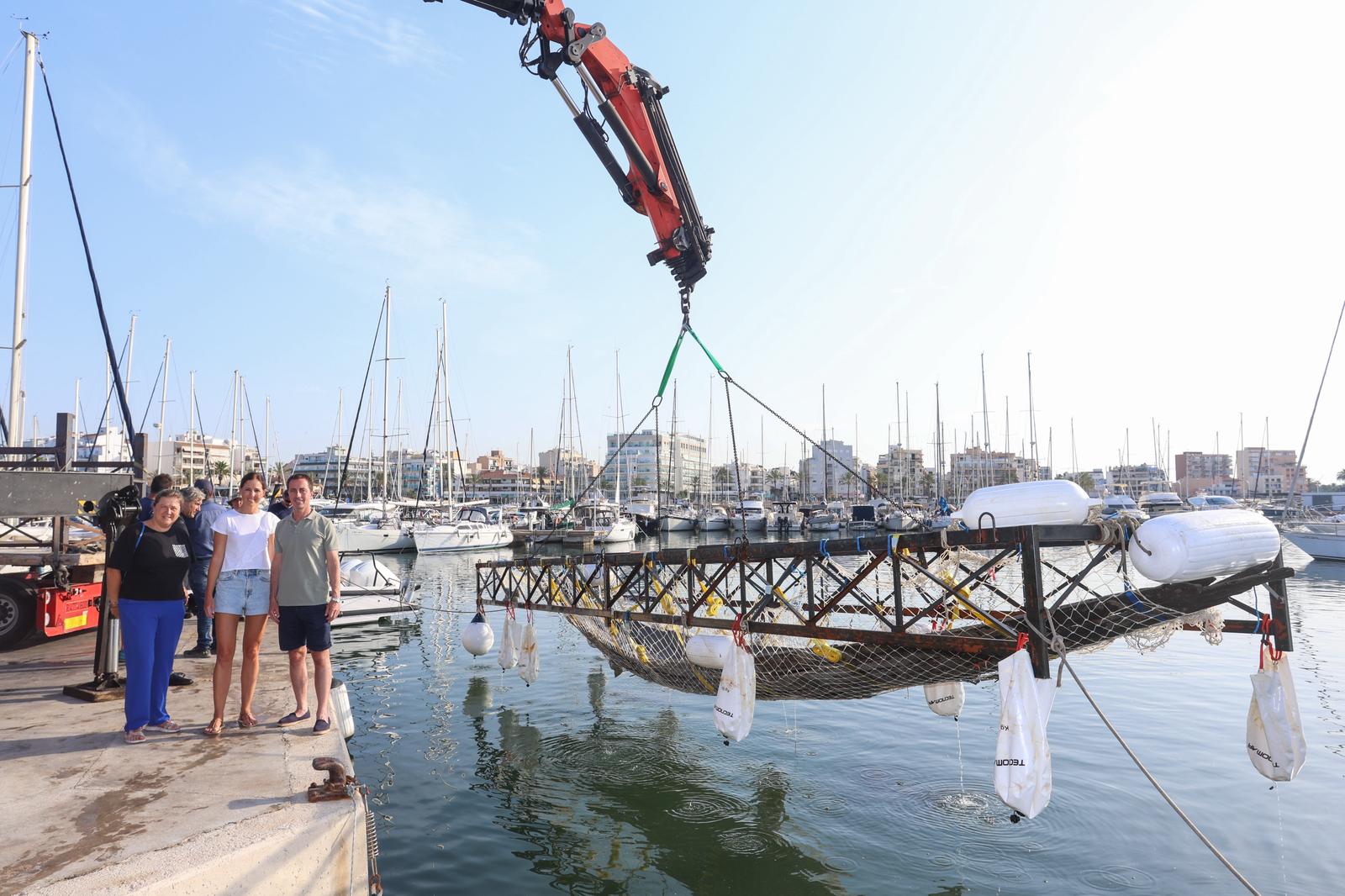
The final section of the hull was recovered on Monday after a delicate operation that began at dawn. Using a system of buoys, the structure was lifted from the seabed and slowly towed to the Club Marítimo San Antonio de la Playa. From there, a crane lifted it and loaded it onto a specialized truck, which transported it to the Castle of St. Charles, where it will remain for approximately a year and a half in desalination pools, an essential treatment to ensure the preservation of the wood after centuries underwater.
This operation marks the culmination of the work that began last March, during which a team of fifteen archaeologists worked continuously to gradually dismantle the ship. The extraction was carried out in accordance with a rigorous scientific protocol, and each of the vessel’s structural elements was removed until only the two large sections of the hull remained, the recovery of which has been completed over the past few days.
Beyond the ship itself, the campaign has significantly expanded our understanding of the context of the shipwreck. Researchers excavated an area six to seven meters around the wreck, recovering an exceptional collection of artifacts that offer a unique insight into commercial maritime transport in Late Antiquity.
Among the finds are several amphorae, practically intact, that were part of the cargo; kitchenware and fine North African tableware; an oil lamp used by the crew, four anchors—some of which still retain their original knots—, about 90 meters of rope, two complete baskets made of plant fiber, a pulley, and a sounding line used to measure the depth of the seabed.
One of the discoveries that has aroused the greatest interest among specialists is the remains of the linen sails found on the port side. Although the fabric is in an advanced state of deterioration, its preservation will allow researchers, for the first time, to study aspects related to sail manufacturing, sewing techniques, textile reinforcements, and the rigging configuration of a ship from this period.
For the president of the Council of Mallorca, Llorenç Galmés, the salvage of the shipwreck represents a milestone for the heritage of the island and the Mediterranean, as it has allowed the preservation of a unique testament to ancient navigation. “We have succeeded in saving a unique archaeological treasure thanks to the tireless work of an extraordinary team and the collaboration between institutions. “This shipwreck will allow us to discover what navigation was like more than 1,700 years ago and will reinforce Mallorca’s role as a leading center for underwater heritage research and conservation,” said the island’s president.
Along the same lines, Vice President and Regional Minister of Culture and Heritage, Antònia Roca, emphasized that the excavation does not mark the end of the project, but the beginning of a new phase focused on research and conservation. “The work carried out over the past few months ensures that future generations will be able to learn about and study an exceptional discovery that is part of Mallorca’s historical legacy.”
This new phase will take place at the ARQVAtec laboratory of the National Museum of Underwater Archaeology in Cartagena. There, the wood will undergo a complex restoration process that includes impregnation with polyethylene glycol (PEG) and freeze-drying, a technique that prevents the structure from deforming once it has dried. At the same time, researchers will conduct studies on naval architecture, wood species identification, radiocarbon dating, and the cataloging of all recovered materials.
The project’s co-scientific director, Miguel Ángel Cau, emphasizes that the main objective set five years ago – the complete recovery of the ship to ensure its preservation – has been achieved. From now on, he explains, the real work moves to the laboratory, where each piece will help continue reconstructing the history of a vessel whose uniqueness places it among the best-preserved late-period shipwrecks in the Mediterranean. Monday’s recovery marks a milestone, he emphasized, “the first of many to come if we want to save our underwater cultural heritage.”
The excavation represents one of the key milestones of the Arqueomallornauta project, promoted by the Council of Mallorca in collaboration with the University of the Balearic Islands, the University of Barcelona, and the University of Cádiz, with the cooperation of the Spanish Navy Diving Center. Cau also highlighted the numerous “surprises” yielded by the recovery, mentioning the discovery of North African cooking ceramics, the virtually intact plant fiber baskets, and the ship’s sails – “a great surprise” that constitutes an exceptional find.
While the scientific work is underway, the Council is already preparing an exhibition at the La Misericòrdia Cultural Center, which will open its doors in November and offer the public an in-depth look at both the history of the shipwreck and the complex archaeological process that made its recovery possible. It is a way to share with the public a project that goes beyond the realm of heritage to consolidate Mallorca as one of Europe’s leading centers for underwater heritage research and conservation.