







The controversy over AENA’s plans to expand the Balearic Islands’ airports has reached the other side of the Atlantic. The New York Times has picked up on the question that first the public and then regional politicians have raised with the Spanish government: “These European cities claim to have too many tourists. Why are they expanding their airports?” is the headline the American publication uses to frame a report on the contradictions of overcrowded European destinations that complain about mass tourism while adapting their infrastructure to accommodate a greater volume of arrivals.
The article focuses on the expansions of the airports in Barcelona, Venice, and Amsterdam, as well as Son Sant Joan. It highlights the “paradox” that is playing out in various cities across Europe. “Across Europe, airports are expanding to meet growing travel demand, even as the cities they serve struggle to stem the flood of visitors through tourist taxes, bans on short-term rentals, and initiatives to reduce carbon emissions.”
Conflicting Jurisdictions
In the case of Mallorca, The Times refers to “conflicting jurisdictions” when pointing out the contradictory approaches taken by the central government and certain regional administrations—starting with the regional government—which “have been forced to respond as citizens have begun to protest the impact of tourism”. In fact, it describes Mallorca as “one of the main flashpoints of tension between local and national authorities.”
It includes statements from Tolo Deyá, dean of the School of Tourism at the University of the Balearic Islands (UIB), who points out that the most these destinations can do “is reduce the number of accommodations or impose a tourist tax, whereas controlling or reducing the number of flights is in the hands of the central government. And for central governments, airports are a very important source of revenue.”
The lack of coordination and communication between the central government and the autonomous communities is one of the issues analyzed. The article quotes statements by the president of the Balearic Islands, Margalida Prohens, in which she complains that she learned of AENA’s plans too late. “It is unacceptable that while local institutions are working together on a strategy to curb tourism on our islands, AENA is planning for continued growth.” Since then, the media outlet notes, Prohens has been complaining to Pedro Sánchez’s government about the lack of coordination.
The public company’s position is summed up in the statements made by Maurici Lucena, the entity’s president: “Airports, like any infrastructure, cannot be the ones to control demand.” This observation clashes head-on with Deyà’s view that airport growth can undermine efforts to curb overtourism and may even lead to an influx of more tourists. “When you look at the case of Mallorca, the number of hotel rooms has remained the same for many years, and vacation rentals are strictly controlled. But the number of arrivals keeps rising,” Deyà asserts.
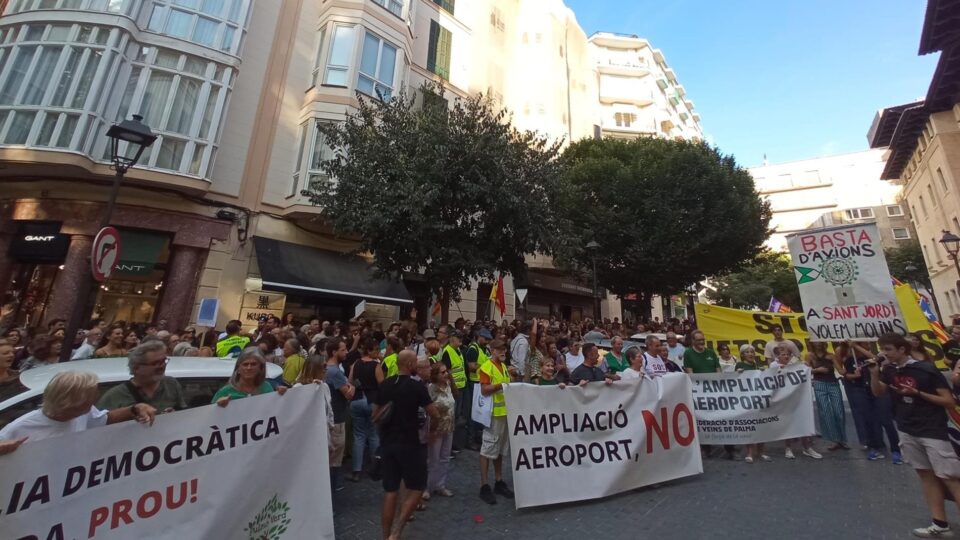
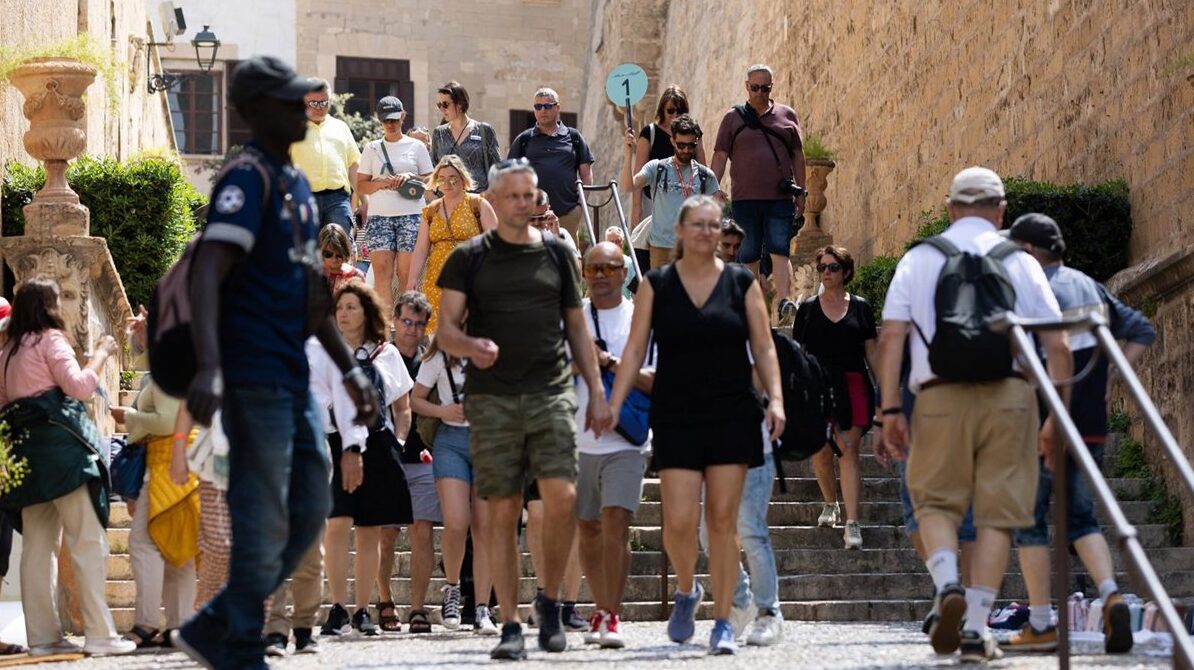
The report also includes various facts to provide context for the social debate surrounding mass tourism, such as the recent citizen protests against the current growth model—which has led to overcrowded streets, infrastructure, and services, as well as an increasingly serious housing crisis. The streets of Palma were filled with tens of thousands of people last July (25,000, according to the NYT, though local sources cited higher figures), while last weekend saw new protests in Palma and Ibiza against the airport expansion plans.
“It’s definitely a contradiction,” Alex Chapman, director of economic and environmental policy at the New Economics Foundation, a progressive British think tank in London, told the NYT. “There are cases like Barcelona, where you have a population that is practically taking to the streets to protest what they perceive as unsustainable and unfair practices by the tourism industry. Proposing yet another massive expansion of the airport at the same time is really hard to reconcile.”
Prohens’ Claims
The issue of tourism growth once again dominated much of Tuesday’s political debate. Prohens reiterated her opposition to AENA’s plans in the Parliament, emphasizing that they support investment but that such investment cannot be tied to increases in passenger numbers. The Balearic president responded in this way to PSIB spokesperson Iago Negueruela during the debate on questions to the regional government after the Socialist criticized her for contradictions in her tourism policies, which he claimed would ultimately make her “the president of 20 million tourists.” The Socialist criticized Prohens’ “little charade” of feigning outrage at AENA while simultaneously applauding and supporting the opening of new long-haul routes to the Balearic Islands, such as those to Montreal (Canada) or Abu Dhabi (UAE) this summer.
Prohens insisted that it is the central government “that wants 50 million tourists to visit the islands by 2031” and noted that the Consell de Mallorca is conducting a capacity study to reduce the number of tourist accommodations. Finally, he asserted that the containment decree is working. “You can twist it any way you want, but you’re the ones who approved 115,000 tourist beds, while this government has approved zero,” he declared.
The vice president of the regional government and minister of Economy, Finance, and Innovation, Antoni Costa, echoed this sentiment when referring to the need to set limits on growth in Ibiza, given that the island is a “fragile and limited territory that cannot grow indefinitely.” Costa thus argued that this is the territorial model the regional government is pursuing for the island and the one already being implemented by the Ibiza Island Council. In this regard, he cited measures such as vehicle restrictions and the “firm ‘no’ to unchecked expansion” of the airport.
From the opposition, groups such as Més have accused the regional government of living in a “parallel world” for arguing that its containment policies are working, even as the number of tourist visits continues to grow throughout the year—albeit at a slower pace during the high season. In this regard, the eco-sovereignist left advocates for degrowth, not for containment efforts that, in any case, are not yielding the expected results.