








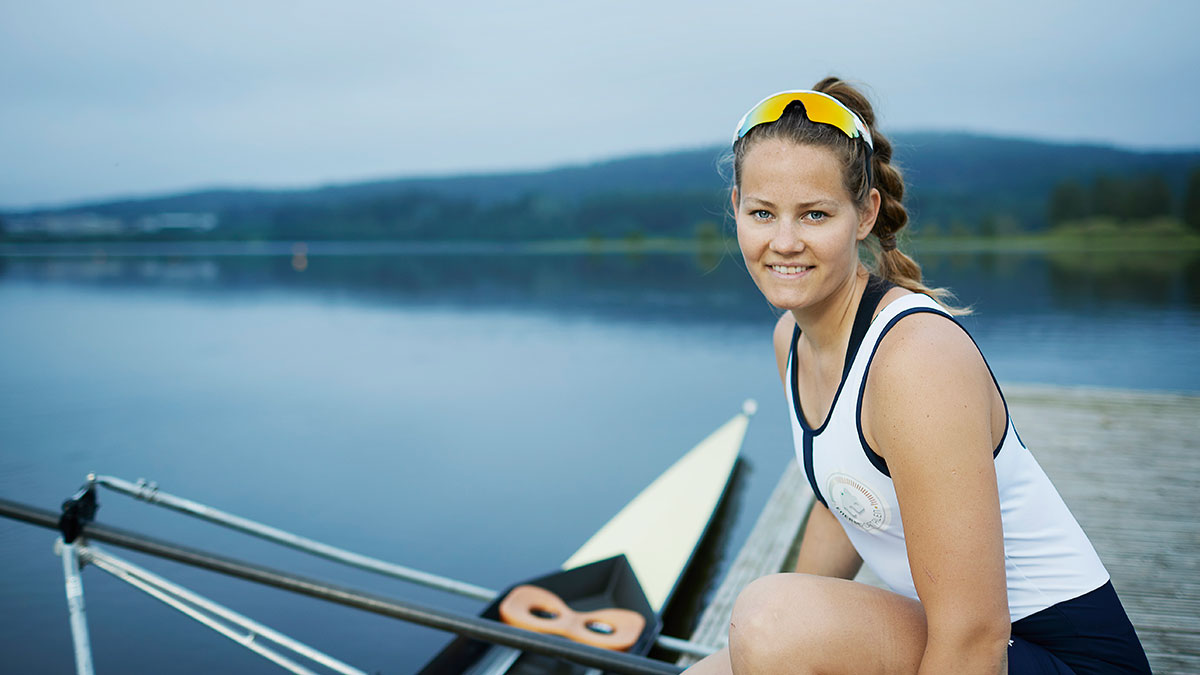
Norwegian sailor Helga Marie “Mara” Løvenskiold Kveseth is in the final days of preparation for this year’s Golden Globe Race, in which 17 participants will sail solo and nonstop around the world, navigating by sextant and without GPS, in boats no longer than 36 feet, to recreate the spirit of the original 1968 race. She is the only woman participating and is sailing aboard the Showgirl, a Saltram Saga 36.
A seasoned athlete (she has excelled in fencing, rowing, and bobsledding), Mara then spent four years sailing around the world as part of the Sailing Ripple Effect project, which took inexperienced people aboard a catamaran to sail while making a positive impact in the places they visited. When that project ended in 2024, Mara set her sights on her next challenge: the Golden Globe.
I spoke with Mara on the phone while she was in Les Sables d’Olonne, during the final days of preparation before the start of the race, which begins on September 6.
There are only a few days left before you set sail for about eight months. What’s happening this week?
I have my safety inspection tomorrow, which means I need to have everything ready. They’re coming to check all my equipment and how the boat is set up to make sure it’s safe to set sail. We’ve been very close to being ready for a long time. It’s a little overwhelming. I’m really looking forward to that moment when there’s nothing left for me to do and it’s finally over… I’ll have set sail and will be able to just breathe again.
How did you get into sailing? Where does your love for the sea come from?
When I was little, I wanted to be a pirate. My dad built me a pirate ship in the backyard, and I spent every day there in my pirate costume. My uncle crossed the Atlantic before I was born, and he showed me photos of himself on the ship or under a palm tree in the Caribbean, and I’d think, “What is this?” I was obsessed with wanting to cross the Atlantic and sail to the Caribbean. But I lived in the middle of the woods, and there was no sailing there, so I didn’t go sailing until I was 15—my first time—with my uncle in Greece. The moment I stepped onto that sailboat, I thought: “Yes, this is it.” I felt so free, and I felt that this was where I wanted to be.
Why the Golden Globe? What attracted you to the race?
A friend told me about it in 2022—that was the first time I’d heard of the race—and it seemed absolutely crazy to me. Then, two years later, when Sailing Ripple Effect ended, I thought: What now? I’d been living my dream life. It was rewarding in every way—I grew as a person and learned so many new skills. Suddenly, the idea of the Golden Globe popped into my head, and I couldn’t shake it. I had to sign up. So it was kind of a mini existential crisis that led me to it, but now I’ve realized just how big of an impact my participation has on other people—especially my nieces. They see the things I do and know that they can do them too.
Where do you think this desire to do great and bold things comes from?
I didn’t have many limitations growing up. I had four siblings, and whatever they did, I did too. I had my mother and my grandmother—they were such strong women, always doing whatever they wanted. I hadn’t realized until now just how much that has influenced me, because I simply believe I can do anything, and I feel like, “Okay, let’s go for it”—I give it my all, and then it works out. When people I don’t know write to me and say, “I’m using you as a role model for my daughter, and I hope she gets to live her own adventure too,” I think that’s great, and it’s really nice to hear. If I can make a girl’s life just a little bit better with what I’m doing, it’s already worth it.
Do you feel that being the only woman participating this year puts extra pressure on you?
Definitely. People pay closer attention to me and ask me more questions. But I like being the underdog. Plus, since they underestimate me a little, they’re more willing to help me. I focus on all the positives.
How important do you think it is, in a race like this, to have a strong social media presence? Social media has played an important role in your campaign.
From the very beginning, I had two goals in mind: I hoped it would help me finance everything, since I’m paying for it entirely out of my own pocket. But it’s also been very important to me to share it, because that’s been my main goal: to reach other people and show them what this is all about and what’s possible.
And you don’t shy away from showing your feminine side either—was that intentional?
It was a very deliberate choice, because I’ve gotten so many comments like, “Oh, do you really think you can sail the Golden Globe Race in a pink bikini? You’re going to die out there.” And that’s why I think: well, you know what? I’m going to show you my pink tutu, and I’m going to sail around the world wearing it. It’s been important, because many girls and women feel like they have to “tone it down” in very male-dominated environments. So it’s been like saying: no, I’m going to sail in a dress, I’m going to have a pink boat—and not necessarily because I love pink, but to make a point.
I saw that you streamed your qualifying crossing of the Atlantic live 24 hours a day. What was that experience like?
I’m used to having the camera there, so it wasn’t a big adjustment for me. But, of course, it affects the trip in some ways—sometimes for the better—because I know people are watching me, so I have to make sure I do things right, like always staying clipped in [with the harness]. People judge, and that could be a little tough in that sense, but what happened was that the most incredible community formed. I’m so grateful to them, and they’ve been helping me with everything—whether I needed parts or guidance.
And now you’re going to be broadcasting three hours a day during the race—but does that worry you? A big part of the Golden Globe is that you’re on your own and off the grid.
I don’t feel like it’s affecting my journey. I think it’s good that it’s not mandatory, because for some people it would affect them. And I think it’s good that you can always turn it off if you don’t want to see it. So, for me, I think it’s just a great way to share what this is all about. But it’s three hours a day—not 24 hours a day, seven days a week.
Climate change is making the oceans more unpredictable, and at the same time, the GGR imposes restrictions on the type of boat that can be used and what equipment is allowed. Some have wondered how safe it is to set out in this old-fashioned way, without access to all the necessary tools…
It’s a bit risky, especially with El Niño this year. And it’s so unpredictable. Some say it’s going to be calmer in the Southern Ocean, and others say it’s going to get much worse. So all the predictions are all over the place. It’s something I think about a lot. That’s why I’ve spent a lot of time setting up an SSB radio network to receive weather updates over the radio. Because I think that, if there’s one thing I’d want to have, it would be the weather report—because it’s going to be tough no matter what happens. And now, with all this uncertainty, I wonder how it’s going to affect me mentally as well. That’s what scares me the most about all this—because you can’t control it—but I feel like I’ve done everything I can to make it as good as possible for myself.
Do you get a weather report once a day?
Yes, there’s a man in New Zealand, for example, who does this once a day; he scans various radio frequencies and says, “At this location, the weather is like this, and it’s moving in this direction at this speed.” It’s like an old-fashioned weather map. Then I have to figure out where I am and what I should do.
What’s making you the most nervous right now?
The weather is what makes me the most nervous, because it’s just so unpredictable, and then, of course, being alone for so long—I have no idea how that’s going to affect me. I know myself, so if I eat well, exercise, and learn something new every day, I’ll be fine. But maybe I won’t be able to do those things, and then what will happen? I don’t know. But we have a satellite phone, and we can always call the medical service for anything—even just to chat, because that’s good for mental health.
And what are you most excited about?
Now I’m excited to start and finish, but also about marine life and the Southern Ocean. I’m also excited about not having social media, because when I’m not distracted, I get really creative, and I’m excited to be in that state where I can—I don’t know—write songs… anything other than staring at my phone.
What are some of the non-negotiables you stick to in order to stay sane?
Things like eating well. I’m a nutritionist, and I’ve spent a lot of time preparing my meals. I’ve come up with a bunch of recipes I can make at sea, like Snickers-style bars or croissants. Oh my gosh. Every Sunday I make banana pancakes for brunch. Because it’s really good for my mental health, and it’s nice to have some rituals. Then there’s working out no matter what. It doesn’t matter if it’s 10 minutes of stretching or a full HIIT session—I need to do something every day because it makes me feel better, and I just have to adapt to the circumstances. And then, something that challenges me—like learning a new skill or being creative—to stimulate my brain.
Is there any cherished, indispensable item that you take with you on board?
Well, there’s a turtle my niece made for me. And then there’s face paint, nail polish, my pink tutu, and my cow costume—for those times when I need to do something silly. These are the things that make me happy. And I’ll need some chocolate.
What is the most special thing about sailing and being out at sea? What does it mean to you?
To me, it simply means freedom. I never feel as free as when I’m on a sailboat. I feel like I could actually go anywhere I wanted right now, if I wanted to. The wind is my engine, the sun provides my electricity, I can make or collect water, and I can fish for food. I could survive on this boat forever if I had to. And I think knowing that is what makes it feel so free.


