






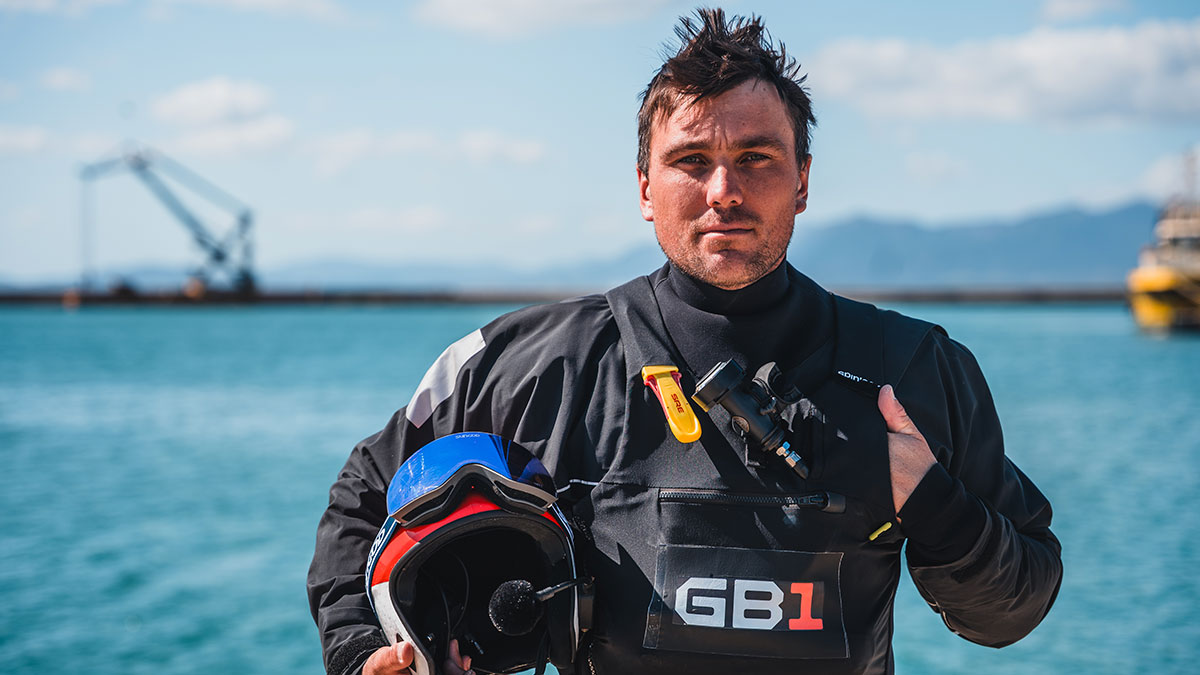
A lifelong dinghy sailor and former world No. 1 in the Finn class championships, Ben Cornish now represents Great Britain as co-skipper of GB1, the British America’s Cup team, and as a reserve sailor for the Emirates GBR SailGP Team.
The 38th edition of the America’s Cup, which will be held next year in Naples, marks his third campaign in the competition. With changes in boat design over the years, Cornish has shown that versatility pays off: he started out as a grinder, then moved on to using his leg strength as a cyclor, and finally made the leap to the helm.
During a rare break at his home in Devon, on the south coast of England, between training sessions for the America’s Cup and SailGP, Ben talked about his career so far, his preparations for Naples, and what it’s like to sail at speeds of up to 100 km/h.
Let’s go back to the beginning. How did you start sailing?
I grew up here on the river Exe, which is where I learned to sail aged seven. Initially I hated everything about it. The first time I went out on a boat I made them put me out on Exmouth beach and I walked about 2km back to the sailing club. I don’t know what changed but at the age of 10 I started sailing a small boat and it was the reverse of what I hated…it was the feeling of freedom, setting off from the shore and knowing you’re on your own to figure it out.
I was lucky that Exmouth sailing club was a hub of talent. We had a golden era of people who had made it to the Olympics and they were friends but also peers that I looked up to. Without those people there, it would never have even been on my agenda how far you could go in sailing.
You went on to win gold at the World Cup Final of the Finn – a singlehanded dinghy – in Santander in 2017. How did you start competing in the Finn class?
I progressed in the laser class at junior and youth level, and then went through the national team where I started to get OK results, nothing amazing. But then I got this opportunity to be training partner for [four-time Finn Cup winner] Giles Scott on the Finn.
I remember my coach putting this to me when all I was focusing on was how to make it in the laser. But the reality was I was probably too big for the laser and perfect size for the Finn. That was one of the biggest opportunities I could have had.
Ben Ainslie had just stepped away [the British champion sailor retired from Finn class sailing after the 2012 Olympics], so Giles was now top in the Finn and I got the chance to be his apprentice. We had such a strong working relationship, and he went on to win two Olympic golds in Rio and Tokyo.
It was announced during the Tokyo Olympic cycle that the Finn was being cut from future Olympic games, which must have been a shock. What did you do next?
It was quite a shame because I was on a good trajectory and my end goal was gone. But that was also the stepping stone to the America’s Cup. I’d already had an introduction to the British America’s Cup team and Ben was super welcoming in opening the door for me. The first campaign I joined with Ineos Britannia was in 2018, for the Cup in 2021.
What was your role on board in the America’s Cup?
I was there as a grinder [using arm-power to turn winches]. We had quite a big crew, probably 15 or 16 sailors, and there was a big emphasis on physical training, which I loved. Giles was the tactician during that campaign but he was still deeply involved with his Olympic cycle, so any periods where he wasn’t available I slotted in to cover him. But to my frustration I was also heavily involved in the simulator.
Why was that frustrating?
We were running the America’s Cup boat design through a series of tests. All I wanted to do was be out on the water and progressing in the role that I was there to do, but actually, in the bigger picture, it was amazing to be learning the helm role in the simulator from such an early point. In hindsight, I was learning a lot more than I would have been spinning my arms around as a grinder.
Then you switched to using pedal power, when cyclors were reintroduced to the America’s Cup boats ahead of Barcelona. How did you find that change?
The New Zealand team [defending champions of the America’s Cup] decided you could be more efficient and provide more power with the legs than the arms, so we brought in a lot of Olympic rowers to train them up.
It was hard work, though I benefitted from all the Finn training – it’s extremely dominated by the strength of the quads because you’re basically hanging off your legs all day.
Alongside that we had the AC40s – smaller versions of the America’s Cup foiling boats – and we would race each other in-house, with [British Olympic Gold medallist] Dylan Fletcher and me as co-helms. So I got the best of both worlds: I was in the trenches with the boys training as a cyclor, but then I’d get let loose to go racing.
It used to be that you had to get an Olympic medal to have a chance of competing in the America’s Cup, but it seems that there are now more pathways into the sport.
Yeah definitely, though I’d still class myself as an outlier as a helmsman. If you look across the helms in the America’s Cup and SailGP there are a lot of successful Olympians. On the broader side of things – trimming roles and other people involved in the Cup – there are far more avenues into it.
How have you found being at the helm with Dylan?
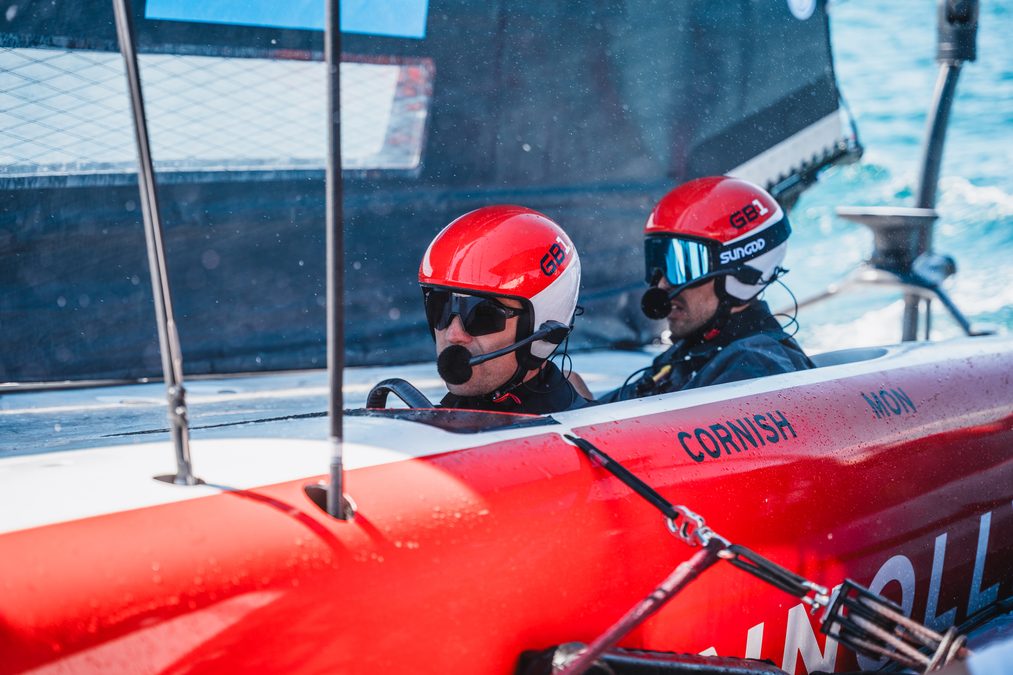
I’ve loved it. It’s been the most intense thing I’ve been involved in, but also the most enjoyable. I’ve always had what I refer to as a ‘goalkeeper role’; you’ve just got to do a good job but you don’t really get any praise until you get it wrong and then you certainly know about it. In the helm role you’re a bit more exposed.
How important do you think it is to be able to adapt to different positions?
If you’re an out-and-out positional player it’s not as important. If you asked Dylan, he certainly wouldn’t have it on his radar to be upskilling in how to become a trimmer. But for me and the development of my career, it has been important. I was always conscious that I’d entered the America’s Cup as a grinder but I didn’t want to get put in this bracket of ‘that’s Ben Cornish, yes, phenomenal grinder’.
Have you proactively pushed to do different things?
Yeah, and just putting your hand up when there are opportunities, making sure that you take them. I think back to some of the campaigns where it seemed tedious at the time doing 50 hours on the simulator a week. But without that you’re not the next person in line when somebody doesn’t turn up to work one day and they say, well, we know Ben can do it. So then you’re out helming and there’s your shot. Suddenly you do a good job of it and it’s like, why is he not a feasible option?
What do you think about recent changes to the rules and governance structure to the America’s Cup to modernise the 175-year-old tournament?
I think for the competition on the whole it will be really positive; shortening the cycles and having more events is what it needs. Something that excites me is the future of what a sailing boat is capable of. Growing up here and learning to sail I wouldn’t have even been able to imagine that these boats exist now. I hope the Cup can keep the development side rolling and keep pushing the technology as far as it’s possible.
How has it been switching between training for the America’s Cup and SailGP?
My roles complement each other. I work in the coaching booth at SailGP, which is like the pit wall in Formula One. We’re in live communication with the boats, so we talk to them as they race.
It means you’ve got this perfect bird’s eye view of how the race is unfolding and you can assist with the strategy and the decision making, which is often hard because the races are short, sharp and there’s high intensity on board. Then when I step onto the boat with that same group I know what communication works in that team.
It’s busy [training for both] and it does chop and change. In between I’m trying to get my handicap back down to single figures. That’s certainly my switch-off – golf, and making sure my garden’s recovered from the weeks that I’ve been away.
What is the coolest thing about sailing at this level that you’re at at the moment?
How capable the boats are, the speed and the efficiency of them. I still remind myself how lucky I am to be able to not only go out and sail on one of these things but to do it regularly and for a living. The direction that the racing’s heading and and the momentum of it all is amazing between SailGP and the Cup.
How does it actually feel to sail one of these boats?
There’s a lot of G-force, you know, through the corners. The boat’s got a lot of grip, it’s extremely smooth in most conditions – even if the sea’s rough you’re foiling above it so it’s a smooth ride, unless you crash and then it’s not.
You’re very aware of the speed. Every now and then you’ll clip the surface of the water and it sends a bit of spray into you, which reminds you how quick you’re going.
What excites you most about this next America’s Cup?
Each cycle that goes by with the same class of boat, we see teams get closer together in terms of performance. We left the last America’s Cup getting into the final and we have seen what the winning team is capable of. It feels like this time round that that gap is very bridgeable. In previous cycles, one team has been a long way ahead.
Beyond the Cup, what longer term dreams do you have?
I think the days of The Ocean Race when it was at its peak really appealed to me – it doesn’t so much now because they’re sailing on these semi-foiling things and I really liked the idea of the crew element, with everyone going through seriously hard miles together. It is still seriously hard, it’s just different. But maybe one day I might be tempted.