







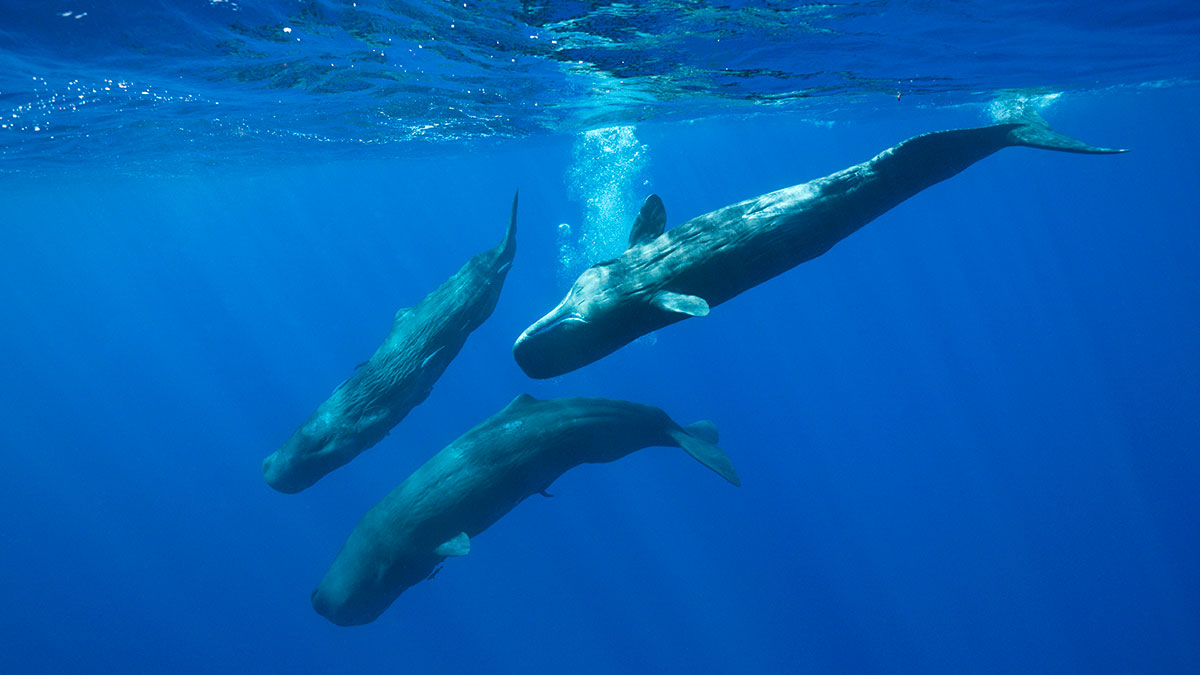
The waters north of Menorca once again confirm their importance for Mediterranean sperm whales. The latest campaign of the Moby Mummy project, led by the Tursiops Association, detected 48 sperm whales in the area this summer, of which about 20% are calves—the highest figure recorded to date in a research series that began in 2019.
The discovery took place between July 17 and 30, during a sailing expedition in which the researchers covered about 1,100 nautical miles. Throughout the expedition, they searched for and located the animals, photographed their tails and fins to individually identify each specimen, recorded their vocalizations—rhythmic patterns of between three and forty clicks that sperm whales use to communicate with one another— and captured aerial images that will help determine their nutritional status, possible pregnancies, and morphometric measurements.
In total, the team had eleven encounters with sperm whales: two of them were acoustic only—one with a group of five individuals and another with a pair—and the remaining nine were both visual and acoustic. Among the latter, there were three solitary males and six groups totaling 38 animals, nine of which were calves. The largest group consisted of seven sperm whales, three of which were calves.
“The fact that more than 20% of the animals found in groups are calves is excellent news,” said Txema Brotons, scientific director of the Tursiops Association, who emphasized that the data confirm that “northern Menorca is teeming with animals, teeming with groups, and teeming with calves”.
The project’s historical data supports this claim. The first observations indicating this area as a recurring breeding ground date back to 2019. During the 2021 campaign, about 20 sperm whales were counted; in 2022, despite initially poor weather conditions that were later overcome thanks to more favorable weather, the number doubled to 40 individuals—eight of which were calves— during an expedition aboard the sailboat Irifi. Among the Tursiops researchers participating was Menorcan marine biologist Aina Blanco, who noted at the time that “on half the days we were out at sea, we saw sperm whales.” In 2023, four groups totaling 36 sperm whales were tracked, nine of which were calves. The figure of 48 sperm whales recorded this summer thus consolidates an upward trend that, according to the researchers, confirms the robustness of the species’ presence in the area.
Northern Menorca is a region with low shipping traffic, far from the main maritime routes used by large vessels, making it a particularly vital area for the conservation of this Mediterranean subpopulation of sperm whales (Physeter macrocephalus), which is classified as Endangered and threatened primarily by collisions with ships, entanglement in fishing gear, pollution, underwater noise, and disturbances caused by boat traffic.
Tursiops, which has been researching the Mediterranean sperm whale population since 2003, requested that the Ministry for Ecological Transition establish a marine protected area north of Menorca to safeguard the area as the species’ primary breeding ground in the Western Mediterranean. Prime Minister Pedro Sánchez himself endorsed the creation of this protected area last summer—one of five announced during the United Nations Ocean Conference (UNOC3) held in Nice. In June 2025, the government confirmed that it would officially push for its designation, and the Ministry subsequently launched a preliminary public consultation to draft the corresponding royal decree.
Now that the area to be protected has been delineated, researchers are focusing on gathering as much information as possible about this essential and stable breeding habitat and on exploring the best management measures. “We’re going to focus our efforts on identifying the pressures and threats affecting the species so that, once the area is officially designated as a protected area, we can present an effective management plan and reduce the most significant impacts,” explains Brotons.
In addition to photo-identifying sperm whales, the team has studied their acoustic behavior to distinguish differences between pods and explore possible cultural differences compared to other populations, and has collected samples for environmental DNA analysis in collaboration with the University of Valencia.
Although the sperm whale was the main focus of the research, the expedition also yielded data on other cetaceans: five bottlenose dolphins (Tursiops truncatus), three groups of about 70 gray porpoises (Grampus griseus), and six groups of striped dolphins (Stenella coeruleoalba) totaling about 104 individuals, as well as more than twenty sea turtles (Caretta caretta)—a diversity that had already been noted during the 2022 campaign, with 41 additional sightings of species such as loggerhead sea turtles, manta rays, gray pilot whales, striped dolphins, and bottlenose dolphins, and even a Cuvier’s beaked whale and a fin whale.