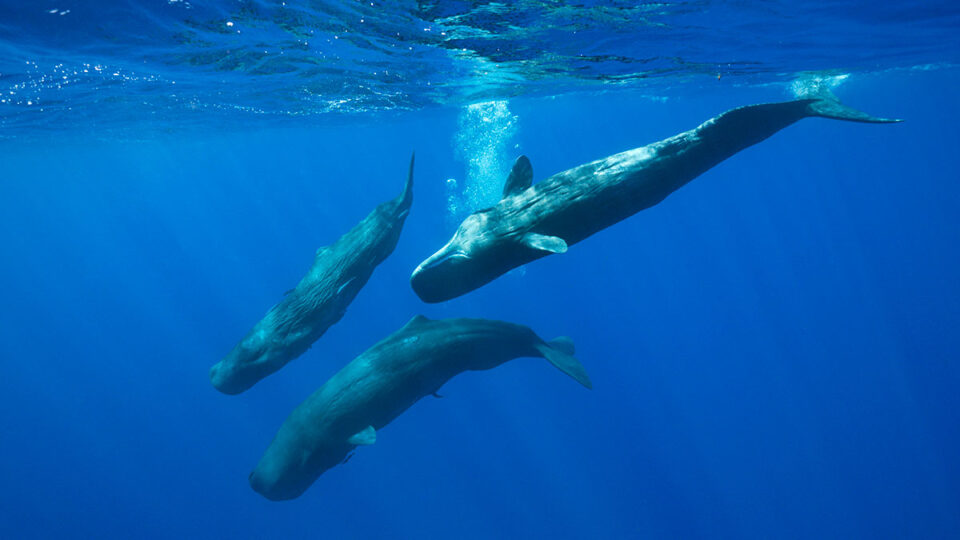








It’s called Project CETI (Cetacean Translation Initiative) and aims to decipher how sperm whales communicate. Founded in 2020 as a nonprofit organization, the initiative brings together eight institutions and about 50 scientists specializing in artificial intelligence, linguistics, cryptography, marine biology, and robotics. Its field of work is the waters off Dominica in the Caribbean.
Researchers have discovered that sperm whales communicate using series of short clicks called “codas,” which sound like Morse code to the human ear. After analyzing nearly 9,000 recordings, researchers have identified 156 distinct codas—sequences of between 3 and 40 clicks—which are considered the basic building blocks of their language. Small variations in these patterns could convey different information.
The team has expanded its analysis to include other species. In the spring of 2026, it published a study of 61 hours of orca recordings, in which it identified sounds equivalent to “vowels” and “consonants.”
A study published in the journal *Proceedings B*, led by linguist Gašper Beguš (University of California, Berkeley), goes a step further. According to the study, sperm whales distinguish vowels using short or long clicks and rising or falling tones, with patterns similar to those found in languages such as Mandarin, Latin, or Slovenian. The authors speak of “close parallels” with human phonetics and phonology, although these interpretations may still be subject to debate.
The Challenge of Listening Deeply
“We already have our first language models for sperm whales,” explains David Gruber, founder of Project CETI. For now, they perform very simple tasks, such as predicting diving behavior.
Recording data from an animal that dives to depths of more than a mile (about 1.6 kilometers) is a technical challenge. For every hour, sperm whales spend about 50 minutes submerged and only about 10 at the surface, and it is near the surface where they “chat,” with their heads close together.
To capture these conversations, engineers at Harvard’s John A. Paulson School of Engineering and Applied Sciences (SEAS) developed a bio-logger that is attached to the animal’s back using drones and suction cups inspired by the anatomy of suckerfish. It incorporates three synchronized hydrophones, GPS, and sensors for depth, temperature, light, and movement; it operates for up to 16 hours and can distinguish which whale is emitting each sound. Its design, published in PLOS One, is open source.
Gliders that follow whales
The latest addition is a type of aquatic drone: autonomous gliders, developed in collaboration with the French company Alseamar. They move by adjusting their buoyancy, with very low energy consumption and a silent motion that does not disturb the animals. According to Roee Diamant, the project’s underwater acoustics lead, they surface every few hours to transmit data via satellite.
The team has installed four sets of tetrahedral microphones on the front of the device, which allow it to calculate the direction of sounds. A proprietary system, the Backseat Driver, interprets the vocalizations and instructs the glider to follow the sperm whales without human intervention. The project can detect the animals from a distance of about 12 kilometers, depending on the type of vocalization.
Following initial tests in southern France, with signals transmitted from ships, the team deployed the device in Dominica for a mission lasting more than a week. During that time, it detected sounds from sperm whales 40% of the time it was submerged. Project CETI now has two gliders and aims to conduct missions lasting several months.
The amazing cooperation among sperm whales—is it the result of language?
Gruber explains that this species was chosen because it has the largest brain in the animal kingdom, lives in lifelong matrilineal groups, and emits signals that are easy for machines to process. The project also draws on two decades of data from the Dominica Sperm Whale Project. Among its achievements is the recording of a calf’s birth with the assistance of other group members—something that had not previously been documented outside of primates and humans.
The team estimates that within five years, the system could understand 20 vocal expressions related to actions such as diving or sleeping. Gruber compares the current state of the technology to that of a one- or two-year-old child and is confident it will reach the level of a five-year-old. He acknowledges that deciphering the entire language is a longer-term goal.
The project highlights the ethical limits of its work. Listening must not become a mechanism of control, and the interests of animals must take precedence over those of humans. This is especially important for a species of which there are now about 200,000 remaining, compared to the approximately 1.2 million that existed before industrial hunting began.
The project director also advocates for the positive use of technology. “This democratizes and opens up the field of marine science,” he says of the biorecorder’s open-source code. In the long term, understanding cetaceans could even serve as a basis for giving them a voice in the legal sphere.