







Summer 2026: a busy time for Spain’s merchant marine. Between the islands, from the mainland, in the Alboran Sea, or in the Strait: the summer season drives traffic up every year. However, what has truly changed in recent months is not the volume, but the maritime landscape. Mergers, acquisitions, new ships, and vessels changing hands: the Spanish shipping landscape has been shifting for months at a pace not seen in recent memory.
In the mainland-Balearic Islands sector, this restructuring involves three key players. On one hand, there is Baleària, which is experiencing the greatest expansion in its history after acquiring the business of Armas Trasmediterránea in the Canary Islands, the Strait, and the Alborán Sea—a move that has given the CNMC a headache, brought the Danish group DFDS into the mix, and forced the Denia-based shipping company to break its alliance with Fred Olsen on the mainland-Canary Islands route via Huelva. On the other hand, there is GNV, a subsidiary of the giant MSC, which is exerting ever-greater pressure from Spanish ports. The Italian company closed out 2025 with a 12% increase in volume, and its Valencia-Balearic Islands routes are operating at near-capacity season after season.
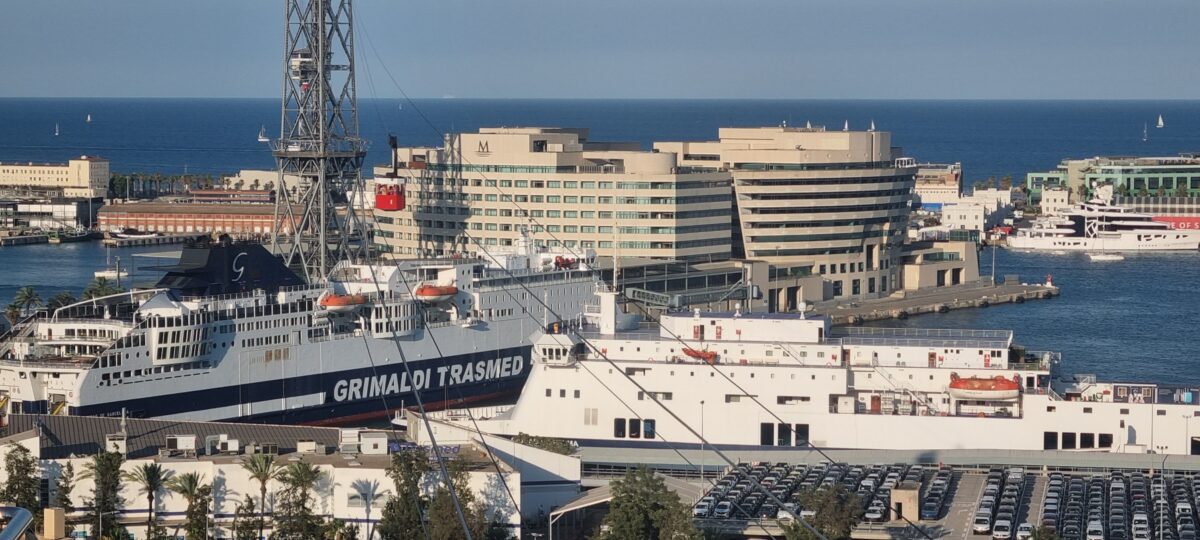
There’s a third company that’s talked about a little less, although it’s taking a not-insignificant slice of the Balearic Islands–mainland or mainland–Balearic Islands market, depending on the customer’s perspective. It is backed by a family name that has been linked to the sea for decades: Grimaldi. That third company is Trasmed. And its name, like almost everything in this story, is no coincidence.
A move Grimaldi had been waiting for for some time
Trasmed got its name because—with all due respect—it did to the Balearic market of Trasmediterránea what Baleària has just done to Armas-Trasmediterránea in the Canary Islands: it took over the part of the business that interested it. Ibiza, Mahón, Palma, and Alcudia—as well as Barcelona and Valencia—had been on the Italian group’s radar for years, as it sought to gain a firm foothold in the Balearic corridor. It succeeded in 2021, when it purchased the fleet and routes from the old Trasmediterránea, a shipping company that had been operating on those routes since 1917.
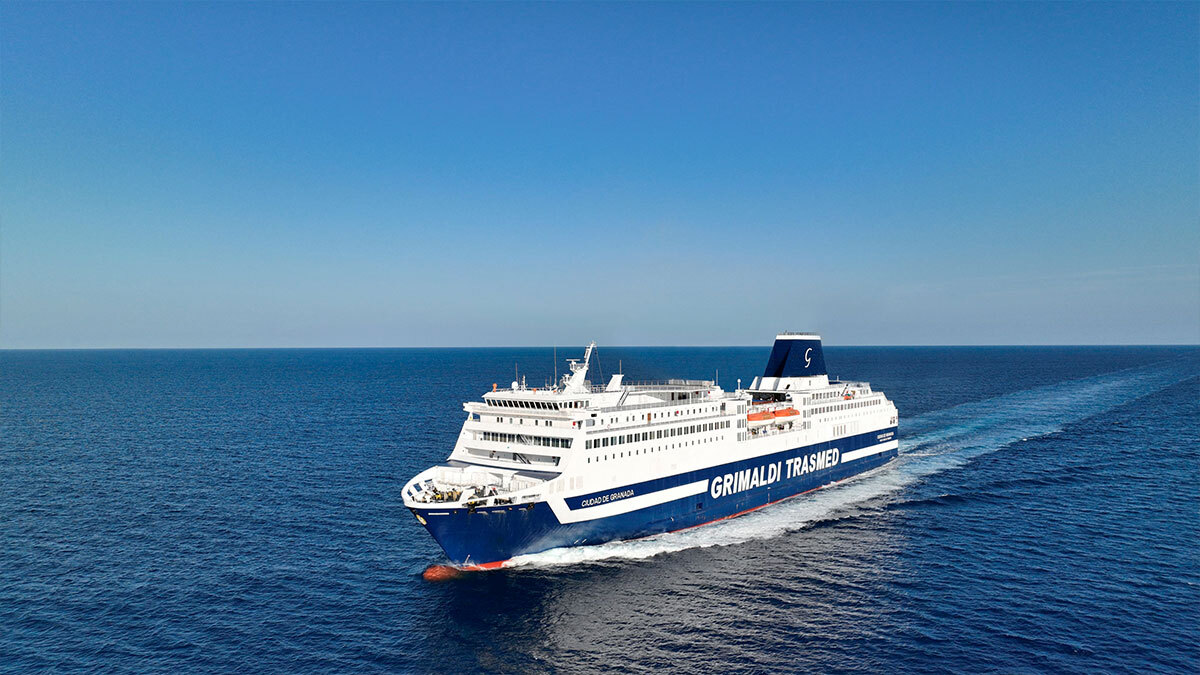
That “Grimaldi” heritage is even evident in the hull’s paint scheme. Except for the Gubal Trader (a chartered cargo ship, orange like the butane it often carries), the entire Trasmed fleet sports the corporate navy blue of its siblings (or cousins) from other Grimaldi subsidiaries.
These Spanish-flagged ships also have their own history; almost none of them started out as what we see today docked at their usual moorings. The Ciudad de Barcelona was once the Volcán del Teide, operated by Naviera Armas in the Canary Islands. The Ciudad de Granada was once the Sorolla, one of the flagship vessels of the former Trasmediterránea. The Ciudad de Sóller had a Greek name: it was called the Igoumenitsa while sailing for Grimaldi in the Adriatic, although it is actually a very Spanish ship—it was built in the shipyards of Cádiz. And the Ciudad de Palma is now the fifth ship to bear that name in more than eighty years of shipping tradition, although the current vessel has had a particularly eventful history: it arrived in the Balearic Islands as the Dimonios, having previously sailed as the Borja Dos, T Rex Uno, and once again as the Dimonios for GNV and Tirrenia, between Genoa, Sicily, and Sardinia, before finally settling on the Balearic route. Historical maritime curiosities.
The market is undergoing a shake-up; Trasmed is taking a different approach
It’s no coincidence that Trasmed is celebrating its fifth anniversary at a time when the sector is booming. While Baleària is growing through acquisitions and GNV is renewing its fleet with LNG-powered ships, Trasmed has chosen a third path (never has the expression been more apt): carving out its own niche based on its product and a unique market segment.
That gap begins by making the crossing part of the trip, not just a necessary step to reach your destination: swimming pools, a gym, an à la carte restaurant, and free Wi-Fi from port to port. In addition, there’s a very notable initiative: they’ve gone all out to be pet-friendly, with certification from the FAADA Foundation—cabins where you can travel with up to two dogs or cats, kennels with video monitoring via your phone, an outdoor Pet Garden, and even a café and restaurant where pets are welcome. Nearly 30,000 pets crossed the sea with Trasmed in 2025. Anyone with pets in their family appreciates this.

On the other hand, there’s the less glamorous—though more strategic—side of the business: the hazardous cargo carried by the Gubal Trader, which is dedicated exclusively to transporting the supplies the islands cannot do without a single day of the year (butane, oxygen, chlorine, hospital supplies). It’s a service that doesn’t show up in vacation photos, yet it explains why a shipping company “that’s talked about less” carries more weight than it seems: the islands are about more than just tourism.
The figures that support the thesis
That positioning (a product for traffic on the upper decks, essential logistics in the parking garages) has translated into solid numbers. In 2025, Trasmed posted a positive EBITDA of 21.5 million euros, improved its earnings by more than 70%, and reported revenue of 165.4 million, up 9.4% from the previous year, while reducing its debt by 66% with the goal of becoming debt-free by 2027. More than 700,000 passengers and 339,394 units of cargo passed through its lines, with Barcelona alone accounting for more than 363,000 passengers.
For Ettore Morace, CEO of the shipping company, 2025 was “a year of consolidation”—a notable development in an industry where the imbalance between supply and demand remains the norm rather than the exception.
On the environmental front, the company highlights in its press releases that it will reduce CO₂ emissions by 22,800 metric tons between 2024 and 2025 (equivalent to taking 5,000 cars off the road) and, starting in March 2025, the Ciudad de Palma will connect to the Port of Barcelona’s power grid at every port of call. The next milestone is to earn its first Lean & Green star, scheduled for 2027.
A small piece of a very large board
Behind all of this is the Grimaldi Group: 130 ships in 150 ports across 50 countries and an ongoing investment of more than 1.3 billion euros for nine methanol-powered ferries that will be delivered between 2028 and 2030. In Spain, this is already evident in Barcelona, where the group is consolidating terminals and topping a vehicle storage facility with solar panels, and in Valencia, its logistics hub in the Mediterranean.
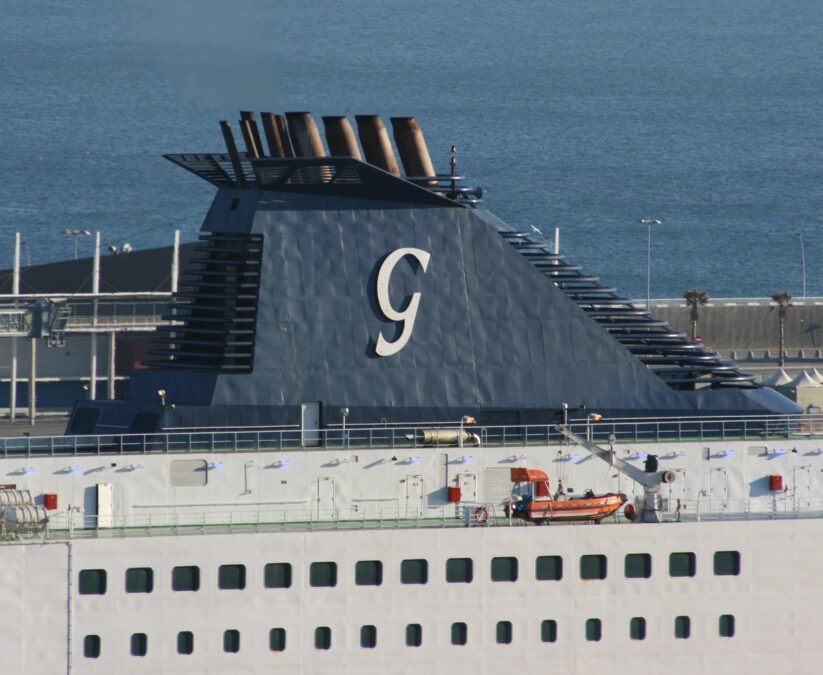
So there you have it: while two giants battle it out with mergers and new fleets, the third contender has decided to gain ground without making headlines, with ships that have lived half a dozen lives before arriving in the Balearic Islands. And perhaps that’s precisely it—the shipping company that doesn’t make a fuss, yet never misses a beat—is the most intriguing part of this whole story.