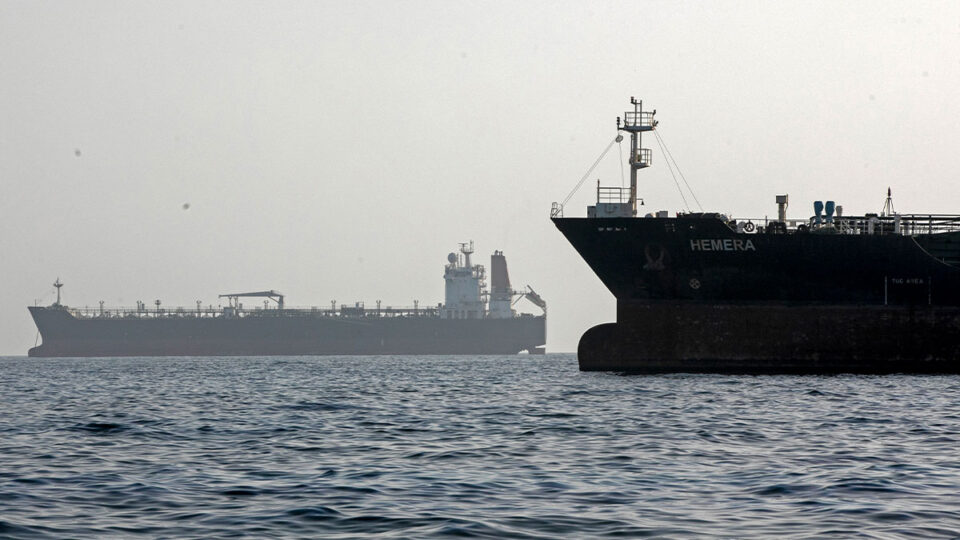








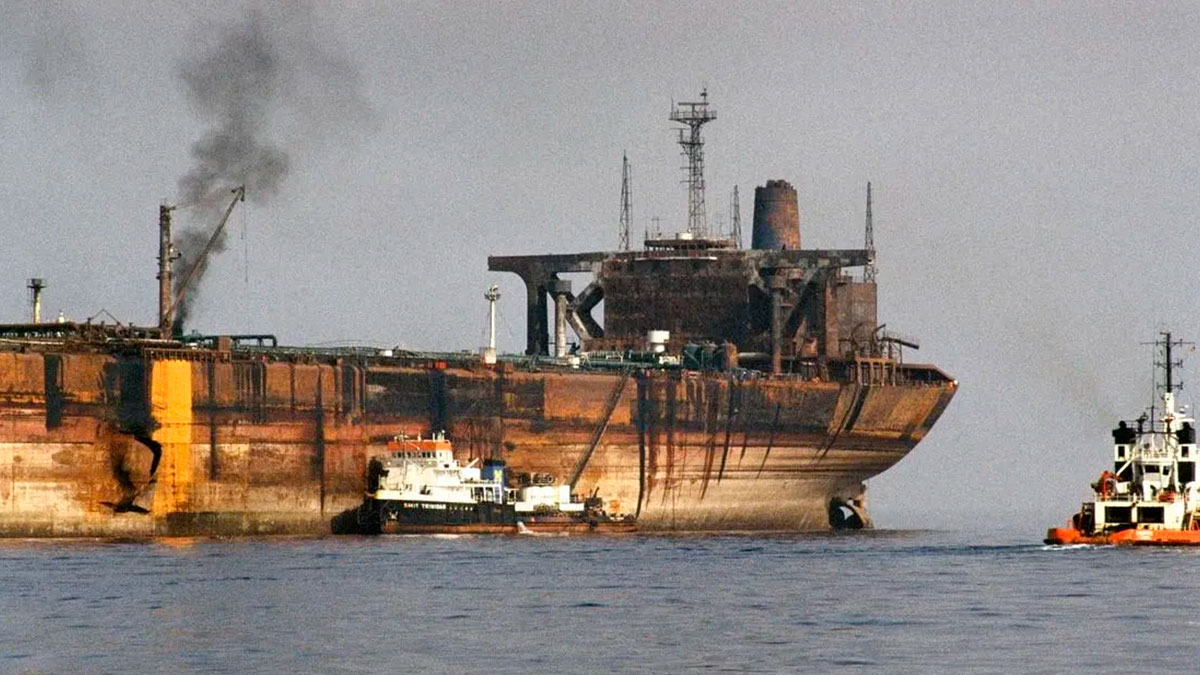
Central Asia wants to become the world’s alternative route to bypass the Strait of Hormuz and Russia. Kazakhstan’s oil has two routes to the world, and both are under attack. Most of it flows through Russia to the port of Novorossiysk on the Black Sea. In July, several drones repeatedly attacked oil tankers loading there, and shipments were halted on several occasions. Russia blamed Ukraine, and Kazakhstan—whose crude oil was on board—demanded that the attacks cease.
The other route runs southward, through Iran and the Persian Gulf. That route has been largely closed off since the United States and Israel went to war with Iran on February 28.
This week has been worse. Two cargo ships operated from the United Arab Emirates sank near the Strait of Hormuz after being hit by projectiles. PortWatch, part of the IMF, recorded two ships transiting the strait on October 11, compared to approximately 85 per day before the war.
Brent, the global benchmark crude oil, traded this week at around $105 per barrel (about 92 euros), roughly 45% above its pre-war closing price of $72.48 (about 63 euros)
The pressure has revived an old idea: oil and gas pipelines across the Caspian Sea bed. The three countries that would build them—Kazakhstan, Turkmenistan, and Azerbaijan—want to transport oil and gas from Central Asia to Europe without passing through Russia or the Persian Gulf. The route is short, and most of the infrastructure already exists. What’s missing is funding and an agreement on the seabed. This is not a shift toward the West, but rather a risk-mitigation strategy that gives the three countries bargaining power. I call it strategic pluralism: maintaining ties with several major powers at the same time so that no single buyer or transit country can impose its conditions.
Oil pipelines across the Caspian Sea would complete “a new Silk Road for molecules,” wrote Simon Flowers, president and chief analyst at the energy consulting firm Wood Mackenzie, last week.
How the route would work

Let’s take
a moment to look at the geography. Kazakhstan pumps about 2.2 million barrels per day of oil and associated liquids. More than 1.5 million barrels per day of that total flow through the Caspian Pipeline Consortium (CPC) pipeline across Russia to Novorossiysk. Across the sea, Turkmenistan has the world’s fourth-largest natural gas reserves, but it has only one customer: China.
Just to the west, on the opposite shore of the Caspian Sea, lies Azerbaijan. It has already built oil pipelines through Georgia and Turkey: one carries oil to the Turkish Mediterranean coast, and the other transports gas to Europe. The pipeline can move 1.2 million barrels per day and, according to Wood Mackenzie, is operating well below capacity. What Kazakhstan and Turkmenistan lack is a way to reach them.
Both infrastructure projects start from the coast near Baku, in Azerbaijan. Kazakhstan and Turkmenistan are on the eastern shore, and no pipeline crosses the sea that separates them. Today, oil tankers carry only a trickle of Kazakh crude, and gas cannot be transported by ship.
The missing piece is about 300 kilometers of undersea pipeline from Turkmenistan to Azerbaijan for gas, as well as an oil pipeline from Kazakhstan. From Baku, oil and gas from Central Asia could reach Turkey and Europe without passing through Russia or the Strait of Hormuz.
The seabed itself could also carry clean electricity. Azerbaijan, Kazakhstan, and Uzbekistan are exploring the possibility of an undersea cable to transmit renewable energy from Central Asia to Europe, and Siemens Energy joined the effort this month.
The biggest change is taking place in Turkmenistan, which has long been reluctant to participate. This month, Myrat Archayev, vice president of the state-owned gas company Turkmengaz, told the regional news outlet Eurasianet that the government now considers the gas pipeline a priority and welcomes Western investment. On October 8, the presidents of Turkmenistan and Azerbaijan met and discussed the Caspian Sea.
Why would Turkmenistan care, if China already buys its gas? Because China absorbs only a fraction of what Turkmenistan could sell. It buys about 34 billion cubic meters a year, and talks to purchase more have made little progress, according to Wood Mackenzie. Furthermore, a single customer holds all the bargaining power when it comes to price. With gas accounting for up to a third of Turkmenistan’s economy, a second buyer matters. That said, Turkmenistan will continue to sell to China, just as Kazakhstan will continue to ship most of its oil through Russia.
The Problem with Money
Who will pay? No one has committed yet, and the reasons are more commercial than political. Before investing billions in an undersea gas pipeline, investors need three things: a buyer, a clear legal right to build, and a supplier they can count on. Europe has not offered long-term contracts. Russia and Iran are disputing the legal right, and the boundary line on the seabed between Turkmenistan and Azerbaijan has not been drawn. And Turkmenistan has never guaranteed the gas to fill the pipeline. The European Union has supported the idea on paper for years, but has never paid to build it.
Washington supports the project—in words, if not yet with dollars. After meeting with the Turkmen foreign minister this spring, Secretary of State Marco Rubio expressed his strong support for transporting gas from Turkmenistan westward across the Caspian Sea. The U.S. International Development Finance Corporation (DFC) is studying port and logistics projects in the Caspian region, in Kazakhstan.
Skeptics have history on their side. This gas pipeline has been on the verge of being built for decades. Russia and Iran maintain that any project on the seabed requires the approval of the five coastal states: Russia, Iran, Kazakhstan, Turkmenistan, and Azerbaijan. And the Carnegie Endowment warned in June that all export routes from Central Asia now run close to a war zone.
Why It Might Be Different This Time

Even so, the old objections are losing ground. Turkmenistan, once reluctant, now considers the gas pipeline a priority. The Russian route through Kazakhstan has proven unreliable. Europe has already suffered two disruptions to its energy supply in four years: Russian gas in 2022 and shipments from the Gulf in 2026. And a 300-kilometer gas pipeline doesn’t require peace across all of Eurasia. It just needs Turkmenistan and Azerbaijan to agree on where one country’s seabed ends and the other’s begins. Archayev, from Turkmenistan, says those talks are underway.
The Caspian states are turning geography into influence. Kazakhstan gains an outlet that bypasses Russia, Turkmenistan gains a customer in addition to China, and Azerbaijan collects transit fees. Europe, for its part, obtains oil and gas that never pass through the Strait of Hormuz or the Black Sea (and Washington weakens both Russia and Iran).
Next week brings a double test. On Monday, Rubio and more than 200 American business leaders will meet with Central Asian leaders in Samarkand (Uzbekistan). On Wednesday, Turkmenistan will kick off its annual oil and gas forum in its capital, hoping to attract Western investors. The question is whether anyone will bring their checkbook.
“The Trans-Caspian pipeline is very important,” Archayev told Eurasianet. For 30 years, that was a diplomatic courtesy. A closed strait and a Black Sea terminal under drone attack have turned it into a compelling business case.