






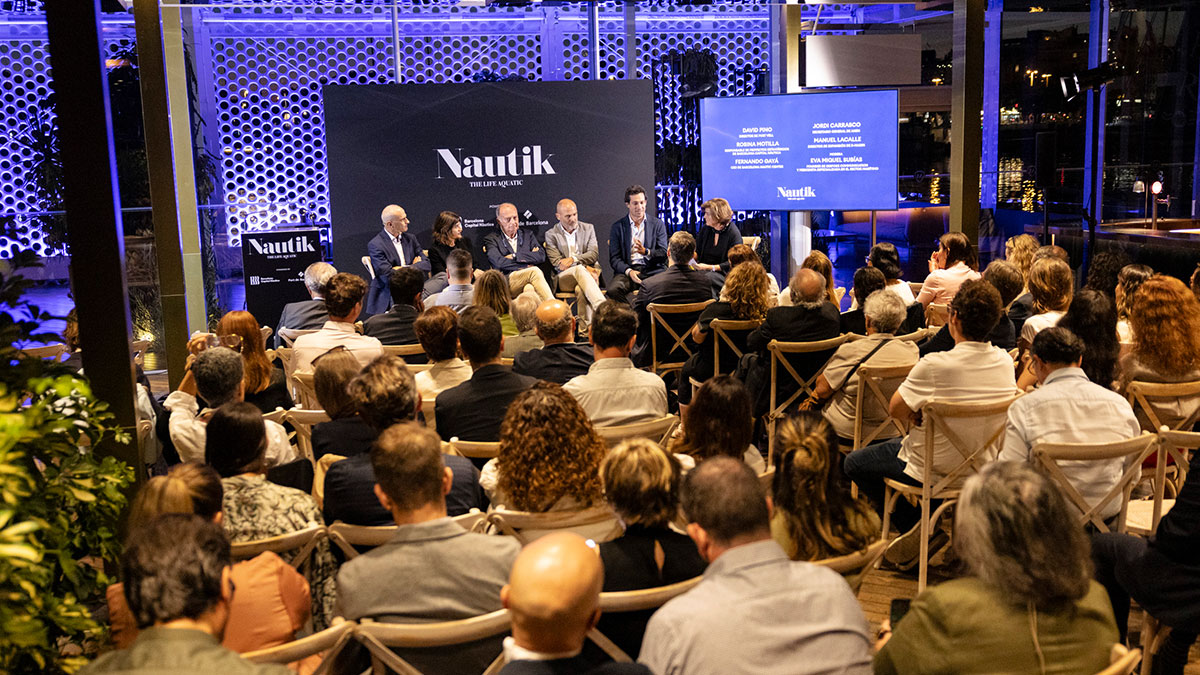
Barcelona is counting down the hours until the opening of the International Boat Show, and Marina Port Vell served as the industry’s gathering place this afternoon. The Sea Garden hosted “Nautik | Rumbo al Futuro,” a Nautik event designed as a space for discussion, networking, and planning the strategic development of the maritime and nautical sectors, organized in collaboration with Barcelona Capital Nàutica, PLAYTHEGAME Agency, and the Port of Barcelona.
After host and moderator Eva Miquel Subías (founder of Bespoke Communication and a journalist specializing in the maritime sector) thanked the attendees for coming, Andrés Rodríguez, president of SpainMedia and editor and director of Nautik, addressed the audience. Although he was unable to attend in person, he participated via video. In the video, he explained that the magazine was born out of the conviction that there is “a large community of people who love the sea” (many of whom also make their living from it) and out of a desire to bring them together.
The sea is a passion, but it is also an economic driver
Rodríguez argued that the country cannot be understood without its coastline: “Without the sea, it is impossible to understand our main industry—tourism—and even our own identity.” He concluded with a pledge: to help that community grow and to remember that “the sea unites us all, and, I hope, so does this magazine.”
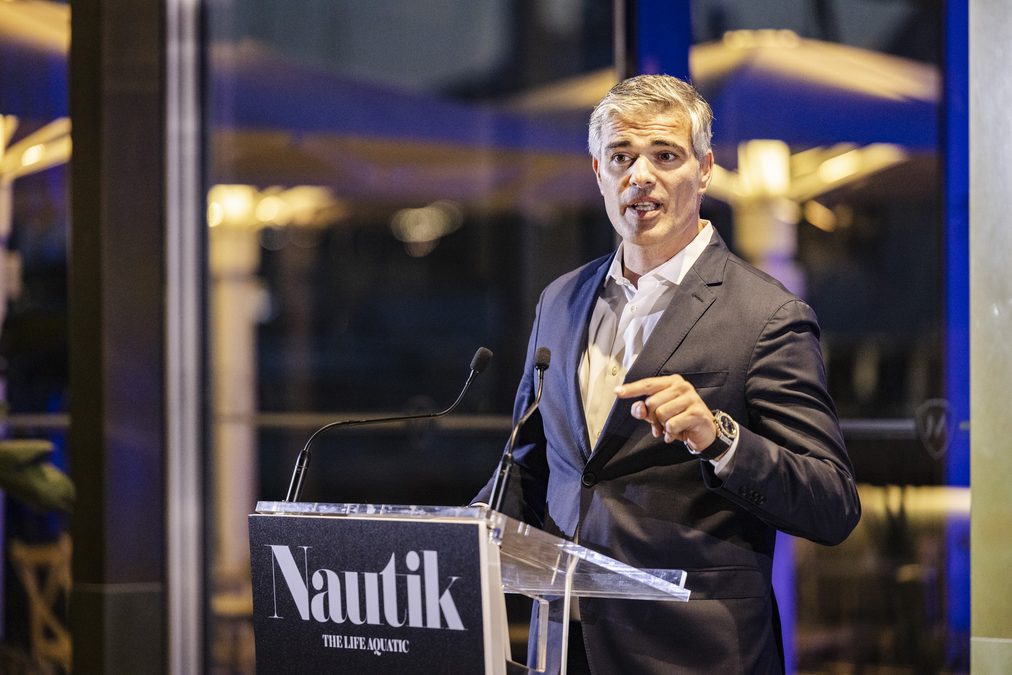
The official welcome was delivered by Cristiano Badoch, CEO of SpainMedia, who highlighted the strong performance of the Spanish market. Between January and September, 4,642 recreational boats were registered, a 7% increase over last year. Motorboats, which already account for more than 40% of the market, are up 16%.
The Impact of the Ocean on Our Economy
For Badoch, these figures reflect “a dynamic sector that is also undergoing a major transformation.” “Today, when we talk about boating, we’re talking about much more than just boats. We’re talking about industry, innovation, technology, tourism, design, jobs, and new ways to enjoy the sea,” he said.
Our CEO highlighted Barcelona’s blue economy, which generates more than 15,000 jobs and approximately 4,000 million euros in revenue. From there, he outlined the challenges facing the sector: “How do we make this ecosystem increasingly competitive? How do we better connect ports, marinas, industry, innovation, and the city?” He added a third question: how to leverage new technologies to build the future of the boating industry.
Badoch also pointed to another phenomenon: the ocean has become a central part of many brands’ strategies, as they incorporate it into the way they communicate, design, and create experiences for consumers who “are looking for more than just a product.”
Five Voices from the Boating Community
This was followed by a panel discussion titled “Toward a Competitive Nautical Ecosystem: Marinas, Supporting Industries, Innovation, and Port-City Integration.” Moderated by Miquel, the panel featured David Pino, director of Port Vell; Fernando Gayá, CEO of Barcelona Nautic Center; Jordi Carrasco, secretary general of ANEN; Manuel Lacalle, director of Expansion at D-Marin; and Rosina Motilla, Head of Strategic Projects at Barcelona Capital Nàutica.
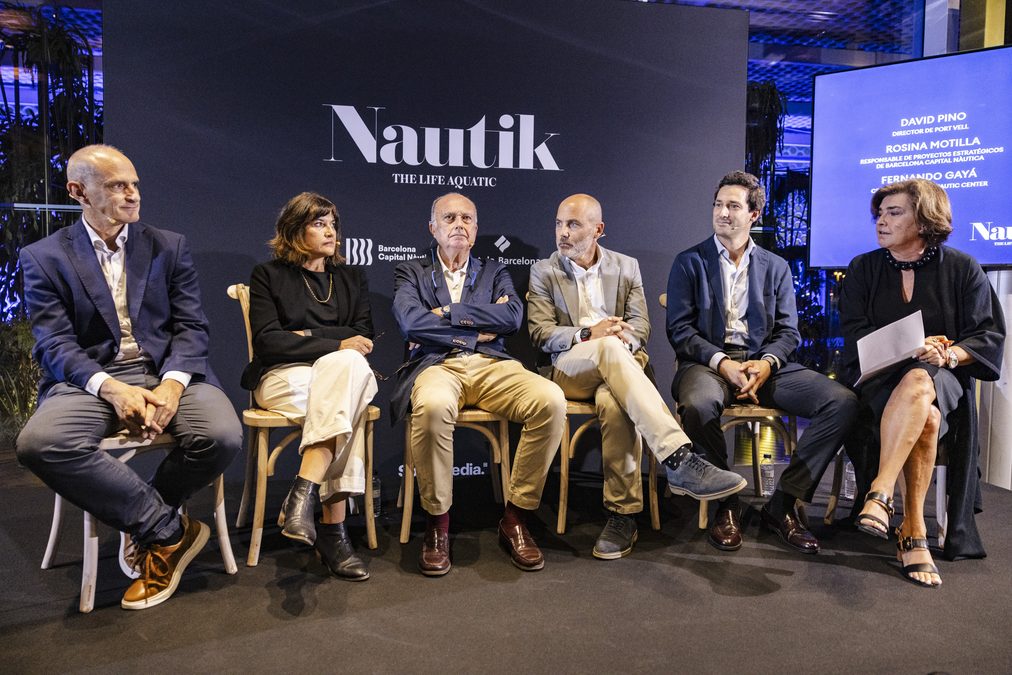
David Pino began by echoing Andrés Rodríguez, noting that “we all love the sea,” and Cristiano Badoch, highlighting the economic impact of the sea: “About 10,000 people work in Port Vell, and we have 25,000 visitors. This generates 1.6 billion directly and 2.2 billion indirectly, according to a 2023 study. On the social front, the challenge is to integrate the nautical sector into our community. How? By creating businesses and through training.” Pino also recalled that “Port Vell began during the Olympic era, when it was realized that heavy port activity had to be moved south and this part left to the city.”
Rosina Motilla also elaborated on the relationship between Barcelona and the sea: “We are the link between the competition and the city. This public-private partnership is complex, but it allows us to carry out many projects.”
The head of Strategic Projects at Barcelona Capital Nàutica explained that the organization had conducted a study to map out the recreational sector and identify the challenges: “Based on this study, we have drawn up an action plan—a project developed in collaboration with the sector and all levels of government—since our ambition is to scale up to other levels; that is, to remain relevant in recreational boating while also moving toward the commercial sector.”
For his part, Jordi Carrasco noted that, while “Spain is already competitive in recreational boating, to be truly competitive we need infrastructure, and that’s where we face a barrier. There are certain bodies of water where recreational boating can play a leading role.” Carrasco explained that “at the National Association of Nautical Companies, we are conducting an economic impact study to quantify the value generated by recreational boating.” He also noted that “in any town with a marina, it functions like an industrial park and has a multiplier effect, creating direct jobs not only related to mooring or spending but also to the boats themselves, which require maintenance and repairs.”
Manuel Lacalle also focused on employment. As he explained, “One very striking reality we’ve observed is that the greatest indicator of a marina’s success is the service provided by its employees. No matter how much you invest in large facilities, what customers value most is being greeted by a smiling marina employee and feeling cared for and comfortable.” He also noted that “we try to promote mobility among marinas: we have plenty of marinas to encourage this.”
Fernando Gayá also spoke about employment, stating that “one of our main concerns is having the workforce and the companies we need to subcontract in order to succeed. Today, this is one of our main challenges. It is a challenge to promote and encourage the hiring of young people in these professions.”
“Our sector has undergone significant growth in tandem with and as a result of the expansion of recreational boat fleets,” Gayá continued. “We play an important role because we are part of a whole system that ensures boats are in good condition during the summer and peak season and that their owners experience as few problems as possible,” he continued.
Badoch summed up the spirit of the event with a question: “Where is the boating industry headed?” Nautik and Forbes Spain achieved their goal: for the event to be, as Badoch put it, “a gathering place to hear from those within the industry, those who are innovating, and those who make decisions about the future.” The evening concluded with a cocktail reception.