







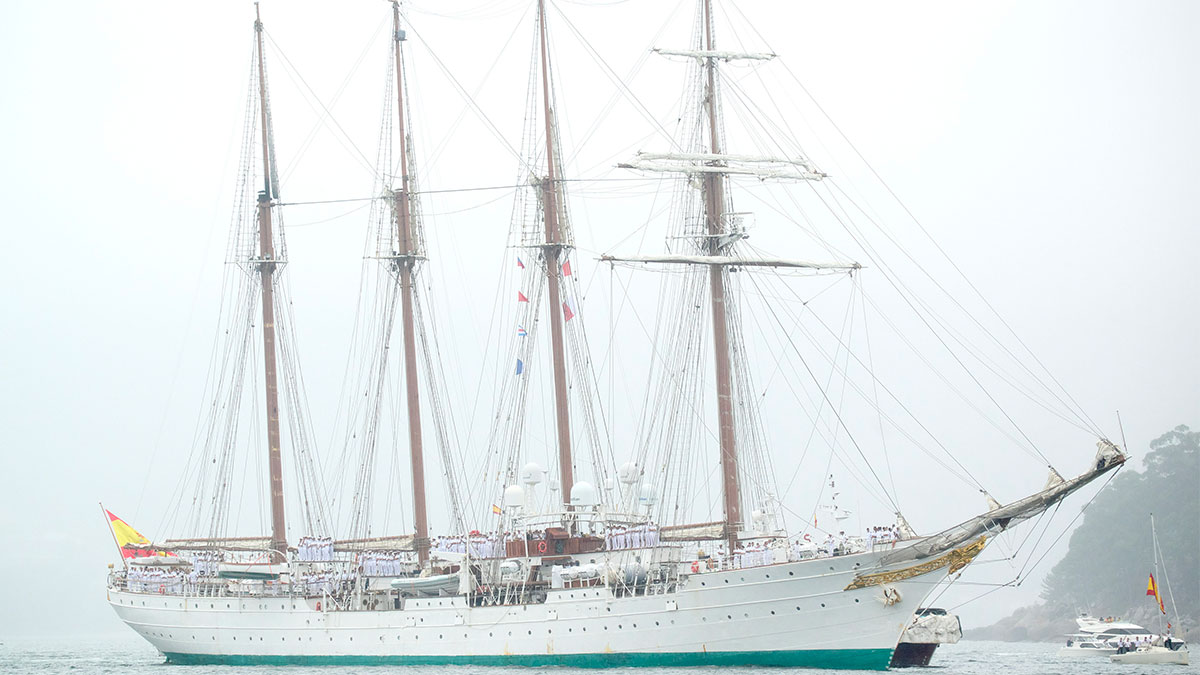
The Juan Sebastián de Elcano will celebrate its 100th anniversary in 2027, and the Navy has planned a celebration for the occasion befitting one of Spain’s most recognizable ships. It will not be a single ceremony or an event concentrated on one date: the centennial will span 2027 and 2028, will have a strong international dimension, and will combine navigation, training, culture, diplomacy, and activities open to the public. Under the slogan “A Century Sailing Toward the Future,” the official program will be presided over by King Felipe VI, and its main highlights will be two extraordinary training cruises: the 99th “Hispanoamérica 2027” Training Cruise and, subsequently, the 100th Training Cruise, which will include another round-the-world voyage.
The choice of date is no coincidence. March 5, 2027, will mark exactly one hundred years since the ship was launched in Cádiz. On that day, the Elcano will be in El Callao, Peru, participating in the international tall ship regatta Velas Latinoamérica. It will be one of the first major highlights of a celebration designed to ensure that the ship itself is, quite simply, the star of the show.
Two cruises and a trip around the world
The program will begin in January 2027 with the departure from Cádiz of the 99th Training Cruise, which will take the ship through the waters of Latin America. One of the highlights of the voyage will take place on March 5, coinciding with the anniversary of the ship’s launch and the Elcano’s presence in El Callao. The voyage will then continue toward Spain, and among the announced ports of call are A Coruña, Lisbon, and Cádiz, where the celebration will take on special significance.
The city of Cádiz will be one of the main venues for the centennial celebrations. An extensive program of cultural and sporting events is planned for June 2027, along with the installation of a monument dedicated to Minerva, the figure that presides over the ship’s figurehead. Cádiz will thus once again take center stage in a story that began a century ago in its shipyards and made the city the natural home of the Navy’s training ship.
But that will be just the first major chapter. In September 2027, the Elcano will set sail once again to begin its 100th training cruise—a milestone that will hold special significance because the voyage will include a trip around the world. The cruise will last until June 2028 and will take the ship to some of the locations that are part of its history. Among the planned stops is Málaga in October 2027, a city linked to the ship’s first training voyage in 1928.
The return to Cádiz is scheduled for June 2028, and it will be then that the city where the ship was built will once again become the setting for one of the centennial’s most memorable events: a commemorative naval parade. The program will then continue in Pasajes, where the celebration will coincide with the presentation of the ship’s first Battle Flag, and will conclude at the Naval Military Academy in Marín on July 16, 2028. The official centennial documentary is also scheduled to premiere in September of that year. In total, more than a year and a half of activities centered on a ship that, precisely because of its nature, could not celebrate its hundredth anniversary while remaining moored.
Cádiz, the epicenter of the centennial
If there is one city that can be considered the home of the Elcano, it is Cádiz. The ship was built at the Echevarrieta and Larrinaga shipyards in the Bay of Cádiz. That is where its keel was laid, where it was launched, and from where it began a journey that would eventually take it across virtually every major ocean on the planet. That is why Cádiz will play a central role during the anniversary celebrations, with cultural and sporting events, activities related to maritime heritage, and various initiatives designed to bring the ship closer to the public.
The installation of a monument dedicated to Minerva will be one of the permanent features of the celebration. This is not the first time that the relationship between the city and the ship has been symbolized in this way. In January 2025, the Navy unveiled the new location in Cádiz for one of the ship’s historic artifacts: its former mizzenmast.
The scope of the celebration extends beyond the Navy. The centennial has been declared an Event of Exceptional Public Interest, a designation that allows for the development of a specific program of corporate collaboration and sponsorship and recognizes the historical, cultural, and international significance of the anniversary. King Felipe VI also serves as honorary president of the commemorative program.
The Crown’s connection to the ship dates back practically to its earliest years. Alfonso XIII was present during the ship’s first moments of operational service, and subsequently, members of different generations of the Royal Family have sailed aboard it. This connection took on a new dimension with Princess Leonor’s military training, as she completed her shipboard training on the training ship. Five generations of the Royal Family have sailed on the Elcano, according to official documentation from the centennial commission.
A Century of Training Sailors
The celebration, however, has a purpose that goes far beyond simply commemorating the past. The Juan Sebastián de Elcano remains a training ship, and its primary mission continues to be the training of future Navy officers. On every cruise, its decks become a classroom on the move. Midshipmen study navigation, meteorology, astronomy, maneuvering, and other disciplines, but they also learn something that is difficult to replicate on land: living together for months at sea, taking on responsibilities, working as a team, and making decisions in a constantly changing environment.
That characteristic accounts for much of the ship’s extraordinary longevity. Other large sailing ships built during the first half of the 20th century ended up as museum pieces. The Elcano, on the other hand, continues to serve the purpose for which it was built. That combination of historical heritage and full operational activity is precisely one of the elements that makes its centennial so exceptional.
A Spanish Ambassador Under Sail
Over the course of a century, the Elcano has fulfilled a second, equally important mission: representing Spain abroad. Every international port of call turns the ship into a sort of floating embassy. Its silhouette, its four masts, the Spanish flag, and its status as a historic tall ship make it recognizable long before the crew sets foot on land.
In this case, naval diplomacy takes on a particularly visual dimension. The Elcano arrives at a foreign port, welcomes officials and visitors, participates in institutional and cultural events, and opens its decks to citizens who, in many cases, are experiencing their first direct contact with Spain at that moment. For decades, this role has made the ship one of the Navy’s most effective tools for international outreach and, by extension, for promoting Spain’s image.
From Cádiz to the World
The story officially began on March 5, 1927, when the ship was launched in Cádiz. Its construction was driven by the need for a new training ship to train Navy officers, and it was designed by British engineer Charles V. Nicholson. The result was a four-masted brigantine-schooner that would go on to become one of the great icons of Spanish sailing.
The choice of name also carried a message. Juan Sebastián de Elcano was the sailor who completed the first circumnavigation of the globe following the death of Fernando de Magallanes in 1521. The name thus linked the new ship to one of the greatest feats in Spanish seafaring. The ship entered service in 1928 and embarked on its first training cruise that same year. Shortly thereafter, it would make its first circumnavigation of the globe.
Between 1928 and 1929, he sailed 32,282 nautical miles on 172 voyages, crossing the Panama Canal for the first time. It was the beginning of a relationship with the oceans that would last for a hundred years.
More than two million miles
The numbers help put the story into perspective. Throughout its history, the ship has logged more than two million nautical miles, visited hundreds of ports, and sailed through dozens of countries. But perhaps the most significant figure is another: generations of Spanish sailors have learned to sail on its decks.
It has survived political, technological, and social changes that radically transformed the world into which it was born. When it was launched, commercial aviation was just beginning to take off, satellites did not exist, the Internet was unimaginable, and today’s electronic navigation systems were the stuff of science fiction.
That is one of the key aspects of this centennial. The Juan Sebastián de Elcano is not merely a symbol of naval technology from a bygone era. It has also become a showcase for the evolution of Spain’s maritime sector. Companies and organizations linked to the shipbuilding industry, technology, and innovation are participating in the celebration.
Among them is Marine Instruments, a Spanish company specializing in maritime surveillance technologies and dual-use systems, which joined the program as a sponsor in 2026. The designation of the centennial as an Event of Exceptional Public Interest also paves the way for greater involvement by the business community.
For the Spanish shipbuilding industry, this anniversary offers a unique platform: a ship with enormous international appeal that can serve to showcase how the maritime sector has changed over the past century. From sails and celestial navigation to sensors, satellite communications, electronics, and autonomous systems, the Elcano is, in a sense, a time capsule.
A Hundred Years for Remembrance, Too
The celebration will also have a cultural dimension. The Navy, through the Institute of Naval History and Culture and the Naval Museum Foundation, has launched the photography project “Juan Sebastián de Elcano: One Hundred Years, One Hundred Perspectives.” The initiative will bring together about a hundred images related to the ship and will result in a traveling exhibition throughout 2027 and 2028, as well as a printed and digital catalog.
The best way to understand the centennial program is to look at what the Navy has decided to do with the ship: it hasn’t left it in port, but has put it back on the water. First, Hispanoamérica. Then, a trip around the world. In between, Cádiz, El Callao, Málaga, Lisbon, A Coruña, Pasajes, Marín, and many other stops. The celebration will therefore be a natural extension of the ship’s own history.
In March 2027, exactly one hundred years after its launch, the Juan Sebastián de Elcano will be at sea. And when it returns to Cádiz in June 2028 after its 100th training cruise, that image will convey better than any speech what its centennial means.


