








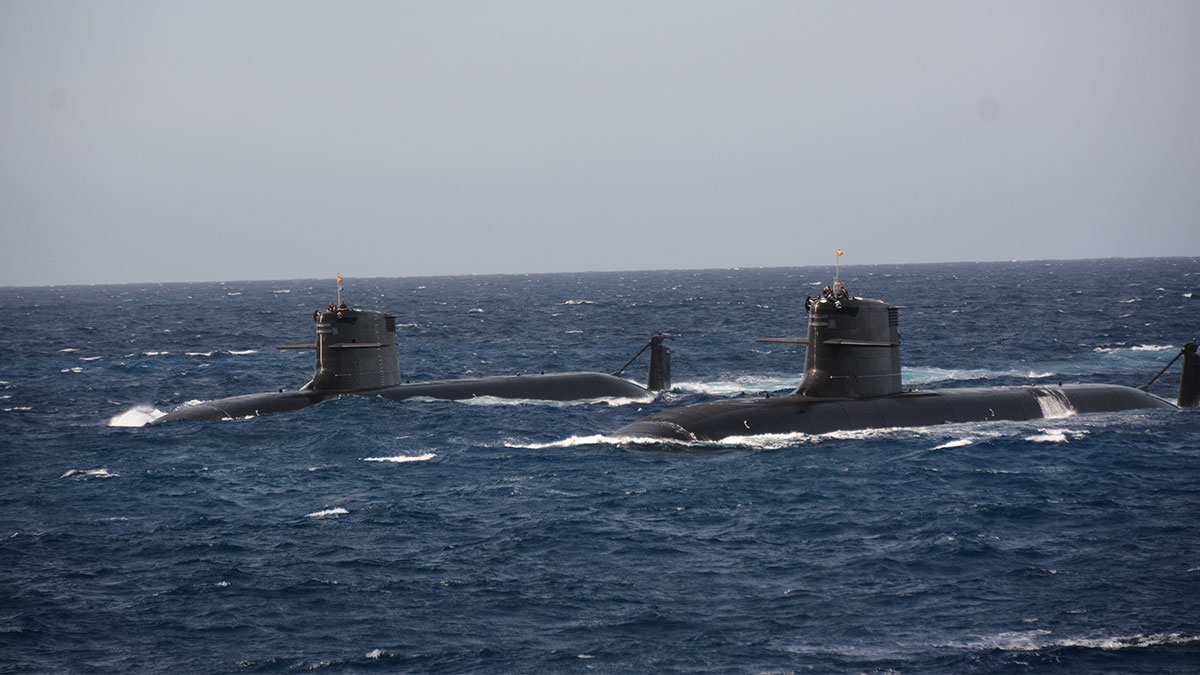
This week, Cartagena witnessed an unprecedented sight: two submarines from the S-80 class sailing together off its coast. The S-81 Isaac Peral and the S-82 Narciso Monturiol have set sail together for the first time, each at a different stage of its operational life, but both representing the same technological leap forward for the Spanish Navy.
While the Isaac Peral trains its crew, the Narciso Monturiol continues to undergo sea trials designed to confirm—before its final commissioning—that the platform and its systems perform as expected. The second vessel in the series began this process in late June and reached a key milestone in July: its first static submersion, carried out in waters near the La Algameca Naval Base.
The fact that these two ships are together at sea is no small matter. It is visible proof that the S-80 program—one of the most ambitious industrial and strategic projects in recent Spanish defense history—is beginning to take shape as a fleet, and not just as a series of individually delivered vessels.
The Importance of What Is Not Seen
The S-80s aren’t just new submarines: they represent a commitment to silent deterrence. Their combination of surveillance, intelligence, naval warfare, and special operations capabilities—coupled with stealth and autonomy far superior to those of the previous generation—makes them one of the most valuable (and least visible) assets in a naval force. Their true value lies, precisely, in what cannot be seen: the ability to operate covertly for weeks on end.
Through this program, Spain is developing and designing domestically a technology that only a handful of countries have mastered, thereby gaining strategic autonomy that goes far beyond simply having new ships: it means not relying on third parties in a field that is as complex as it is sensitive.
The Isaac Peral, Already Gaining Experience in NATO
The S-81 Isaac Peral, the first in the series, was delivered to the Navy in November 2023 and has already begun to demonstrate its capabilities outside Spanish waters. In November 2025, it completed its first international deployment as part of NATO’s Operation Sea Guardian: 46 days at sea, 840 hours submerged, and more than 5,050 nautical miles traveled. In February of this year, it repeated the experience by participating in Operation Noble Shield, consolidating its presence in the allied operational environment.
Its commander, Lieutenant Commander Fernando Clavijo Rey-Stolle, sums up the leap forward compared to the previous generation as follows: the Isaac Peral offers “enhanced intelligence-gathering capabilities along with technologically advanced equipment that allows us to cooperate with other units over greater distances and with greater precision in the information we provide.”
While the Isaac Peral racks up miles and completes actual missions, the Narciso Monturiol is going through the reverse process: the testing, verification, and patience required to commission a submarine designed and built in Spain.


