








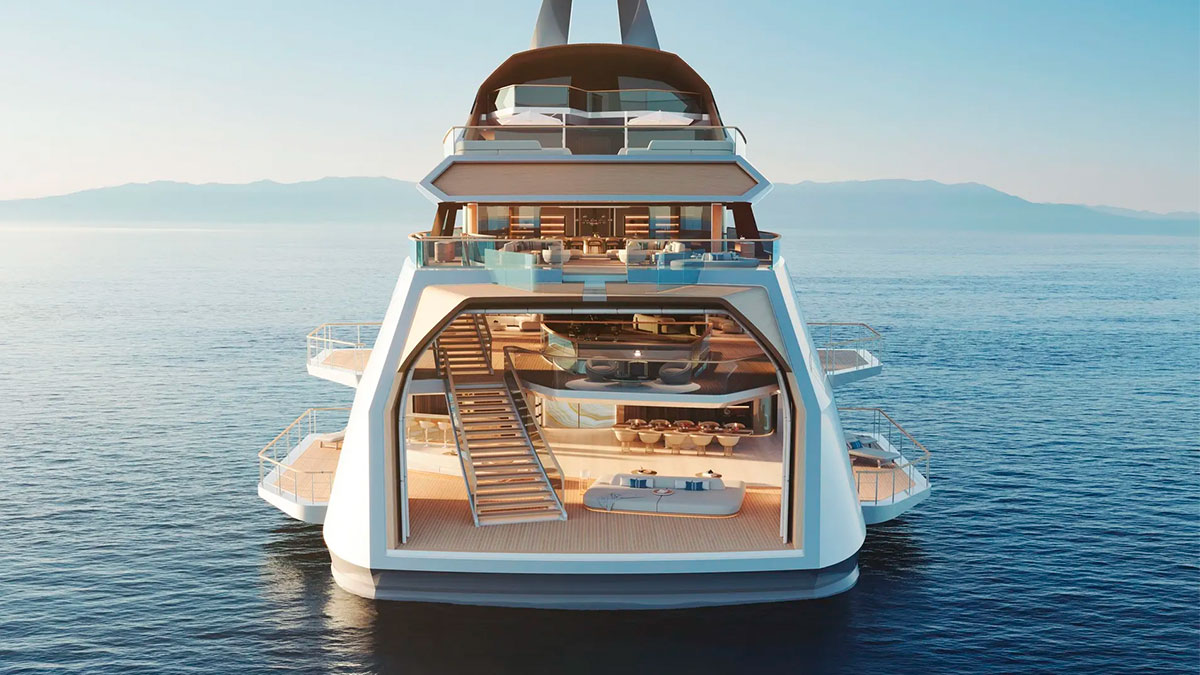
A 66-foot (20-meter) swimming pool? A virtual command center with cameras for navigation? A glass window below the waterline to view the marine life outside? It may seem far-fetched, but all of these are central features of this latest superyacht concept unveiled by Feadship. The Dutch shipyard took advantage of the Monaco Yacht Show—the world’s largest showcase for superyachts—to unveil “Hive,” a 115-meter (377-foot) superyacht concept that turns the conventional approach to yacht design on its head.


The yacht was designed with a fictional family of four in mind; each family member was given a character profile and a wish list that the Feadship designers were tasked with incorporating into the project. The result is an architectural design built around the idea of bringing people together without sacrificing private spaces.


Hive is Feadship’s largest conceptual design to date and was developed by Studio De Voogt in collaboration with the shipyard’s naval architects and specialist engineers. During the project’s press conference, I learned that Feadship places the utmost importance on the actual “buildability” of its projects. It’s not just about concepts that look good; it’s about real, feasible proposals for discerning clients.
The 20-meter (66-foot) pool is, for me, the focal point. It uses Feadship’s patented ContraWave technology and extends from the exterior to the interior of the yacht as a suspended infinity pool with a glass bottom. Below, light filters down into the beach club.


The name of the concept comes from its central organizing principle: a beehive in which many different activities take place around a shared core.
That heart is a huge open “atrium” that spans four decks. On the main deck, it can serve as a large lounge, but it can also be transformed into a stage or auditorium. Terraces open up on both sides of the yacht, while curved staircases lead to balconies and smaller rooms on the upper levels.
The designers have even incorporated utility spaces, storage for furniture, and a dressing room, allowing the space to transition from everyday family life to larger-scale events, ranging from performances and conferences to parties.
The idea was partly inspired by the salons of 1930s Paris, where conversation, culture, entertainment, and social interaction all took place in the same spaces.


The exterior of the Hive is just as unconventional. One of the most striking changes is the absence of a traditional wheelhouse where one would expect to find it.
Instead, Hive uses what Feadship describes as a virtual command center. Cameras and sensors provide the information needed for navigation, allowing the forward section of the superstructure to be dedicated to the owner’s quarters and a panoramic lounge.
The result is a superstructure dominated by glass, terraces, and unobstructed views, with the various levels visually connected rather than stacked on top of one another as is typical in a conventional yacht.


The pool may be the most eye-catching feature of the Hive, but the superyacht also has some more understated surprises in store.
At the bow, a circular, glass-enclosed library opens onto a secluded garden, creating a private outdoor retreat surrounded by greenery. The design brings natural light and views into what would traditionally be a closed-off interior space, while offering a more intimate alternative to Hive’s large social areas.
And then there’s the Neptune Lounge, located below the waterline.
Designed as an underwater observation room, it offers guests a direct view of the ocean from beneath the yacht, making the surrounding water part of the experience. Instead of simply gazing at the sea from a deck, guests can sit below the surface and watch the marine environment pass by.


Since 2006, Feadship’s conceptual designs have been used to explore ideas that could eventually find their way into actual yachts. Previous projects have examined technologies such as hybrid propulsion, new structural applications of glass, and alternative fuels. Hive continues that tradition, but its most interesting idea may have little to do with its propulsion system.
Instead, it raises a more fundamental question: What happens when a yacht is designed around how people want to live, rather than starting from a traditional yacht blueprint?
“Hive is designed around the idea that experiences can change people,” says Jan Schaffers, a senior designer at Studio De Voogt who led the project. “We wanted to explore what becomes possible when we start not from what a yacht has always been, but from how people might want to live on board in the near future.”


