








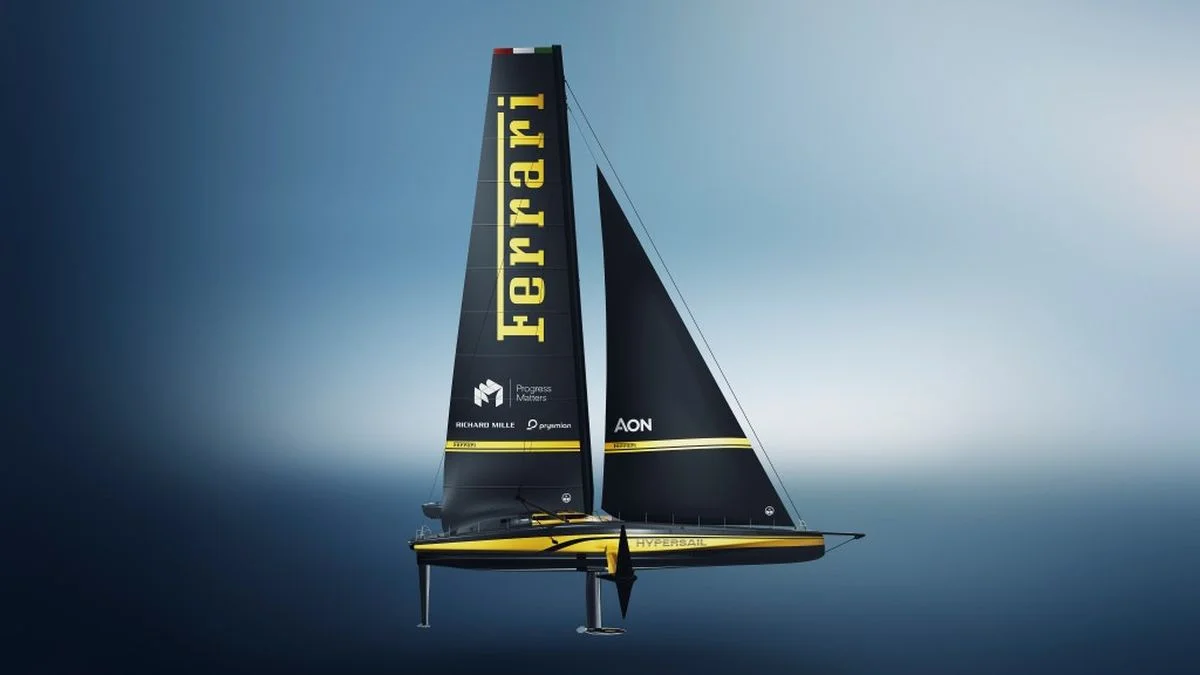
Ferrari has found a new testing ground for its obsession with performance. There’s no asphalt, no curves, and no pit stops. Nor is there an internal combustion engine. Maranello’s new testing ground is the ocean, and its star is the Hypersail, a 30-meter monohull designed to sail on foils at speeds approaching 100 km/h and to tackle, among other challenges, the record for sailing around the world.
The project, which Ferrari unveiled in 2025, is now entering a decisive phase. The boat is nearly complete, and the company is working on integrating its systems and training the team that will push it to its limits. The current schedule calls for the first sea trials to take place in the first quarter of 2027, based in the Tyrrhenian Sea, before its competitive debut in Mediterranean waters later that same year.
The ambition goes far beyond simply building a fast boat. Ferrari wants to use Hypersail as a technological laboratory on the water—an environment where its engineers can experiment with energy, materials, electronics, and control systems under conditions that are impossible to replicate in a car.
A monocoque that wants to fly
Designed by French naval architect Guillaume Verdier, Hypersail is a 100-foot (30.48-meter) monohull whose design combines elements from the America’s Cup and large ocean-going vessels.
Its most striking feature is its foils. These wing-like structures lift the hull above the surface of the sea when the boat reaches sufficient speed, drastically reducing hydrodynamic drag.
The solution developed for Ferrari also introduces a unique feature: one of the boat’s three points of support is the tilting keel itself, while the others are the rudder foil and, alternately, the two side foils.
The result is a boat that can sail almost as if it were floating above the water and that has been designed to maintain extraordinarily high cruising speeds during long voyages.
Designer Verdier has noted that the project aims for speeds of around 50 knots—about 92 km/h—under ideal conditions. In the simulations and system tests conducted so far, the boat has already exceeded 40 knots in moderate crosswinds.
But at sea, speed is only part of the problem. As the hull lifts, stability becomes much more delicate, especially when large waves appear. That’s why much of the technology developed by Ferrari focuses on something less visible than the foils: the boat’s electronic control system.
The software that keeps the Ferrari afloat
Hypersail will feature a flight control system capable of making constant adjustments to the foils, the keel, and its movable surfaces. The concept bears a clear resemblance to the electronic systems Ferrari uses in its cars. Rather than relying solely on the sailor to manually correct each movement, the boat will use sensors, actuators, and algorithms to continuously respond to changes in speed, wind, and position.
Ferrari has brought to this project some of the expertise it has accumulated over the years in the development of suspensions, electrical systems, and dynamic control for its high-performance cars. Technology transfer, however, works both ways: the boat is also becoming a test bed for solutions that could have future applications in automobiles.
One of the Hypersail’s most ambitious features is its energy system. Ferrari wants the boat to be able to operate for weeks at sea without relying on fossil fuels to generate the electricity it needs on board. To achieve this, the project combines various sources of renewable energy.
The roof incorporates approximately 100 square meters of solar panels, while wind turbines will be installed on the rear of the vessel. The system is supplemented by the energy the crew can generate themselves during maneuvers.
All of this powers an electrical architecture designed around two main voltage levels—48 and 800 volts DC—which make it possible to manage everything from auxiliary systems to the components with the highest energy demands.
In September 2026, Ferrari also added a new technology partner to the project: ABB, which will collaborate on the development of the direct-current electrical architecture and on the management and distribution of the energy generated on board. The goal is to turn the Hypersail into a kind of floating microgrid capable of producing, storing, and distributing its own energy while sailing.
This philosophy extends to one of the most traditional elements of any sailboat: the crew. Ferrari has developed the so-called “Winch by Wire,” a system that eliminates part of the conventional mechanical connection between the crew member’s effort and the mechanism that moves the sails.
Sailors continue to perform the work physically, but the motion is converted into electricity that can be stored and used later.
For Ferrari, this is another opportunity to apply automotive technologies to the sea. The motors used in the electric thrusters are related to solutions employed in active suspension systems on models such as the Purosangue and the F80. The boat thus becomes the result of a series of small technological exchanges between two worlds that, at first glance, have little in common.
From the F80 and the Luce to the Ocean
One of the most striking examples is the system responsible for moving the ship’s large appendages. The Hypersail uses 800-volt electric technology derived from the rear electric axle developed for the Ferrari Luce, while other rapid-response movements rely on 48-volt electric motors. This choice is no accident. On a boat designed to sail for weeks in extreme conditions, the reliability of the systems is just as important as their power.
Ferrari has also applied simulation and material analysis tools developed in the automotive industry to study components made of carbon fiber, titanium, and other high-performance materials.
The project has already resulted in more than twenty patents, according to the most recent information provided by Ferrari and its technical staff.
A Ferrari That Won’t Be Sold
Hypersail is not the start of a new luxury yacht division. Ferrari has no plans to enter the private yacht market. The company views it as a technological and sports prototype.
That difference is significant. The boat was not designed for comfort, cruising range, or spacious living quarters. Everything about it is geared toward answering one question: How far can an ocean-going monohull go when traditional limitations are removed and the design incorporates the tools of a company that specializes in high-performance vehicles?
The parallels with Ferrari’s Hypercar program are no accident either. The brand has applied the same endurance racing philosophy to the Hypersail that it has used in the World Endurance Championship and the 24 Hours of Le Mans.
From Giovanni Soldini to Enrico Voltolini
The project began under the leadership of Italian sailor Giovanni Soldini, one of the most renowned figures in ocean sailing. Soldini was involved in the early stages of the design, construction, and team training.
In April 2026, Ferrari announced a new phase for the program and appointed naval engineer and sailor Enrico Voltolini as the new Project Leader. Voltolini, who has worked on high-level competition projects such as the America’s Cup and SailGP, is currently responsible for leading the construction and testing phase of the Hypersail, based in Pisa. His task is to transform an extremely complex prototype into a boat capable of competing on the open ocean.
Nor will the team’s structure necessarily follow the traditional model of an ocean-going sailboat. Ferrari is working with specialists in navigation, foil control, trim, sailing, and technical management, with the aim of distributing responsibilities that traditionally fell to a single person at the helm.
The record that awaits on the other side of the horizon
The program’s main goal is the Jules Verne Trophy: a crewed, nonstop round-the-world sailing race. The current record is held by Thomas Coville’s Sodebo Ultim 3, which completed the circumnavigation in January 2026 in 40 days, 10 hours, 45 minutes, and 50 seconds, after covering 28,315 nautical miles at an average speed of 29.17 knots.
This is an especially demanding challenge. Ferrari will not only have to build a boat capable of sailing at high speeds, but also keep it operational for thousands of miles, with the crew facing extreme weather conditions and electrical systems that cannot afford to fail.
That’s why the primary goal won’t be to break the record right away. Hypersail needs to log sailing hours, test its systems, and discover how its foiling architecture performs in the real ocean. The schedule calls for the first sea trials in the first quarter of 2027, with a home base in the Tyrrhenian Sea, and the boat’s debut in Mediterranean ocean races throughout 2027.
The real race starts now
Ferrari has a process ahead of it that could last until 2031. The Hypersail won’t be fully developed by the time it hits the water—its evolution will begin right then.
That is probably the most interesting part of the project. Maranello hasn’t simply built a fast boat, but rather a platform on which to test how some of the technologies that are defining the next generation of its cars perform in an extreme environment. On land, Ferrari has been chasing tenths of a second for decades. At sea, the units of measurement will be different: miles, days, and entire oceans.
And while the Sodebo Ultim 3 sets the time to beat today, the Hypersail is preparing to find out whether the technology—born from a combination of race cars, batteries, carbon fiber, and electronic systems—can propel a 30-meter monohull to the other side of the world faster than anyone else.