








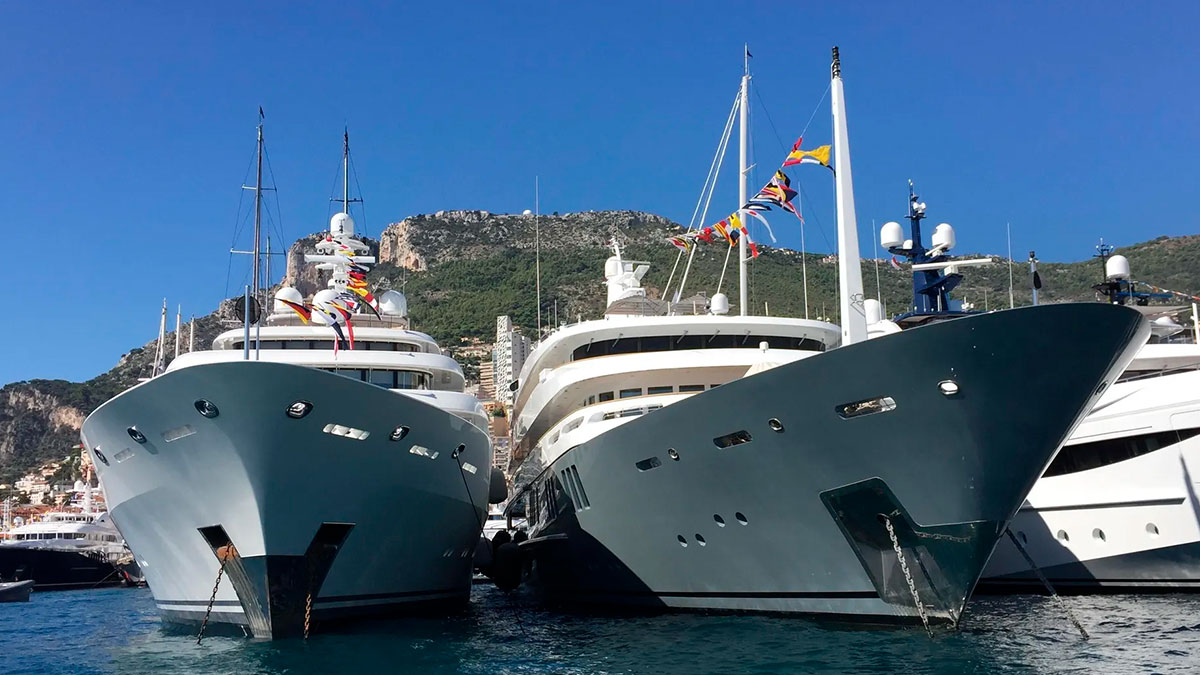
There has been extensive media coverage recently regarding Cecil Wright & Partners’ lawsuit against Nikolay Storonsky. Essentially, the renowned superyacht brokerage is suing the founder of Revolut for 17.5 million euros in unpaid commissions, plus interest and legal costs, based on an estimated sale price of 350 million euros, alleging that they were the actual reason for the defendant’s purchase of the 102-meter superyacht Nixie.
How to Earn a Commission
In law, a broker’s commission isn’t earned through effort. Nor through strategy. Nor through marketing. Nor through patience. It’s earned only when a specific event occurs: a completed sale—and only if the real estate agent was the actual cause of that sale. If either of these two requirements isn’t met, you get nothing. Not even a reduced fee. Not even a consolation prize. Nothing. Real estate agents who work on a “no sale, no fee” basis assume all the risk. If the deal falls through—even if the seller is the one who cancels it—the agent doesn’t receive a single penny and cannot claim anything for the time and money invested.
Which brings us to the “effective cause” test itself: a phrase that courts use constantly but that is not clearly defined. The phrase was first used in a legal case in 1903, in which it was ruled that it means more than simply “cause.” The question is whether the broker’s actions actually brought about the relationship between buyer and seller. In other words, many factors contribute to a sale taking place. A shipyard sales manager might explain the specifications. A captain might discreetly recommend the ship to his employer. A manager may personally facilitate the introduction between the parties. All of these things may be happening at the same time, and more than one of them may, in principle, count as a legally effective cause. The law does not require the broker to be the sole cause, but simply a cause substantial enough to be decisive.

Reason, in fact
The phrase was examined in the 2011 decision in Berezovsky v. Edmiston. The 110-meter motor yacht Darius, built by Lürssen for the late Boris Berezovsky, was sold while still under construction to the Al Futtaim family of the UAE for 240 million euros. Berezovsky had engaged the leading brokers Edmiston & Co on a non-exclusive basis. As is standard practice, Edmiston worked with other brokers, including Merle Wood & Associates, which happened to know a captain working for the Al Futtaim family. The captain showed his employer some photographs of the yacht bearing the Edmiston logo, which piqued his interest. The buyer negotiated the purchase directly with Berezovsky’s own assistant, completely bypassing the brokers.
Berezovsky’s attorneys argued—and not without reason—that a broker who was excluded from the negotiations and did not even discuss the price with the buyer could not have been the actual cause of the sale. Fair point. But the judges ruled that simply making a presentation can be the effective cause, even when the principal subsequently takes the negotiation into his own hands.
Merle Wood & Associates, meanwhile, having done a great deal of legwork, learned the hard way that being helpful to Edmiston’s case was not the same as having a contract with the yacht’s owner. Subbrokers have no right to make a claim against the owner, and their commission comes out of the lead broker’s pocket according to the private agreement made with that lead broker.
Close, but no commission
Let’s now compare that case with the 2016 ruling in Moran Yacht & Ship v. Pisarev. Moran managed the 47-meter 4YOU for Kirill Pisarev and acted as his exclusive charter agent. In May 2010, a Moran broker showed the yacht to a wealthy acquaintance, Alexander Miliavsky, who spent about thirty minutes on board and made it very clear that he had no interest in buying it. The Moran team had no further contact with him. Twenty-one months later, during a dinner in Moscow, Pisarev casually mentioned that the 4YOU was still for sale and that the price had dropped. Miliavsky recalled the yacht, and his financial situation had improved considerably since then. In February 2012, he purchased it for 19.8 million euros, with Moran nowhere to be seen, as his retention agreement had expired months earlier.
Moran sued over the commission and lost. The court held that, even if a brokerage agreement had existed (which, based on the facts, was doubtful), showing a boat to a man who says he is not interested and then having no further contact with him for nearly two years—before the owner resumed the conversation on his own initiative during a dinner—does not make you the actual cause of the agreement that eventually took place. The passage of time and the buyer’s changed circumstances combined to sever any causal link that might have existed.

Avoiding Public Attention
Given the media’s interest in matters related to superyachts, it is surprising that disputes involving them end up in court. But the inability to resolve differences does not mean the matter must always be brought before a public and open court. There is an alternative that is all too often overlooked: arbitration.
Think of it as a private and confidential tribunal, convened by you, where you select the arbitrators (typically senior, independent attorneys with extensive knowledge of maritime matters). Case documents are not made public, and the decision (known as an award) is usually easier to enforce abroad than a court judgment. One drawback is that you pay for the arbitrators’ time, but this may be a drop in the bucket. No one other than the parties and the attorneys involved needs to know that a dispute took place.
Arbitration requires the agreement of both parties to proceed in this manner and may not always be appropriate. A surprising aspect of the Cecil Wright case is that 17.5 million euros are being claimed for breach of an agreement that was never formalized in writing. As a result, the court documents are available to anyone who requests them and pays a nominal fee, and they reveal numerous names and details that the parties would undoubtedly prefer to keep private.
Final Conclusion
So, what does all this mean in practice? Whatever your role may be, make sure that any brokerage agreement is set forth in a single written document and includes an arbitration clause.
If you are a broker, promptly record each potential buyer’s interest in writing. Being excluded from the final negotiation is not fatal to a commission claim, provided you can demonstrate that your initial introduction set the transaction in motion. A brief, unsuccessful contact, followed by two years of complete silence, will almost certainly yield nothing for you. And above all, never assume that mere effort entitles you to anything: without a sale—or without a demonstrable causal link to the sale—there are no fees. Period. It doesn’t matter how much effort you put in.
This article does not provide or replace legal advice.