







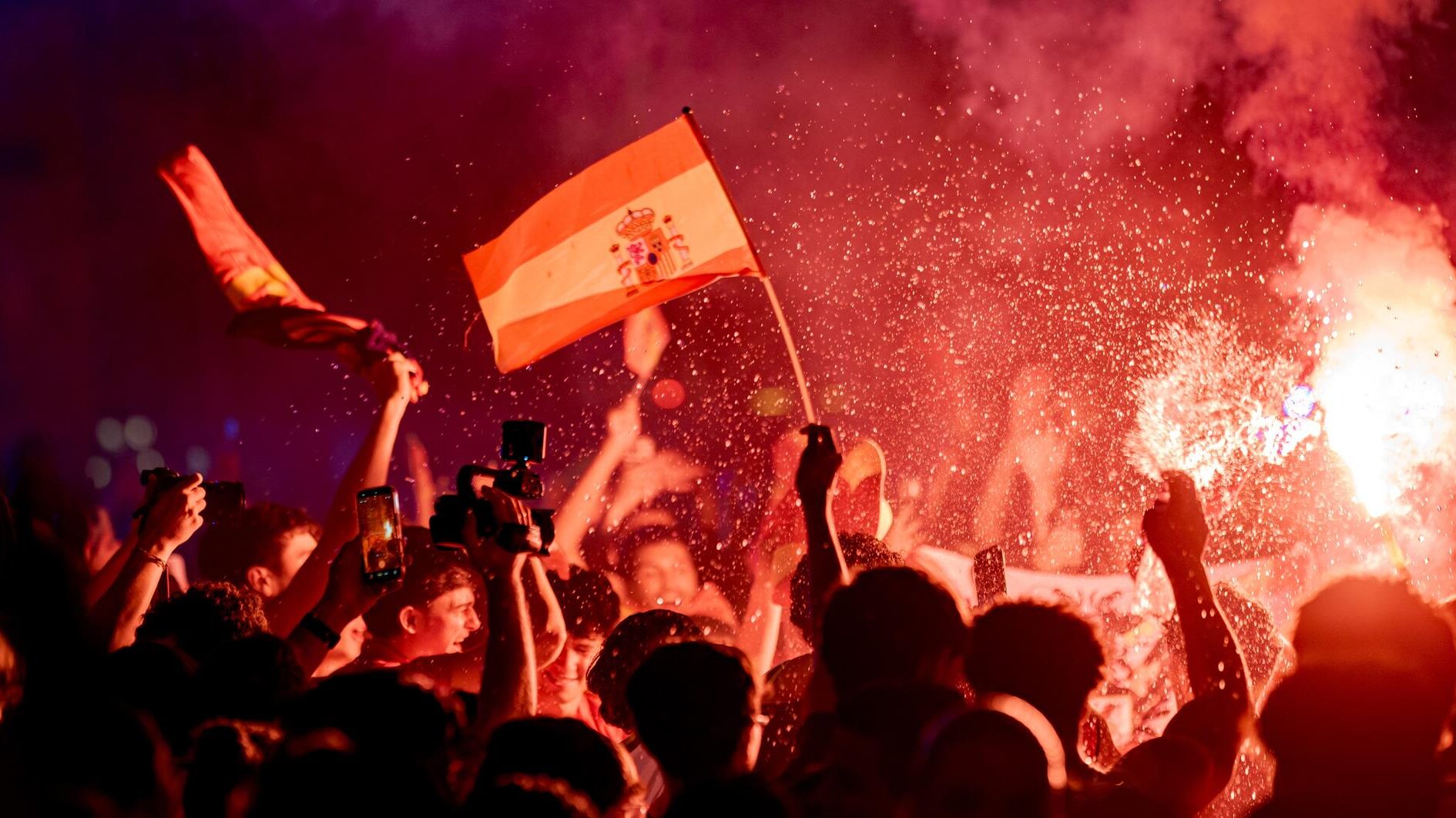
The Balearic Islands woke up on Monday with a hangover. Celebrations on all the islands following Spain’s victory in the World Cup final caused a frenzy of honking and street parties, especially in Palma. Plaza de las Tortugas, the epicenter of sporting celebrations in the Balearic capital, was overflowing to commemorate the triumph of La Roja, recreating the same euphoria seen yesterday in other parts of Spain. However, in terms of television ratings, the Community of Madrid was the only region to surpass the Balearic Islands.
According to Barlovento Comunicación and data from Fifty5Blue, the Canary Islands was the autonomous community with the second-highest audience share: 89.4 percent, a figure that places it just between Madrid in first place (92 percent) and Andalusia in third (89.2 percent). However, it would be an exaggeration to conclude that this level of attention corresponded to unanimous support for the Spanish national team. Hours before the match, a short walk through the streets of Palma was enough to see that blue and white jerseys, flags, and chants would make their presence felt that night. Nearly 40,000 Argentinians living on the islands have given unconditional support to Messi’s team throughout the World Cup. The final match, despite the ultimate disappointment, was no exception.
But red was the dominant color. Whether it was in Son Fuster, Son Moix, or on the hundreds of terraces full of Palma and the Part Forana, whose city councils had installed screens in the plazas, sports centers, and other places in their municipalities. Participation was massive, as were the celebrations. And, fortunately, there were no serious incidents. The same thing happened in the rest of the archipelago: in Ibiza, the planned police operation for the city left two people with minor injuries in two fights that took place there. The City Council highlights that the night passed “peacefully and without serious incidents.”
Historical dimensions
The match also became a television phenomenon of historic proportions nationwide. The final attracted an average of 15.7 million viewers, reached 20.1 million unique viewers, and recorded a national audience share of 87.1 percent. It is the second most-watched event in the history of Spanish television, surpassed only by the penalty shootout between Spain and Portugal in the semifinals of Euro 2012. On that occasion, Vicente del Bosque’s team lifted the trophy, crowning a legendary treble (Euro 2008–World Cup 2010–Euro 2012), which the current coach, Luis de la Fuente, now hopes to replicate. So far, he has completed two-thirds of the way. And the Nations League as a bonus.
As for last night, the peak audience figure was recorded at 12:01 AM, when 17.08 million viewers were glued to their screens waiting for the match result, representing a 91.2 percent share of the audience on La 1, La 2, Teledeporte, and DAZN Mundial. Additionally, the 90 minutes of regulation time drew an average audience of 15.38 million viewers and an 86.3 percent share, while the extra time, during which Spain secured the title, recorded an average audience of 16.6 million viewers and an 89.3 percent share.
The demographic breakdown shows that the match attracted its largest audience among men, who made up 91.1 percent of the audience, and among the 13-to-24 age group, where the audience reached 95.2 percent.The final was also the most-watched game of the entire tournament for the team led by Luis de la Fuente, surpassing the semifinal against France, which registered an average audience of 14.5 million viewers and an 81.3 percent share. The match with the lowest viewership figures was the game against Cape Verde, Spain’s opening match at the World Cup and the only one in which they did not achieve victory, with an average of 7.99 million viewers and a 66 percent share.
