








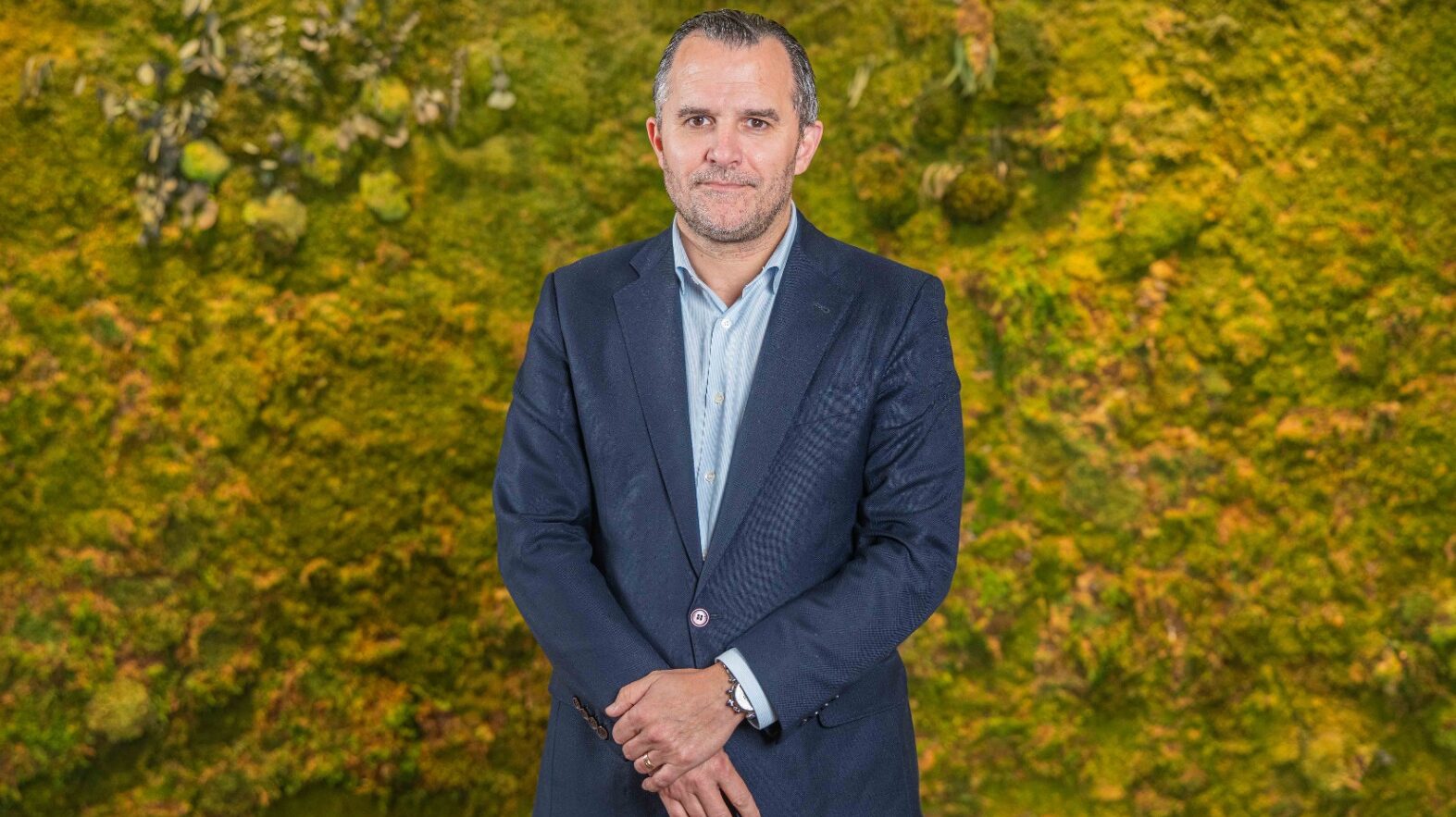
The CEO of Summum Hotel Group, Javier Vich (Palma, 1975), has been at the helm of the Hotel Business Federation of Mallorca (FEHM) for a year and a half. It was in December 2024 that he succeeded María Frontera in the position and took over the leadership of a business association that is constantly in the spotlight. During this time, he has managed to secure a historic agreement for the hospitality sector, participate in the Pact for the Sustainability of the Balearic Islands, attend the launch of two new intercontinental routes to Mallorca, and, in the process, confront the regional government over the Sustainable Tourism Tax (ITS). Just as we reach the mid-season, Vich takes stock of the year and looks to the future to see what awaits him, with another protest against mass tourism (July 26) already on the horizon, as well as a solar eclipse (August 12) for which the sector has long been preparing.
How would you summarize the season so far, and what are your expectations for the rest of the season?
We’re expecting a balanced season. We’ll probably end June on a similar note to last year, even though we started the year with some apprehension due to the geopolitical situation we were facing. Some suggested that Spain in general, and the Balearic and Canary Islands in particular, would experience an excess of demand, but the reality today is that this has not been the case. In the islands, we are coming off a slowdown in the German market that had been dragging since last year due to the macroeconomic situation in that country, and this trend has been offset by the growth of the British market, which is performing better than in 2025. Overall, we are forecasting a stable and balanced season, very similar to 2025, provided there are no major events.
Tourist spending, however, is set to continue increasing.
Last year was already a year in which employment stabilized, as it did not grow substantially, only by 0.6 percent. And, even so, we achieved a 6 percent increase in spending. And this year, according to preliminary estimates from our associations, the trend will be more or less the same. Employment remains stable or decreases, depending on the area, but spending continues to increase.
How did the last off-season go? After a bullish trend, it seems that growth during the winter has slowed down a bit.
Twenty percent of hotels in Mallorca now remain open during these months of the year, which is a significant milestone: it’s the first time this has happened in recorded history, and we hope it will become established over time. It is true that there was a slight slowdown during the first quarter, and when we add to that the fact that there are a greater number of hotels open, the occupancy figures were ultimately not the same as last year.
Has the impact of the war in the Middle East been contained?
With one caveat: although we don’t have definitive data or a specific study on the sector, we know that some companies are experiencing an increase in spending and stable employment levels, but they are also observing a significant increase in operating costs. There are companies that are seeing a 3% increase in spending and a 10% increase in costs. That’s what they’re telling us. It’s something we’ll have to watch in 2026 and 2027. There has been an impact from inflation, energy and raw material costs, labor costs, etc.
Mallorca is launching two new long-haul routes this year, to Montreal and Abu Dhabi. What are your expectations?
Expectations are very positive. For Mallorca, establishing transoceanic connections always represents a clear opportunity. The flight from Palma to New York, by contrast, can be considered a well-established route. The news we’ve received from Air Canada is that there is strong demand, and the same applies to the Etihad flight.
Has Etihad also managed to regain the demand of people from the Balearic Islands, despite the war?
Yes, that’s the news we’re hearing. The Abu Dhabi issue gains even more importance considering the possibility of it becoming the connection hub for the entire Asian market. We also welcome the news from Etihad management that they intend to extend the season if demand remains high. We would very much welcome any news suggesting that these connections are extended beyond the high season. A few years ago, it was almost unthinkable that Mallorca would be connected by direct flights covering seven or eight-hour distances. Now it’s a reality. This provides us with diversification from traditional markets and access to a high-value market. The strategy for the tourism sector—and not just the hotel sector—is beginning to bear fruit.
Is this market fragmentation reflected in hotel bookings?
Yes, and in fact there are hotels in Palma where the North American market is already the number one market. As for Canadian tourists, there has been strong demand in the cycling tourism segment. As for the United Arab Emirates, it’s still too early to assess it in this regard, although it should be noted that it presents a great opportunity to use this route to visit other Asian destinations. On the other hand, since the pandemic, the French market has shown a very positive trend toward Mallorca, which has now firmly consolidated. And this year we are also seeing a recovery in the Scandinavian market.
Two years of the Pact for Sustainability in the Balearic Islands. Have we made any progress, or are we still just getting started?
I think there has been a substantial change between last year and this year, and, in fact, there hasn’t been much public outrage about it. The last demonstration – organized by the same platform as last year (Less Tourism, More Life) – was against absolutely everything, and I think this year is heading in the same direction. I would also like to point out that, in their manifesto, the organizers oppose the reduction of seasonality. This seems really strange to me, considering that all social stakeholders, business leaders, the different levels of government, and Balearic society as a whole have been working so hard to achieve it. And now that reducing seasonal fluctuations is starting to become a reality, it seems some people don’t like it. Or that they also oppose the transformation of the hotel industry toward greater quality, which translates into more jobs and more services that attract more people. In the end, whatever we do, we’re always criticized.
They have been very critical of the “anti-tourism” manual published by the same platform.
What cannot be tolerated is the crossing of certain red lines with calls to action that advocate sabotage and acts of violence and hostility against those who visit us. We cannot tolerate these violations of the most basic rules of coexistence. This is completely at odds with our responsible tourism and peaceful coexistence policies between tourists and residents – a message we recently highlighted in our campaign with billboards at Palma Airport.
Regional President Marga Prohens emphasizes the commitment to sustainability and criticizes the public body AENA for not seeming to be aligned with it. This is especially true after the controversy over the advertising sign at the airport (which was removed because it contained connotations related to excessive tourism). Do you agree with this criticism?
AENA is a public company with private shareholders. All advertising is put out to tender, and it’s other companies that sell those spaces. I’m not sure that AENA itself was ultimately responsible for the banner. As for growth, everything depends on the time slots: there has been no growth in this area; if there is demand, airlines will opt for higher-capacity aircraft, but this year’s slots are the same as last year’s.
Should the ecotax revenue be used to alleviate the housing crisis?
We believe this is distorting the original purpose for which the Sustainable Tourism Tax (ITS) was introduced. Solutions to the housing problem should be funded by the autonomous community’s budget.
They have already won the battle against the regional government over the increase in ITS fares.
I believe the regional government was wrong to claim that a possible increase in the ITS would affect demand, when it has been confirmed in various ways that there is no direct link between the two.
How is the absenteeism problem developing this season?
We don’t have any figures for the middle of the season yet – we’ll have them and assess them later – but we are constantly monitoring the situation in businesses, which tell us that the trend is very similar to last year’s, with extremely high absenteeism rates and enormous costs for the State and for the businesses themselves. It is unsustainable to maintain this level of spending.
What do you attribute this increase to? An oversupply?
I believe that after the pandemic there was a significant social change, and that a part of society and the workforce now prioritizes other things. Let me be clear that we are the main advocates of coverage for authorized sick leave; we always emphasize unauthorized absenteeism. Statistics show that this is more common among young people; those over 40 have much lower rates.
Are you expecting a massive influx of tourists during the week of the solar eclipse?
We don’t expect any excessive demand at any point during August. There will be a bit more activity in the more specialized sectors in this area, but nothing more.
Are you also ruling out traffic congestion?
FEHM and our members will carry out our information campaign through hotels and will strive to encourage people to travel as little as possible.


