








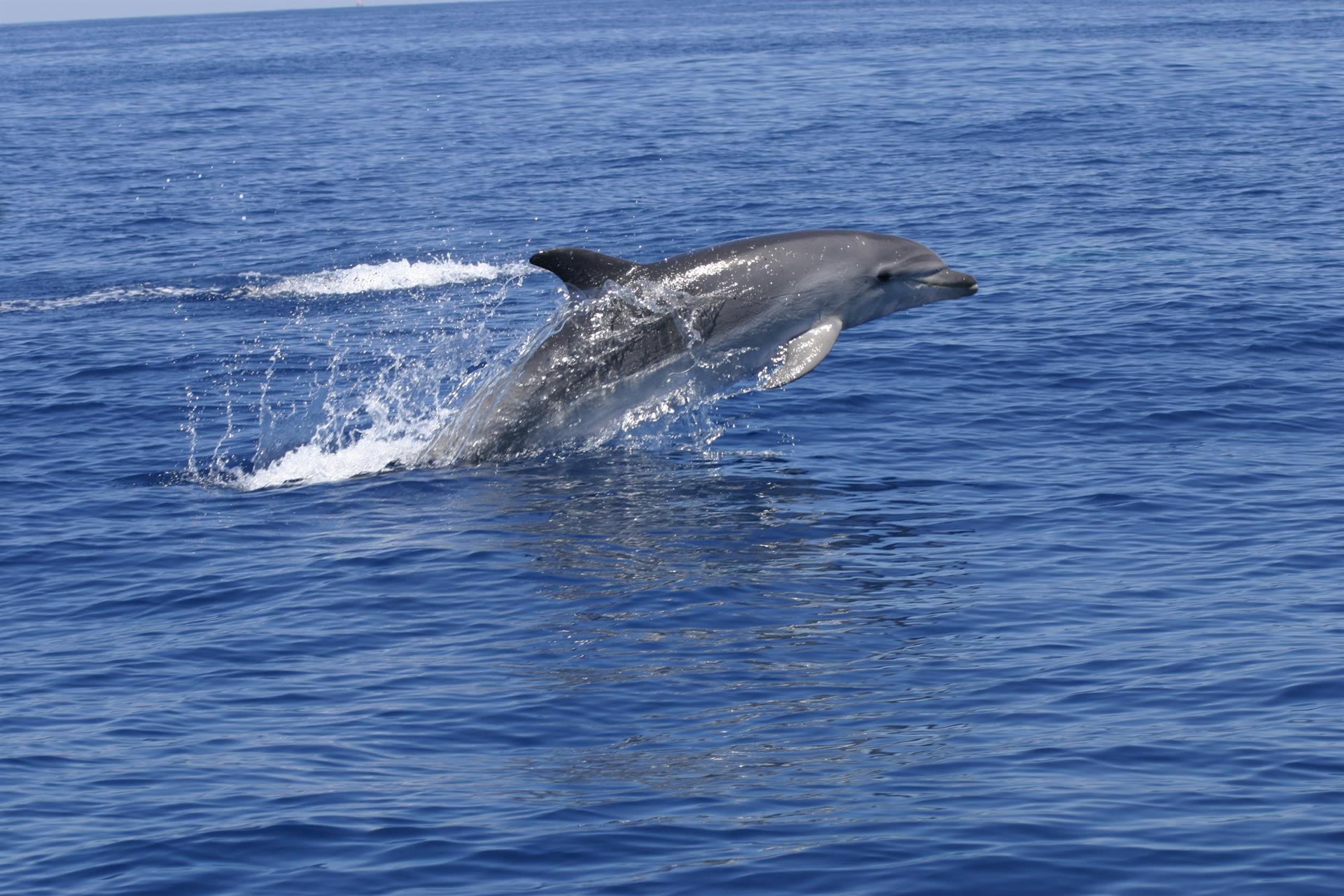
After two years of acoustic monitoring in Cabrera National Park, the Tursiops Association has concluded that the current level of maritime traffic in the archipelago does not significantly interfere with the bottlenose dolphin population that inhabits these waters. The study, carried out with the support of Mallorca Preservation, is the first specific research on this species in the park since it was designated, in 1991, as Spain’s first Marine-Terrestrial National Park.
The research is based on the analysis of more than 213,000 sound recordings made with six hydrophones installed at depths between 30 and 80 meters around the archipelago. The objective was twofold: to estimate the bottlenose dolphin population from their vocalizations and to characterize the underwater acoustic landscape of Cabrera to assess the impact of noise on cetaceans.
One of the researchers on the Cabrera Dolphins project, José María Brotons, explained during the presentation of the results that between 50% and 70% of the recorded sounds are the so-called “signature whistles” – the vocalizations that each individual emits repeatedly to identify itself.
Analysis of these whistles has made it possible to identify the passage of about 82 different dolphins through the archipelago during the study period. Of these, 58 were detected on more than one occasion and 12 were recorded every month of the year. In one case, a single individual was identified on up to 193 occasions.
Based on these data, researchers estimate a density of 0.063 individuals per square kilometer. Extrapolated to the 282 square kilometers covered by the National Park, this figure equates to an average simultaneous population of 17.8 dolphins, although the study notes a decrease in their number during the summer months.
There are no common individuals between Cabrera and the Pitiuses.
The whistle catalog compiled at Cabrera was compared with the one previously compiled by Tursiops in the waters around Ibiza and Formentera. The result was conclusive: no individual was identified as common to both archipelagos.
This result supports the hypothesis that the dolphins of Mallorca and Menorca—the ‘Gimnesias’—constitute an isolated subpopulation from that found in the Pitiuses, probably due to the ‘natural barrier’ formed by the deep channels separating the two archipelagos.
The project’s second main objective was to analyze the underwater noise in the park, which is considered a “growing threat” to Mediterranean cetaceans. The results show that Cabrera’s acoustic landscape remains “relatively stable” throughout the year, with a slight increase in the summer, especially off the coast of Cabrera port. However, this increase was “less pronounced” than the research team had predicted before starting the study.
The most consistent pattern detected at all sites is of natural origin. The researchers identified a marked day-night cycle generated by benthic fauna, mainly invertebrates, which produce a greater amount of high-frequency noise at night.
According to the study, apart from very specific locations such as Na Picamosques – where low-frequency noise is associated with squid fishing by the small-scale fishing fleet – Cabrera’s acoustic landscape is determined primarily by biological activity rather than by human presence.
Cabrera has much lower noise levels than the Pitiuses.
To put the results in context, the team compared the measurements taken at Cabrera with those from a similar study previously conducted in Ibiza and Formentera, an area under considerably greater nautical pressure.
The comparison showed that average noise levels in the Pitiuses were consistently higher, with differences of between three and five decibels compared to Cabrera. In terms of sound energy, this difference represents more than twice the sound intensity across both the entire spectrum analyzed and most of the frequency bands studied.
Furthermore, during the summer, when there are more boats in the area, the distance over which dolphins could communicate in the Pitiuses was reduced by 70 percent.
Despite this, the statistical analysis conducted at Cabrera “did not detect a direct local-level association” between the recorded noise levels and the presence of dolphins.
According to the research team, which also includes Daniel Noreña, Guillaume Pelletingeas, and Margalida Cerdà, the differences observed between one area and another are due to the “specific characteristics of each area” and not to a “causal noise effect.”
This discovery opens new avenues of research to determine which other factors, such as the availability of prey or fishing activity, influence the distribution of the beak’s beak dolphin in the coastal waters of the Balearic Islands.
Protection that can still be strengthened
The Cabrera Dolphins project was launched with the goal of advancing our knowledge of a species listed as “vulnerable” in the Spanish Catalog of Threatened Species and of establishing the relationship between its abundance and the natural noise levels in the archipelago.
Looking ahead to the coming years, the researchers propose to continue monitoring the population acoustically and to incorporate environmental and fishing variables that will allow them to more accurately explain the factors determining the presence of the beak-billed dolphin in the coastal waters of the Balearic Islands.
However, Brotons believes that the protection of the marine park “could be improved.“ Although the study focused exclusively on the bottlenose dolphin, he noted that underwater noise also affects other species present in Cabrera, such as the sperm whale.
In this regard, the researcher highlighted the presence of large ferries and merchant ships sailing far offshore, a practice for which “there is no regulation.” According to him, this maritime traffic could affect sperm whale populations, as well as cause other effects that are difficult to quantify, such as stress.


