








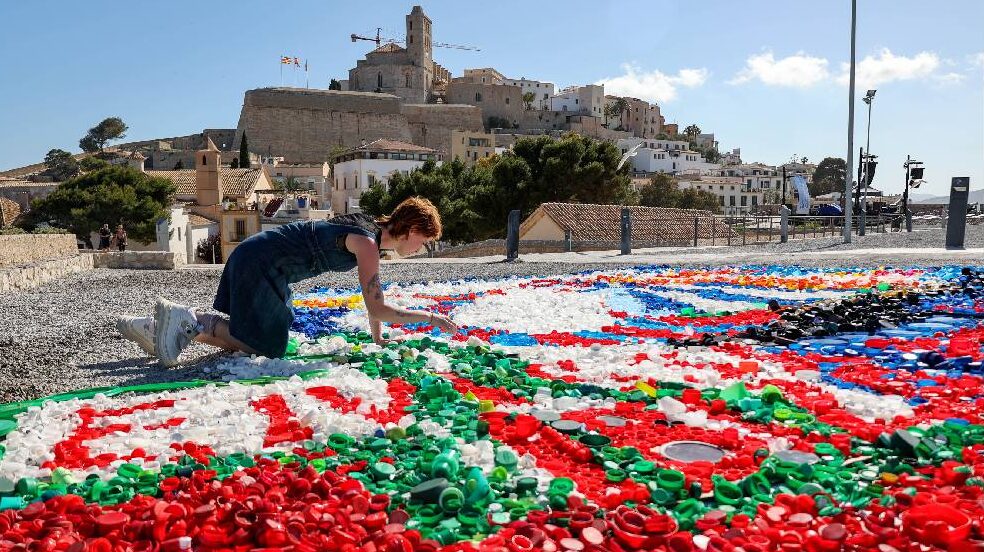
The environmental foundation Ibiza Preservation aims to promote a major political agreement on waste management in Ibiza and Formentera that ensures the continuity of environmental policies in the medium and long term, regardless of any changes in government that may occur following the regional and local elections scheduled for next year. “We need to make political decisions that won’t always be easy for the public to understand, but they must be bold.”
This is how Inma Saranova, the organization’s director, puts it; she also explains that “we have moved from a concern about the proliferation of plastics to a more holistic approach, which is zero waste.” The proposal, inspired by the Water Pact reached years ago in the Pitiusas, seeks to engage all political forces around a common roadmap that will enable the region to address one of its main environmental challenges with a strategic and long-term vision.
Saranova states that the organization will begin a round of meetings with government agencies and political parties in the coming weeks to convey the need to reach consensus on waste management and the circular economy. As she points out, addressing these challenges requires sustained, long-term measures that are not dictated by election cycles. “Right now, we’re waiting to see what happens with the waste we’re generating—whether an incinerator will be built in Ca Na Putxa or if our waste will be sent to Palma.” The foundation’s director is unequivocal when she states that in Ibiza “we are generating exorbitant volumes of waste that cannot be managed.”
In this regard, he notes that the main goal for 2027 is to reach this agreement as a key step toward transforming the Pitiusas “into zero-waste islands.” To achieve this, he insists that, beyond policy, greater public awareness and involvement will be necessary. Regarding the incinerator, he states that for now they prefer “not to take a position” until they can assess the economic and environmental implications the project may have.
The initiative was unveiled a few weeks ago, coinciding with the publication of the foundation’s 2025 annual report—a year the organization describes as particularly successful, both in terms of the scope of the projects carried out and the efficiency with which the funds raised were managed.
More environmental investment despite lower tax revenue
In 2025, Ibiza Preservation allocated 701,000 euros to environmental programs and projects, representing 82% of the funds raised and a 12% increase over the previous year. This figure is particularly significant given that total revenue fell by 8%, to €853,000.
The organization funded some twenty initiatives in Ibiza and Formentera focused on marine conservation, biodiversity, the circular economy, strengthening the primary sector, and monitoring indicators through the Sustainability Observatory.
Among the most notable projects is “Ibiza and Formentera: Planting a Future,” which enabled the planting of 1,350 fruit trees on 25 farms in the Pitiusas Islands. The initiative focuses on varieties adapted to future climate conditions and aims to contribute to the recovery of a primary sector facing structural problems such as a lack of generational succession and the islands’ limited food self-sufficiency.
Another strategic program launched this year was “Gastronomic Activists,” which focuses on reducing food waste through training initiatives aimed at restaurant professionals, vocational training students, and the general public. The initiative aims to reduce the environmental impact associated with food waste in a region where the tourism and hospitality sector plays a decisive role in economic activity.
Marine Conservation and Biodiversity
Marine conservation remained one of the foundation’s main areas of focus in 2025. Notable among the initiatives carried out were studies on the conservation status of Posidonia seagrass beds in areas such as Talamanca and Cala Bassa, as well as environmental DNA projects to identify the presence of shark and ray species in the waters of the Pitiusas.
The organization also continued to run programs aimed at protecting the Pitiusan gecko and stepped up its environmental awareness and education initiatives through the Marine Forum and the Future Forum, platforms designed to engage younger generations in addressing the environmental challenges facing the archipelago.
With its proposal for a waste management agreement and record-breaking investment in environmental projects, Ibiza Preservation now aims to shift the debate on sustainability beyond specific actions and place it in the realm of structural commitments. The goal, according to the organization, is to provide Ibiza and Formentera with a shared environmental strategy capable of standing the test of time and addressing the challenges posed by population growth, tourism, and climate change.
Looking ahead to this year’s programs and activities, the foundation is developing and collaborating on initiatives such as a comprehensive assessment system for coastal ecosystems led by the University of the Balearic Islands (UIB), the intensification of monitoring of invasive snakes (a threat to the endemic lizard that has triggered “an unprecedented ecological crisis”), and the regeneration of the landscape through the planting of a thousand climate-resilient fruit trees, such as those planted in 2025. Work is also underway to expand measures to protect the marine environment in general and Posidonia in particular.


