






The survival of traditional crafts no longer depends solely on preserving time-honored recipes and techniques. It also requires attracting talent, fostering new forms of entrepreneurship, and demonstrating that tradition can be transformed into a future business opportunity. In the Balearic Islands, the generational succession in cooking, baking, and pastry is beginning to take shape through initiatives that connect future professionals with those who are redefining the sector from within. More than 1,200 vocational students specializing in cooking, pastry, and baking have participated in motivational talks designed to share success stories, business models, and new ways of understanding the trade.
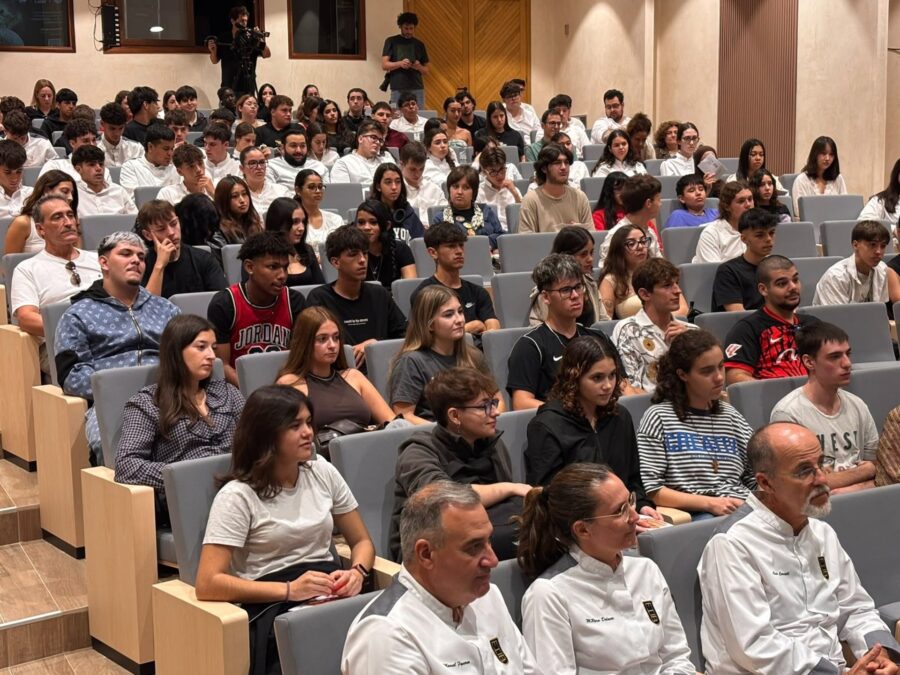
One of the most recent initiatives took place at the Balearic Islands School of Hospitality, as part of Bread Week 2026. There, baker Mauro Benseñor, co-founder of Forn de Barri, shared his entrepreneurial experience and his contemporary vision of baking with about 150 students from that school and from the Josep Sureda i Blanes, Juníper Serra, and IES Calvià schools.
Its story illustrates how a traditional craft can evolve without losing its identity. With three locations in Fornalutx, Sóller, and Palma, Forn de Barri represents an approach to baking based on entrepreneurship, innovation, and a connection with today’s consumers. The session concluded with a tasting of the company’s products, allowing the students to experience firsthand the tangible results of this work.
From the classroom to the workshop: an investment in talent
Beyond the inspiring sessions, the real challenge is turning students’ interest into concrete professional opportunities. In this regard, the Regional Development Agency of the Balearic Islands (ADRBalears) plays a strategic role in connecting educational institutions with bakery employers to facilitate work placements in bakeries.
The plan has already been successfully implemented over the past two academic years, according to information published by the Regional Ministry of Business, Self-Employment and Energy. The initiative allows future professionals to gain firsthand experience in the sector, understand its demands, and develop skills in a real work environment.
The collaboration between educational institutions and companies thus becomes an essential tool for bridging the gap between learning and professional practice. It also provides a means of transmitting knowledge that, in many cases, is acquired through experience and direct contact with the industry.
Preserving tradition, competing on the basis of identity
The strategy is complemented by the collective brand ‘Pa d’aquí, forn i tradició,‘ managed by ADRBalears in collaboration with the Association of Bakers and Pastry Chefs. There are 270 establishments with their own bakeries, each of which offers at least two varieties of traditional bread and produces 70% of the products it sells.
These figures reflect the reach of a network that links local production, local identity, and the continuity of traditional methods. In a constantly evolving market, differentiation through product, technical expertise, and deeply rooted ties to the territory are among the sector’s key assets.
The challenge, however, goes beyond simply preserving our culinary heritage. It’s about ensuring that younger generations see these trades as an attractive career path, one that offers opportunities for development, innovation, and entrepreneurship.
Because the future of baking, pastry, and cooking isn’t built just by preserving what has been learned over decades. It also depends on those who are able to reinterpret it. And, in this transition, connecting masters with the professionals of tomorrow can be as important as the recipe itself.