






Why Mallorca? Simon’s next step in its territorial expansion has taken the most natural course. The company’s arrival on the island is the latest chapter in a 110-year history that was crying out for a closer relationship with the Balearic Islands. “We have quite a few subsidiaries in many countries, and we’ve long since begun to realize that in many of the projects we’ve encountered around the world—in Central America, Southeast Asia, the Middle East…—key influencers based in Mallorca were starting to emerge.” Esteban Bretcha, the group’s CEO, explains that the experience of recent years ultimately confirmed something they had long suspected: the island’s potential as a hub for major projects, even beyond the hotel sector. “There’s a very strong network and ecosystem here, so launching this project on the island was a very logical choice.”
Simon, a group specializing in energy, lighting, connectivity, and control solutions for residential, urban, and professional environments, has just opened Spain’s first Simon Signature space in Palma, at 3 Can Brondo Street. The 100-square-meter space is designed as a meeting place for hoteliers, architects, interior designers, and engineers—from the earliest stages of a project through to its completion. The company is expanding its role as a manufacturer of electrical equipment to also become a technology partner that integrates design, lighting, connectivity, automation, and efficiency within a single project.
This is how Bretcha himself explains it, insisting that the company’s horizons extend beyond the obvious connection to the hotel sector—even though that sector is key to its business because it is at the forefront of areas such as lighting and home automation. “It’s true that the hotel sector has been our entry point, because it’s a very powerful and innovative industry, but the reality is that we cater to all segments: from residential to corporate offices, hospitals, and outdoor lighting in public spaces…. Our product is quite versatile and allows us to cover that entire range.”
This family-owned business, now run by its fourth generation, was founded in 1916. Although these are its first official facilities in Mallorca, the company has actually been operating on the island for 80 years through sales representatives. “The difference is that Mallorca is playing an increasingly important role within the group, with the home automation segment closely tied to the hospitality sector, as it is one of the most innovative sectors.” Previously, the island was just a sales office, whereas now there are Mallorcans on the executive committee. “And their voice is growing stronger.”
And what does Simon offer Mallorca? Bretcha lists five areas of innovation. The first is lighting solutions. Although the company has historically been known for its light switches, “what we’re bringing to Mallorca through Signature is the concept of using lighting beyond its mere function of illuminating: expanding the entire concept of decorating with light and creating greater versatility in every space.” Added to this area are four others, all aimed at managing a building’s sustainability: climate control, electricity consumption, water consumption, and space occupancy. A series of high-tech solutions designed specifically for the hospitality and residential sectors.
Bretcha explains that home automation has traditionally been extremely complex—both in terms of maintenance and use. “It created a series of hurdles for users that acted as limitations.” The development of the latest technologies in the sector—inextricably linked to the rise of AI—has led to a clear simplification and eliminated those obstacles for installers and users. “Now it’s a more open technology that allows us to combine many brands and wireless connections, and optimize all data management with our own… Everything is moving toward automation and making it easier to use.”
The Room Experience
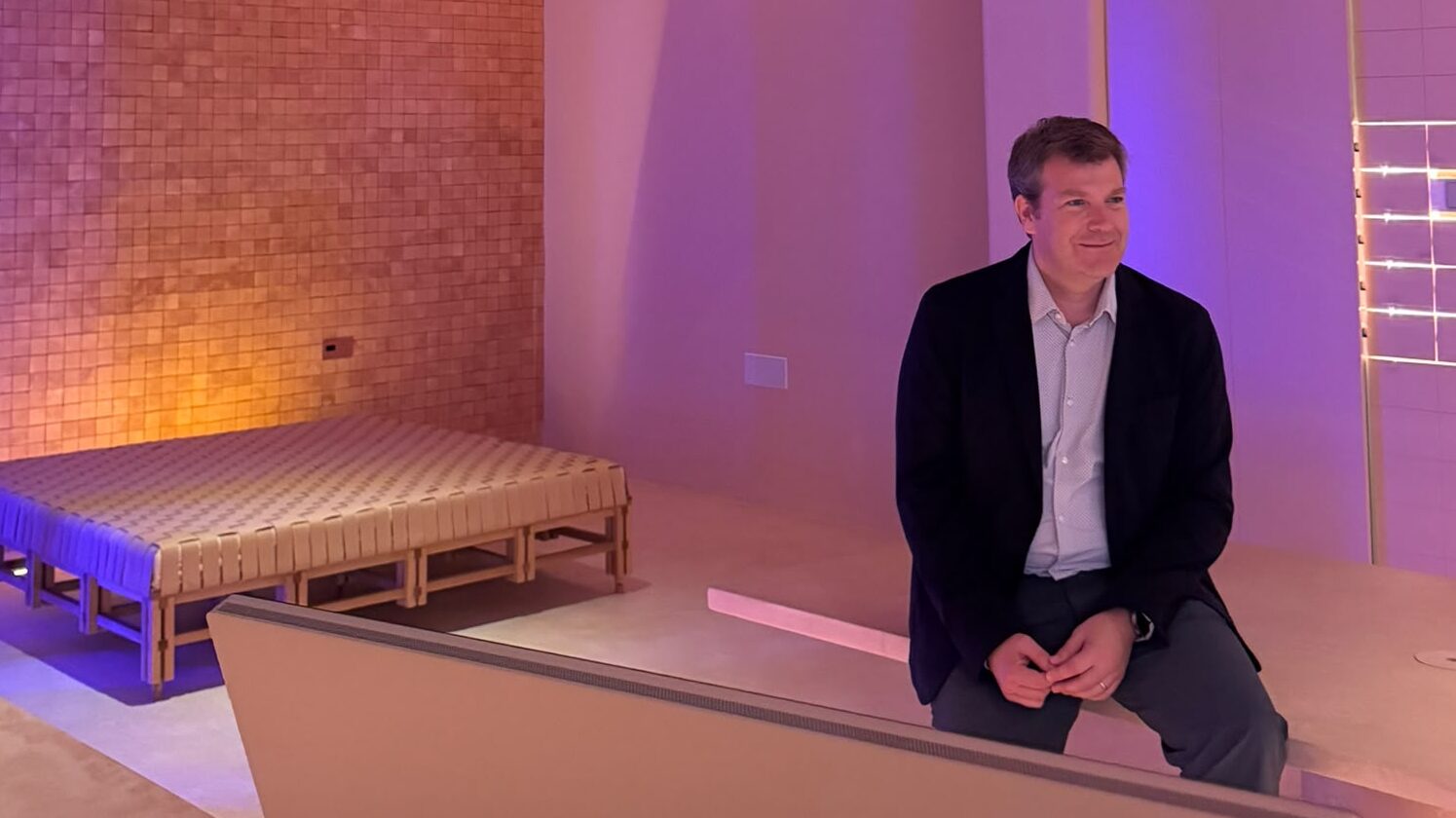
Lighting, control, connectivity, and sound come together in various scenarios designed to replicate real-life situations in the hospitality industry through the Room Experience—a hotel room where visitors can adjust the lighting, temperature, and other settings based on the time of day or the guest’s needs. This concept responds to a trend that is redefining the hotel industry: technology is shifting from a collection of independent systems to an invisible infrastructure capable of coordinating the building’s operations. The goal is no longer to incorporate more technology, but rather to ensure that it adds value without complicating the guest experience.
This entire philosophy revolves around LOLA (a name inspired by the wife of the company’s founder), Simon’s digital platform that enables the connection and management of various building systems. Lighting, sound, temperature, and control can operate in a coordinated manner, while tools such as Facility Manager and Space Controller simplify day-to-day management and provide a more integrated view of the spaces.
The same logic applies to the relationship between guests and hotel services. Some features can be managed directly from the guest room or integrated into the hotel’s management systems. The space also incorporates solutions related to digital services and payment gateways provided by Frekuent.
The new Simon Signature space in Palma also raises an increasingly relevant question in architecture: how to integrate advanced technology without allowing it to dominate the space. The project, developed by architect Cristina Rebolo under the creative direction of YSLA Strategic Creative Firm, addresses this challenge through an identity rooted in the local context. Materials such as Mallorcan marés stone, terracotta, oak, leather, and ceramics connect the design to the Balearic Islands’ traditional use of materials.
When asked about the possibility of expanding in the Balearic Islands—with a second office in Mallorca or a presence in Menorca or Ibiza—the company’s CEO isn’t ruling anything out. “If we see that the concept is working well enough that we need to expand it, we have no doubt that this is a possibility, even if it’s not in the plans right now.”
.