








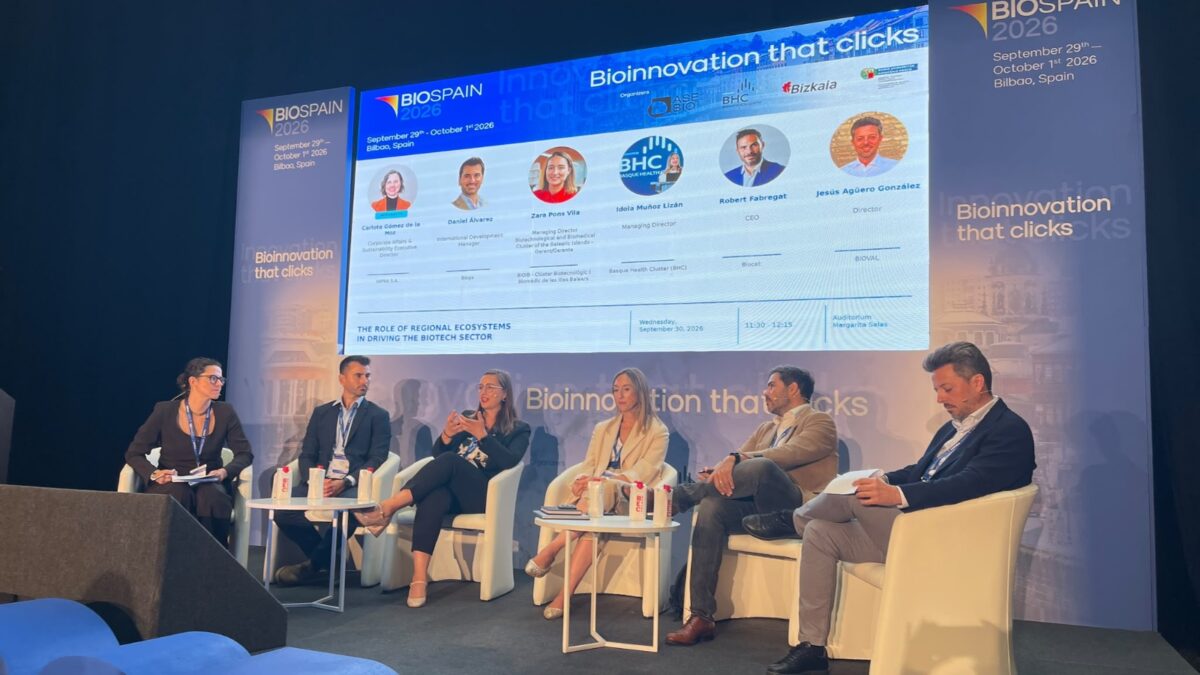
The Balearic Islands are looking to consolidate their biotechnology identity on Spain’s bioregion map. The archipelago aims to gain visibility on the Spanish biotechnology map by establishing its own distinctive position. The Balearic Islands Biotechnology and Biomedicine Cluster (BIOIB) is participating in a roundtable at BIOSPAIN 2026 that brings together representatives from five regional ecosystems to analyze how the specific characteristics of each territory can be turned into an asset for the sector’s growth. BIOIB’s director, Zara Pons Vila, is participating in the panel discussion “The Role of Regional Ecosystems in Driving the Biotechnology Sector,“ along with representatives from the Basque Health Cluster, Biocat, BIOVAL, the BIO Community of Valencia Cluster, and BIOGA.
The meeting brings together the bioregions of the Balearic Islands, the Basque Country, Catalonia, the Valencian Community, and Galicia to discuss an issue that is gaining importance as biotechnology acquires greater strategic relevance in Europe: how to develop regional ecosystems with their own capabilities and, at the same time, connect them to each other to compete in an increasingly integrated market.
The session features Idoia Muñoz Lizan, Director General of the Basque Health Cluster; Robert Fabregat Fuentes, CEO of Biocat; Jesús Agüero González, director of the BIOVAL BIO Cluster of the Valencian Community; and Daniel Álvarez, international development manager at BIOGA. The session will be moderated by Carlota Gómez de la Hoz, Executive Director of Corporate Affairs and Sustainability at HIPRA.
A biotechnology map that highlights different strengths
The combined presence of these five regions highlights the diversity of the Spanish biotechnology ecosystem. The bioregions do not all start from the same position, nor do they share the same assets, trajectories, or areas of specialization. This is precisely where one of the key points of the debate lies: identifying what each region can contribute and how these strengths can be linked with those of other ecosystems to generate new growth opportunities.
The European context adds an additional dimension. The European Biotechnology Act aims to strengthen the competitiveness of European biotechnology and biomanufacturing and to move toward greater integration of an ecosystem that remains highly fragmented.
The lines of action include promoting health biotechnology cluster networks capable of connecting regions, infrastructures, and resources, and facilitating cross-border cooperation. For BIOIB, this scenario reinforces a strategy based on three concepts: identity, specialization, and openness. The issue is not just about developing capabilities within the islands, but about identifying those areas where the Balearic Islands have their greatest strengths and connecting them to networks of knowledge, innovation, and markets capable of expanding their reach.
“The Balearic Islands have a unique structure as a biotech ecosystem. It’s about identifying where our strength and our greatest potential lie, developing them, and connecting them with networks and opportunities that will expand their reach,” says Zara Pons.
Science, health, and business as a single network
The biotechnology sector of the Balearic Islands is centered on a network where science, healthcare, business, and innovation converge. This network brings together companies and start-ups along with institutions and organizations such as the Government of the Balearic Islands, the Bit Foundation, the Health Service of the Balearic Islands, the University of the Balearic Islands, the Foundation of the Balearic Islands Health Research Institute (IdISBa), ADEMA University College and the Beato Luis Belda University Centre, among other involved stakeholders.
For BIOIB, the value of this ecosystem lies precisely in connecting capabilities that develop in different areas. The goal is to foster the translation of knowledge, experience, and activity into new health and life sciences initiatives, while also facilitating their connection with projects, partners, and markets outside the islands. In this sense, the challenge for the Balearic Islands is not only to strengthen its internal ecosystem, but also to ensure that its capabilities can be integrated into broader networks.
“The Balearic Islands bring together knowledge and experience from different fields. Our role is to help bring them together, generate new initiatives, and ensure they can grow and forge connections beyond the islands,” concludes Pons.
The participation of the Balearic Islands in BIOSPAIN 2026 thus places the debate on the development of the biotechnology sector in a dual context: building a distinct identity as a biorregion and, at the same time, being part of a more interconnected ecosystem at the national and European levels.