








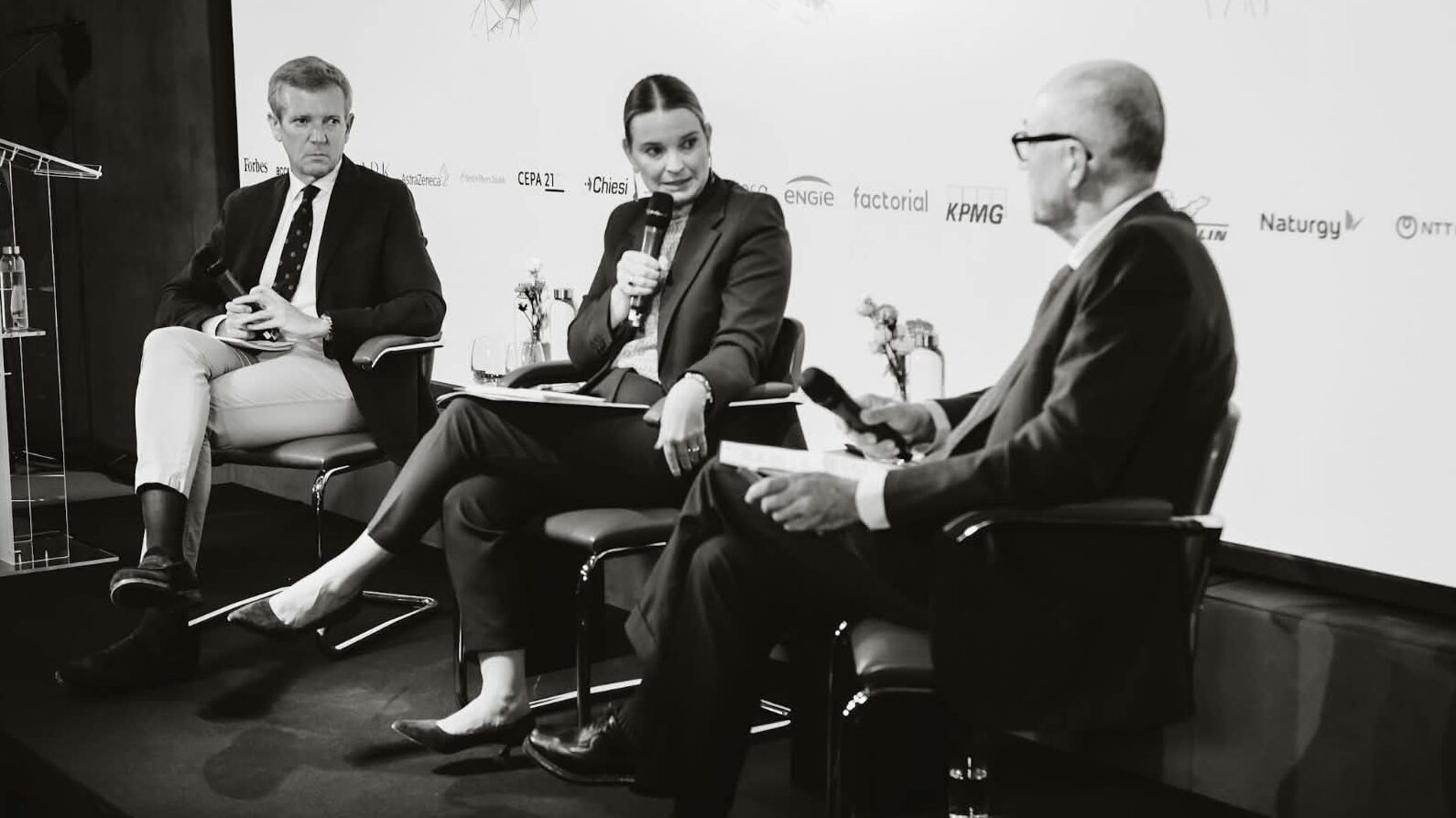
Marga Prohens, President of the Government of the Balearic Islands, spoke about economic challenges, tourism, and immigration during the Forbes Economic Summit, held at the Forbes House from September 21 to 24 in collaboration with Accenture, Árima, ARK Arquitects, AstraZeneca, Bristol Myers Squibb, Cepa 21, Chiesi, DXC, Endesa, Engie, Factorial, KPMG, Línea Directa Aseguradora, MasOrange, Michelin, Naturgy, NTT Data, Pascual, Philip Morris Spain, Seidor, T-Systems and Verisure.
Of the challenges we face in the Balearic Islands – and there are, without a doubt, many – I would point to three. First, the leadership role that I believe we have always played in the autonomous community. Secondly, quality: quality over quantity. And thirdly, for me, what is currently at the heart of all these challenges: sustainability. Managing economic success in a way that translates that success into a better quality of life and greater well-being for residents, and ensuring that it is a sustainable success over time—environmentally, of course, but also economically and socially—Prohens explained.
The president also argued that the economic model of the Balearic Islands “has not run its course,” but is undergoing “a transformation process that cannot be postponed.” In his view, “the growth model must change.” “We cannot continue to grow the way we have for the last 20–25 years because tourism is changing, society is changing, and so are the challenges. We have to grow in value, not in volume. We can no longer continue to measure the success of tourist seasons by the fact that more tourists come each year, or that we break the previous year’s tourist record. We have to set limits.“
There is no tourist lodging, but there is year-round tourism.
One of these limits, which Prohens considers necessary to safeguard the tourism sector, its sustainability, and its future “in the best way possible,” is the growth of tourist accommodation capacity. “We have zero growth in tourist accommodation capacity. To create a new tourist accommodation unit, another one must be taken out of service, which also helps ensure that obsolete units are gradually phased out and that the ones created are of higher quality. And we must not confuse quality tourism with luxury tourism either.”
According to July figures, tourist arrivals have grown by less than one percent, so we are effectively stagnant. However, spending per tourist has increased by 4.7 percent. In other words, we are growing in terms of value. The spending and economic returns generated by tourists in the region are already three times the growth in numbers,” he noted.
The president also emphasized the need to aim for a longer tourist season. To this end, she believes that “there must be great coordination and close collaboration between the public and private sectors.” “There needs to be an offer; for example, we used to talk about year-round cultural tourism, and there also needs to be hotel accommodations, transportation connections, and all the necessary tourist infrastructure and logistics available year-round,” she emphasized.
He spoke about everything that encompasses the sector: “Tourism is much more than just hotels, sun, and beaches; it’s about innovation, new technologies, digitalization, and artificial intelligence.” Therefore, he pointed out that the main Balearic hotel groups “are already exporting this know-how in digitalization and new technologies applied to tourism” and, in this regard, the Balearic Islands “must be able to lead not only in Spain, but also on a global scale; and, moreover, I believe that, in fact, we are already doing so in certain respects.”
In this sense, the priority for the Balearic Islands is “to make even better what we do best, that is, to continue leading—as we have done for the last 30–40 years—the tourism sector in Spain and around the world, and to lead other sectors as well, while ensuring that this economic growth translates into an improvement in the well-being and quality of life of our citizens.”
Prohens also defends “being able to become a region attractive for growth in markets driven not so much by labor, but by knowledge, innovation, and research.” With this objective, he emphasized: “We have to do our homework, and I believe we have already started doing so: less bureaucracy, greater administrative simplification, lower taxes, and becoming a more attractive region to lead these new sectors as well.”
Abandoned and unprotected
“Obviously, we don’t mean to compare ourselves to what Ceuta is experiencing, but it’s true that sometimes it seems that when we talk about immigration, we’re talking about the Canary Islands or the Andalusian coast, and I think recently the focus has been more on the Balearic Islands, but it has been difficult for us to draw attention to this,” said Prohens.
Regarding the figures, he pointed out that this year the Balearic Islands have received more irregular migrants than the Canary Islands, and that they are caring for about 900 fewer unaccompanied minors. “We feel completely overwhelmed, but what is even sadder is that we feel completely unprotected. It’s not about everyone solving their own problems at home. It’s about the fact that we are a country and that we have a government that also has to face these challenges, for which we, as an autonomous community, are not prepared. We don’t manage immigration matters or the borders, and we don’t have enough staff; and although we do take care of minors, we do so under a child protection law that was, without a doubt, poorly prepared for these migratory flows.”
For all these reasons, Prohens is calling for “management at the source.“ “It can’t be fair that people can leave their own coasts so easily and arrive on the coast of the Balearic Islands. We also have a significant flow of migrants from Algeria. What was a rarity just over ten years ago has now become a cause for public alarm, one of the main concerns of the citizenry, and an economic problem.
Regarding the issue of unaccompanied minors, the president said it is a matter managed by the island councils on their respective islands, but that, ultimately, “it all comes from the same source – taxpayers’ money” – and that it costs about 8,000 euros a month. In this regard, the Balearic Islands have amended their regional laws “to curb this pull factor,” but it is not enough. We see no end in sight. And lately, we can no longer accommodate them in conditions that are dignified for the person.”


