







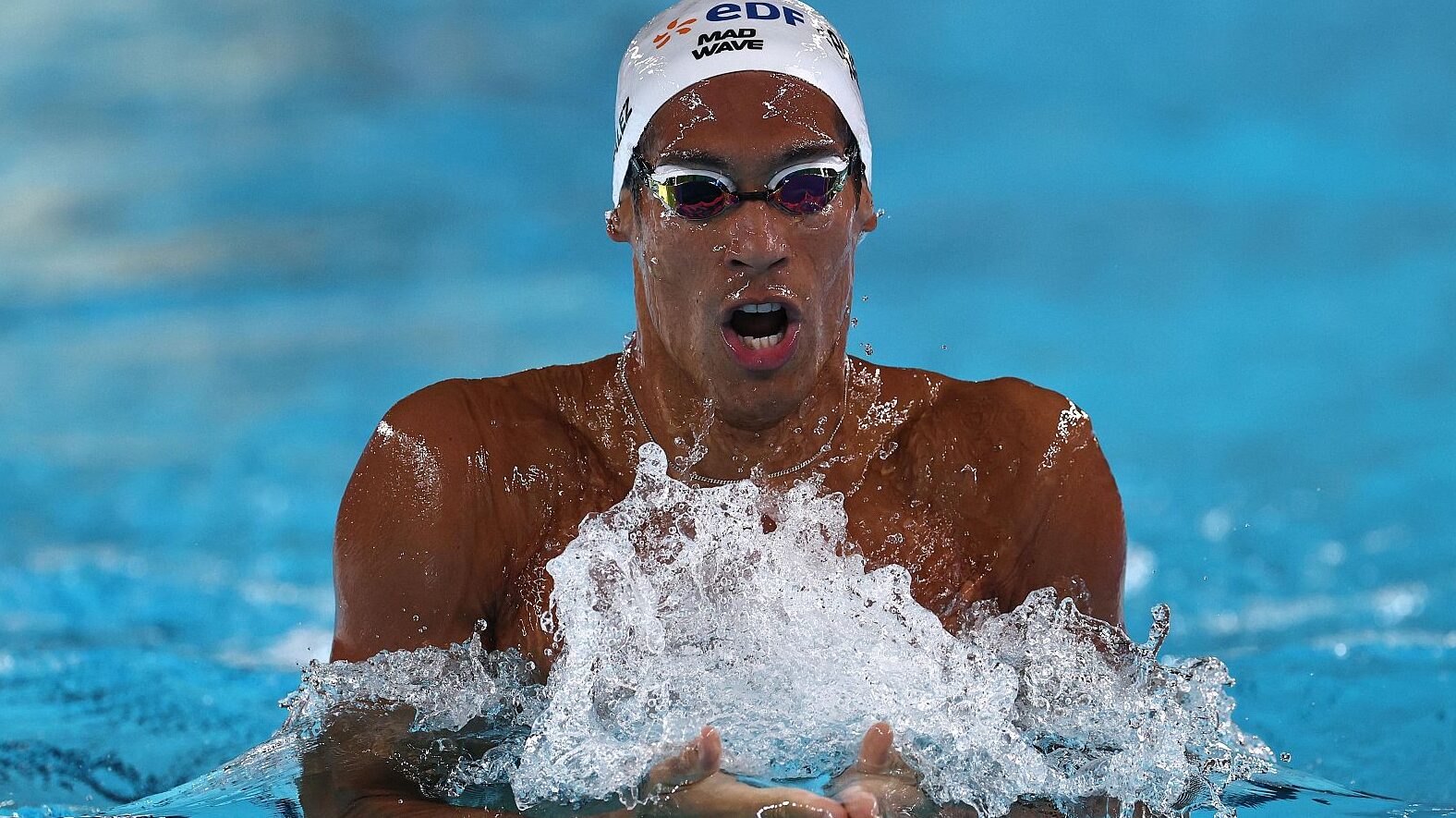
Paris had in store for Hugo González one of those finals that illustrate why in elite sports, it’s not always the one with the best start who wins, but the one who is able to finish the strongest. The Balearic swimmer won the silver medal in the 200-meter individual medley at the European Championships, and in doing so, put Spanish swimming back on the continental podium five years after its last appearance.
González recorded a time of 1:54.44, a time that set a new Spanish record. He was just 2 tenths of a second behind the gold medalist, Hungarian Hubert Kos, who recorded 1:54.24 to secure his third consecutive European title in this event. The Russian Mikhail Shcherbakov completed the podium with a time of 1:56.16.
But the value of González’s performance lies not just in the medal. The race once again showed one of his defining characteristics: his ability to improve as the event progresses. Kos took the lead from the start and managed to open up a 1.79-second lead over the Spaniard after the backstroke. González, however, stuck to his strategy of gradually picking up the pace. In the 50-meter breaststroke, he cut the deficit to 0.98 seconds and reached the final stretch with a real shot at victory.
The comeback continued stroke by stroke. The Mallorcan swimmer finally cut the deficit to just two-tenths of a second behind the champion, but it wasn’t enough. The silver medal, however, carried an important message: González had not only returned to the European podium, but had done so by setting a new national record.
Four European medals
The medal in Paris brings Hugo González’s medal count at the European Championships to four. In addition to this silver, he won three medals in Budapest in 2021: gold in the 200m individual medley, silver in the 100m backstroke, and bronze in the 50m backstroke.
Statistics become more meaningful when put into context. Since that event in Budapest, Spanish open-water swimming had not returned to the European podium. Five years later, it was González who broke the drought.
He did so in a discipline that requires the combination of four different events and which, in his case, has also become a field in which he excels. The national record set in Paris further underscores the competitive caliber of a swimmer who, at 27, remains firmly among the continent’s elite.
A day that tipped the scales in favor of Spain
González’s silver medal also had an immediate impact on Spain’s medal count at the European Championships in Paris. The team had reached several finals and had some exceptional performances since the start of the open water swimming events, but a podium spot had eluded them. The wait ended in the final session: they secured two podium spots.
Just seven minutes after the Mallorcan’s silver, Laura Cabanes added a bronze in the 200-meter butterfly. The 20-year-old swimmer from La Mancha set a new personal best of 2:07.21 to complete a Spanish one-two in one of the championship’s decisive days.
Cabanes reached the halfway point of the race in fourth place, but accelerated in the final sprint and moved into third place on the last lap. She held off an attack from Ireland’s Ellen Walshe by just 0.19 seconds to secure the bronze. The gold went to Great Britain’s Keanna Macinnes, with a time of 2:05.90, and the silver to Denmark’s Helena Bach, with 2:06.14. Later, Cabanes also competed in the 4×100 medley relay along with Irene Ciércoles, Alba Vázquez, and María Daza, and finished eighth with a new Spanish record of 4:00.25. The men’s 4×100 medley relay team finished sixth, while María Ramos was eighth in the 50-meter breaststroke final.
But the big star of the day was Hugo González. His silver medal not only added a new distinction to his collection, but it also ended a five-year wait for Spanish swimming and put the name of a Mallorcan swimmer back in the European spotlight. In Paris, González was 20 hundredths of a second shy of gold. In historical terms, however, his performance was of much greater importance: Spain once again had a star on the European podium, and that star was once again Hugo González.