








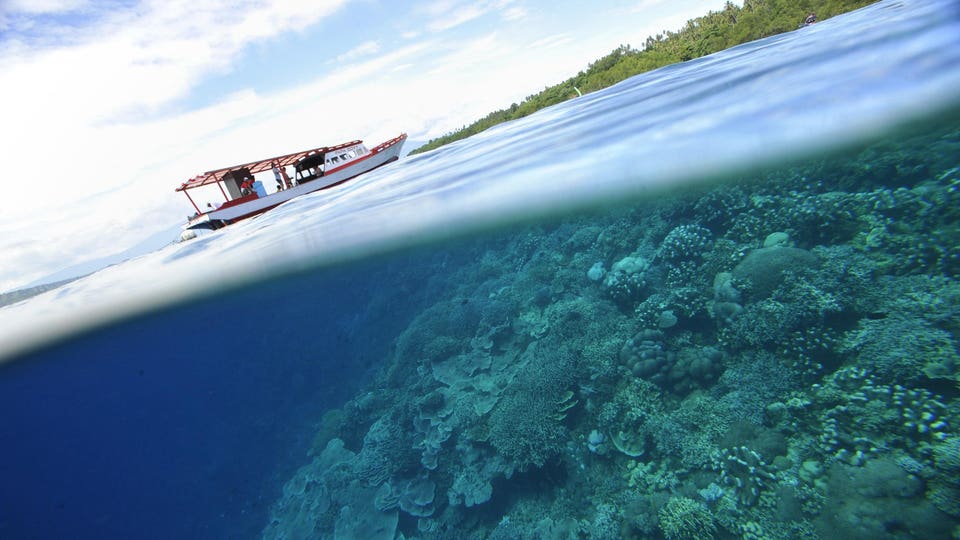
For travelers who enjoy visiting beaches and swimming in the ocean, a marine protected area is an extraordinary destination. These places are like national parks of the sea: they feature crystal-clear waters, healthy ecosystems, and an abundance of fish.
There are currently 16,950 marine protected areas worldwide, according to the Protected Planet database. Together, they protect 10% of the world’s oceans, a milestone announced by the International Union for Conservation of Nature (IUCN) on April 1, 2026.
This achievement is certainly worth celebrating. However, drawing boundaries on a map is only the first step. If marine protected areas are not managed properly, they offer few real benefits. For example, some allow activities such as seabed mining or industrial fishing, which harm ocean resources.
One way to identify the world’s best marine protected areas is to look at which ones have received the Blue Park Awards, presented annually by the Marine Conservation Institute. These awards recognize areas that demonstrate exemplary management and have strong regulations in place to protect marine life.
“A marine protected area is only as good as its ability to enforce regulations,” said Sarah Hameed, director of Blue Parks at the Marine Conservation Institute, during the online announcement of the 2026 winners. “Blue Parks represent the best examples of ocean conservation in the world. These award-winning sites serve as models that should be replicated across the globe.”
Winners of the 2026 Blue Park Awards
The 2026 Blue Park Awards were announced on June 16 during the 11th Our Ocean Conference, held in Mombasa, Kenya.
The winners were:
- KAWAWANA Indigenous Community Heritage Area (Senegal)
- Nosy Hara National Park (Madagascar)
- Nosy Tanihely National Park (Madagascar)
- Rapa Nui Marine Protected Area (Chile)
- Sahamalaza–Radama Islands National Park (Madagascar)
- Banc-des-Américains Marine Protected Area (Canada)
During her virtual acceptance speech, Joanne Thompson, Canada’s Minister of Fisheries, noted that “this award belongs to everyone who contributes to the advancement of this marine protected area: federal and provincial authorities, Indigenous partners, environmental organizations, fishers, the industry, and coastal communities. “We do this work together, guided by science and data.”
According to the Marine Conservation Institute’s MPAtlas, only 3.5% of the oceans are highly protected through no-take marine reserves, where no extractive activities are permitted. Furthermore, a 2024 progress report by the United Nations Environment Programme’s (UNEP) World Conservation Monitoring Centre (WCMC) concluded that only about 1% of all marine protected areas were managed in a way that produced significant conservation outcomes.
High-quality marine protected areas prohibit extractive activities, allowing ecosystems to recover. They also have the support of local communities and involve nearby residents in the management of their marine resources. Many countries have committed to protecting 30% of the ocean by 2030. However, when it comes to protected areas, quality is just as important as quantity.
“Indigenous peoples safeguard marine and coastal ecosystems that are essential to protecting our oceans, alongside officially designated protected areas,” said Grethel Aguilar, IUCN Director General, in the April press release. “Together, we have the capabilities, knowledge, and partnerships needed to fairly and effectively conserve 30% of the Earth by 2030.”
Beyond the Coasts: Protecting the High Seas
Several Pacific island nations are leading the way in establishing high-quality marine protected areas. In 2025, three historic initiatives took place. First, French Polynesia announced the protection of its entire exclusive economic zone of 4.8 million square kilometers, creating the world’s largest marine protected area. Second,
Samoa established nine new marine protected areas, covering 30% of its waters. And finally, the Marshall Islands created their first national marine sanctuary, protecting 48,000 square kilometers of virtually pristine coral reefs in the Pacific.
Although 10% of the ocean is already protected, most marine protected areas are located near coastlines. In the high seas, only 1.66% is protected, partly because the deep ocean lies outside the jurisdiction of any country.
The United Nations High Seas Treaty, which entered into force in January 2026, aims to change this situation. It is the first international agreement specifically dedicated to protecting biodiversity in international waters and establishes a mechanism for creating marine protected areas on the high seas.
“We are at a truly pivotal moment in repairing our relationship with the ocean,” said Lance Morgan, president of the Marine Conservation Institute, during the awards announcement. “If we do not protect these places of immense importance to biodiversity, we will not be able to restore the health and abundance that once characterized the oceans.”
As the global goal of conserving 30% of the planet by 2030 gains momentum, the next phase of ocean protection will require much more than simply drawing lines on a map. It will also be necessary to ensure that marine protected areas have sufficient funding, effective management, and the support of the coastal communities that depend on them.

