








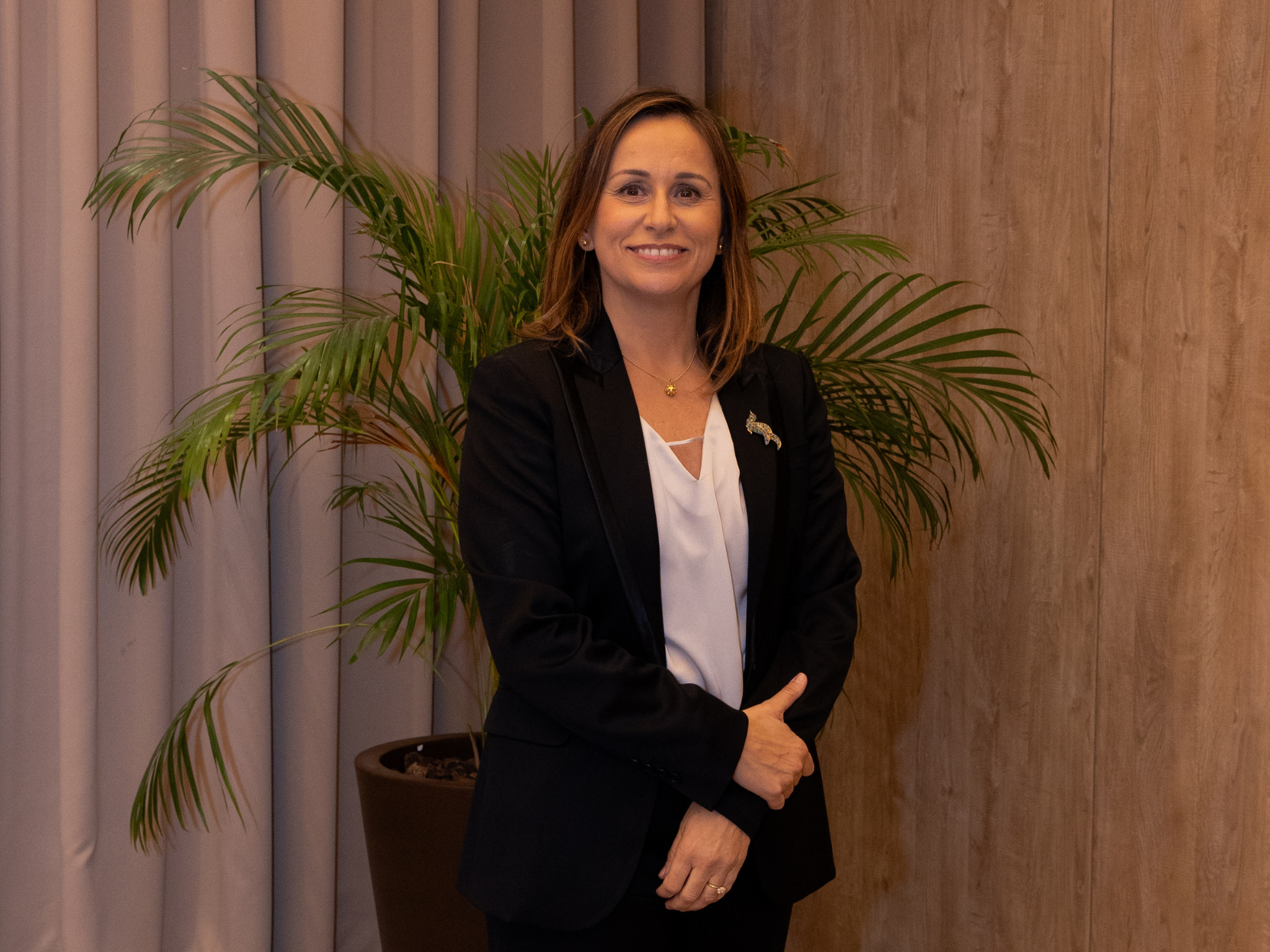
Inés Rotger (Palma, 1976) has been at the helm of the Balearic Association of Family Businesses (ABEF) for a year and a half. She is now exactly halfway through her term, a good time to take stock and set future objectives. In addition to presiding over this organization, she is the director of the Rotger Group, a family business founded in 1927 specializing in retail consumer goods, distribution, logistics, and transportation, where she also held the position of book product manager. She is a fourth-generation member of the company. She advocates for highlighting the full significance of family businesses for the economic and social fabric of the Balearic Islands, believes in their ability to adapt to the new high-tech era, and speaks in support of young people at a time when their commitment, among other things, is to listen to young people more and perhaps stigmatize them less.”
How would you summarize this year and a half at the helm of the ABEF?
I am currently halfway through my term, and when you reach the halfway point, it’s always a good time to take stock. Internally, the most significant task is the work we are carrying out within a committee created by the Board of Directors, through which we are developing the 2026–2028 Strategic Plan. The objective is to establish a roadmap to highlight the fundamental role that family businesses play in the business and social fabric of the Balearic Islands, to define how we want to be present and be part of the narrative of what is happening in the Islands, and, ultimately, what our mission is—the guiding light that directs our activities—and the values that define us. I would like to thank all the members who have been part of this work, which will guide our path for the coming years. Ultimately, we have sought to plan for the future and shape our destiny in the same way we do in our businesses: by thinking long-term, with a shared vision, and the determination to leave a stronger ABEF for future generations.
Have there been any notable developments during your tenure in this period?
Beyond the Strategic Plan, over the last year and a half we have also focused on humanistic management—as we believe the heart of family businesses lies in the people who make them up—and on communication, to highlight the role of ABEF as the leading organization for family businesses in the Islands. Laura Juan Serra has recently joined the team as the new director of our association, and we have given a major boost to the Banca March Chair of Family Business. We have achieved a lot, but this is only the beginning.
At the end of 2024, when this journey began, I highlighted two challenges as more significant than the rest for the family business: the implementation of AI and managing family disagreements. Which of these is proving to be more difficult?
As you can see, both are related to communication, which is the common thread that connects everyone who is part of the family business. AI is part of our processes, but, as Charo Sádaba, Dean of the Faculty at the University of Navarra, explained at the Members’ Assembly held a few days ago, AI must be accompanied by agile, transparent, and, above all, human communication. And this same philosophy applies to managing communication within the family, which brings together people from different generations who occupy different roles. Ultimately, it all comes down to the—not always easy—task of knowing how to listen and communicate with purpose, while maintaining alignment with the same values. Therefore, both are complex—though not complicated—but I believe we are succeeding in focusing on them thanks to the activities and events we organize for our members, which address their main concerns and issues.
Has the labor shortage problem been brought under control?
This is, without a doubt, one of the biggest challenges that family businesses face in the Balearic Islands, along with the need for trained professionals. The issue of labor is on the business agenda in the Balearic Islands as one of the most urgent challenges we must address. And we are not working on this alone; it is essential that we work hand in hand with the institutions. It makes no sense for the private sector to strive to attract and train the best talent if, afterward, these people cannot afford housing. Brain drain is a multifaceted challenge and must be addressed as such.
Complete the sentence: The biggest obstacle to generational renewal is…
Confusing succession with replacement, when in reality it is a shared development process. To make an analogy, we are all branches of the same tree.
Is it that companies can’t retain young staff because of low wages, or do younger generations prefer to try to make a living through the new opportunities offered by social media?
The hospitality and retail sectors have made a significant effort, with wage increases of 4 percent and 4.5 percent respectively, just for this fiscal year. I’ll tell you more: the overall increase for the hospitality sector, during the 2025–2028 period, will be 13.5 percent. We’re talking about a significant increase for a vital sector – the economic driving force of the Balearic Islands – that employs 170,000 people. It’s true that the issue of wages is always controversial, but it’s worth looking at the numbers, which don’t lie. However, beyond these sectors, the ABEF includes companies from other fields like engineering, where salary levels are higher in line with the qualifications of their staff. Broadening our perspective is always important to get an accurate picture of reality. As for social media, I don’t think today’s young people are that different from our generation, even though I still consider myself young. We need to listen to them more and maybe stigmatize them less. I am a strong advocate for young talent because I see it every day in the members of the ABEF Forum: the new generations of family businesses.
Is the business landscape of the Balearic Islands changing?
Yes, things are changing. And they’re doing so at an accelerated pace. Digitalization, sustainability, internationalization, the difficulty of finding talent, and generational succession are transforming the way business is done. But at the same time, one thing remains constant: family businesses continue to be the backbone of the business community in the Balearic Islands. We see family businesses that are increasingly professional, innovative, and open to change, without losing sight of the values that define them: a long-term vision, deep roots in the local community, and a commitment to people. This combination of tradition and adaptability is one of the great strengths of our economy. The challenge is not just to adapt to a new context, but to do so without losing sight of what makes them unique. And I am convinced that the family businesses of the Balearic Islands have the capacity to lead this transformation and continue to be a driving force for employment, investment, and social cohesion.
Is there a decline in family businesses in favor of the expansion of international franchises? Take, for example, the retail, hospitality, and restaurant sectors.
I don’t think we can speak of a setback. International franchises are part of an increasingly globalized economy and coexist with family businesses in the retail and hospitality sectors. The most important thing is that we don’t lose sight of the enormous value that family businesses bring to our economy and our society. The figures prove it. The latest report from the UIB’s Banca March Chair on Family Business shows that family businesses in the Balearic Islands are more resilient and profitable than the Spanish average. 75% of our family businesses are more than ten years old, and their survival rate is 81.5%, above the national average. These figures reflect a solid business model, with the ability to adapt and a clear commitment to the long term. Furthermore, family businesses contribute something that goes beyond economic indicators: they generate stable employment, reinvest in the local area, maintain a strong commitment to the community, and make decisions with a long-term vision. This deep-rootedness is one of their greatest assets. However, we must not be complacent. The main challenge remains ensuring generational succession and supporting business families in this process so they can continue to be a driving force for prosperity for decades to come.
What is the primary value of a family business? What does it offer consumers that other companies cannot?
Our core value is that we are firmly rooted in the region where we were founded and where we have grown. Moreover, family businesses stand out from the rest because they are founded on solid values and a core mission: to endure so they can be passed on to the next generation. A long-term vision without losing sight of our essence, which comes from our origins. The Balearic Islands are a land of family businesses, and so it must remain.
What are your main objectives before your term ends?
Our goal is to build a stronger, more useful, and more representative ABEF. To this end, the Board of Directors has established four main areas of focus within the strategic plan. We want to strengthen the Association’s structure to make it more efficient and accessible; provide better support for family businesses, fostering the participation of all generations and expanding our presence, especially in Menorca and Ibiza; promote the Forum as a space for innovation, training, and networking for younger generations; and strengthen institutional and business alliances to generate more opportunities and greater value for our members. The legacy we would like to leave is a more cohesive and professional ABEF, with a greater presence on all islands and an even more influential voice in advocating for the family business. In short, an Association prepared to continue supporting business families as they face the challenges of future generations.
How would you summarize the first half of 2026? Have the geopolitical upheavals had a smaller impact than was initially expected?
It is true that the first quarter of the year brought a period of geopolitical upheaval that put us all on alert – an alert we must not let down at any time, because the current international situation can change in 24 hours. We are living in uncertain times and we must learn to navigate these constantly churning waters. And, in this regard – as the experts say, and as we know all too well – family businesses are more resilient because our primary mission is to withstand the test of time: we are born to endure. It’s no coincidence that 93 percent of all private companies in the Balearic Islands are family-owned.
Two women have led the ABEF during the last two parliamentary terms. Do you think that would have been possible when the association was founded 25 years ago?
It’s true that times have changed for the better, but to be honest, we women have always been part of the family business, so it was only a matter of time before we took the presidency of the leading association, ABEF. I have always admired Esther Vidal as a role model for leadership, but women like Carmen Serra and Ketty Isern, who were there from the early days of ABEF, have also been magnificent role models for women who have had a significant impact on the family businesses of our islands. Furthermore, women are increasingly represented on the boards of directors of ABEF’s family businesses. Specifically, 44.6 percent of the CEOs of these family businesses are women, and they represent 31.6 percent of management teams, the highest figure recorded in the last decade. These figures were compiled by the team at the Banca March Chair of Family Business, based on information available in the Spanish financial database SABI, as well as the Commercial Register. Leading by example is the best we can do.
You argue that companies that adapt to change are the ones that survive, but in today’s era of constant change, aren’t we asking too much of small and medium-sized businesses?
There’s no doubt that you’re asked to do a lot today. We live in an environment where digital transformation, regulatory changes, sustainability, and geopolitical uncertainty force us to constantly adapt. For a small business, doing so with limited resources is a huge challenge. But if there’s one type of business that’s used to managing change, it’s the family business. For generations, we have overcome crises, reinvented ourselves, and made decisions with a long-term vision. This ability to adapt is in our DNA: we know that preserving our legacy requires constant evolution. That said, we cannot expect SMEs and family businesses to face all these challenges on their own. A supportive environment is essential: a government that facilitates, reduces unnecessary burdens, drives innovation, and fosters generational succession. I am aware that the Regional Ministry of Business is doing important work in this area, especially to help ensure the continuity of many companies whose future depends precisely on finding that succession. At ABEF, we will continue to contribute our experience and knowledge to help ensure that more companies not only survive, but also continue to create jobs, wealth, and stability for future generations.


