








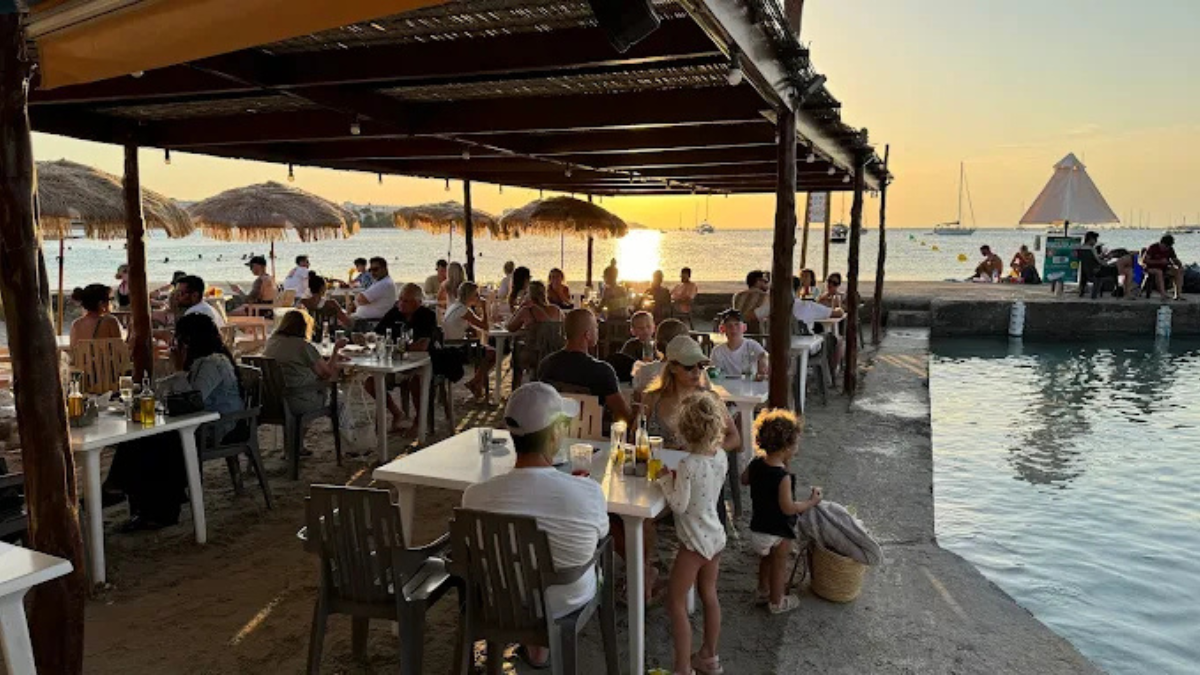
On an island where brand image is almost everything, regulatory decisions are beginning to reshape the product. The recent ruling by the High Court of Justice of the Balearic Islands (TSJB), which upholds the closure of one of Ibiza’s historic beach bars, is not an isolated incident: it is a clear sign of the direction in which the Balearic Islands’ coastal tourism model is heading.
The specific case—the refusal to grant a permit for the operation of the Es Puetó beach bar in Sant Josep de sa Talaia—is based on three main factors: overcrowding of services along the waterfront, the availability of alternative dining options away from the beach, and the mandatory removal of unauthorized structures. In economic terms: density control, redistribution of demand, and strict regulatory compliance.
For decades, beach bars were an integral part of the Ibiza experience. They were informal gathering spots with low operating costs and high symbolic value. However, the sustained growth of luxury tourism has disrupted that balance. Today, the coastline is no longer just a recreational space: it is a strategic asset subject to intensive regulation.
The official message is clear: the spontaneous model is giving way to a planned one. The coastline is managed as a limited resource, where each permit must justify its economic, environmental, and urban planning impacts.
The saturation factor: when success becomes a risk
Overcrowding along the Balearic coastline is nothing new, but the approach to addressing it is. The government is no longer just measuring demand, but also carrying capacity. In market terms, this means higher barriers to entry and a gradual reduction in the number of informal or long-standing operators that fail to adapt to the new framework.
For visitors, this may result in a more organized experience, but also a more uniform one—and, predictably, a more expensive one. For business owners, the message is clear: professionalize or get out.
What is Ibiza losing?
The disappearance of traditional beach bars is not just an economic issue; it is also a cultural one. These places represented a more accessible, less polished, and more organic Ibiza. Their closure raises an uncomfortable question: to what extent does the commercialization of a destination erode its authenticity?
And what’s in it for them? From an institutional perspective, the argument is sound: less pressure on the coastline, greater control over urban development, and a tourism offering more closely aligned with quality and sustainability standards. In terms of branding, Ibiza is reinforcing its position as a regulated premium destination, moving away from overcrowded and unregulated models.
The TSJB ruling not only closes a business; it redefines the rules of the game. Tour operators will have to adapt to an environment where licensing, regulatory compliance, and integration with the local ecosystem will be just as important as location or business concept.
In short, Ibiza isn’t losing its beach bars; it’s redefining its value proposition. The key question isn’t whether this change is positive or negative, but whether the market and visitors will continue to perceive the island as unique in an increasingly regulated and competitive environment.
It’s Puetó—it’s a piece of Ibiza’s history
A long-standing establishment with prices for the locals. With a down-to-earth atmosphere, filled with family memories, and a true reflection of the Ibizan way of life since 1972. The E Puetó beach bar in Ibiza, located on Es Pouet Beach, keeps traditional beach cuisine alive with a simple menu based on classic ingredients, featuring salads, omelets, combo plates, sandwiches, burgers, and wraps, as well as meats like chicken, ribeye, and pork chops. Its seafood offerings reinforce that same spirit with grilled or fried fish, calamari, baby squid, small fish, mussels, and shrimp prepared in various ways—an honest, unpretentious selection that, until now, honored the tradition of Ibizan beach bars. It seems this tradition is now an endangered species.
But the case of Es Puetó has already transcended the administrative realm to become a symbol of the debate currently unfolding in Ibiza. Following the ruling by the High Court of Justice of the Balearic Islands, which upheld the Costas Agency’s decision not to renew the permit to operate on public land, the public response was swift. A campaign launched by ARC Ibiza via Change.org seeks to stop the closure of an establishment that, for many residents, represents much more than just a beach business: it is a space for intergenerational gathering and a recognizable part of the island’s collective memory.
The court maintains that the occupation of the waterfront does not constitute an automatic right and considers that the area already has sufficient dining options. Furthermore, it notes that the facilities had lacked a valid permit since 1984 and that there were unauthorized elements, also ruling out any claim of lack of legal representation during the judicial process. However, the public outcry has reopened a deeper question: what place remains for traditional businesses in an Ibiza that is increasingly regulated, sophisticated, and geared toward premium tourism.
The possible disappearance of Es Puetó would not only highlight the tightening of regulations along the Balearic coastline; it would also mark the end of a certain way of understanding the island. A less contrived and more spontaneous Ibiza, where accessible, imperfect, and authentic spaces still survived in the face of the destination’s growing homogenization.


