








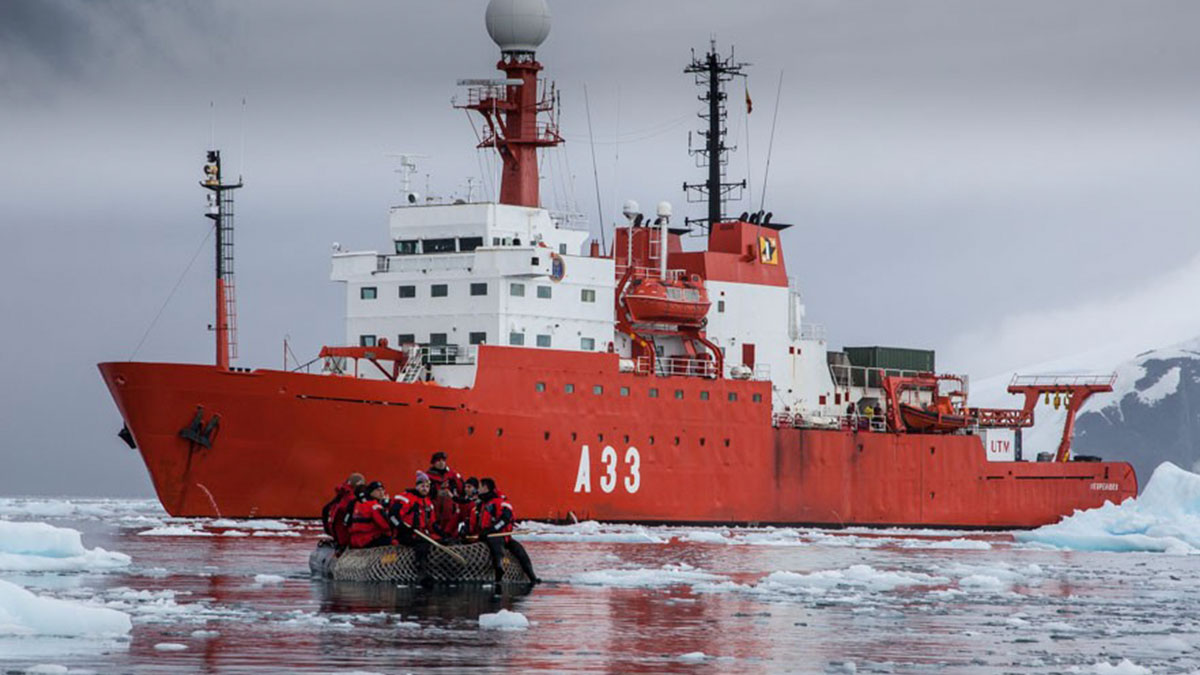
Cartagena. At 1:00 p.m. on Monday, November 16, 2026, the Hespérides cast off from the Almirante Juan de Borbón pier at the Arsenal and began to sail away from its home port. Behind it were waving handkerchiefs, long embraces, and several hundred family members who had risen early to bid it a final farewell. Ahead lies nearly six months of sailing and some 20,000 kilometers to Deception Island, where the Navy’s oceanographic vessel will embark on its 31st Antarctic Expedition.
The farewell ceremony was presided over by Vice Admiral Vicente Cuquerella Gamboa of the Maritime Action Force, who reminded the crew of the harsh conditions they were heading into. His advice was simple: to look out for one another. That spirit of teamwork, echoed by everyone, best summed up the morning.
Commanding the ship for the first time is Commander Balbino López Alonso (Foz, Lugo, 1979), who is already familiar with the ship from his time as an officer, though he admits that his current responsibilities are different. “I’ll draw on my experience when necessary,” he said. At his side, nearly sixty Navy personnel will sail on a ship capable of accommodating up to 37 scientists and technicians, including those from the CSIC’s Marine Technology Unit, who operate the scientific equipment.
From the Mediterranean to the Sea of Hoces
The route will take the Hespérides first to Rio de Janeiro, where it is scheduled to arrive on December 3, and then to Punta Arenas (Chile), where the team for the first project will board the ship. From there, it will sail to Livingston and Deception Islands in the South Shetland Islands to provide logistical support to the Spanish bases Juan Carlos I and Gabriel de Castilla. The Odón de Buen will have already established them. The ship is expected to spend Christmas in Antarctic waters, where it will remain from December 20 to March 20. If all goes according to plan, the ship will return to its base in late April 2027.
Three projects will be the focus of the campaign. Polaromics will study the Antarctic biome and its ability to withstand climate change. SACO will analyze water transfers between the Weddell Sea and the South Scotland Range. Atmeshet will focus on the tectonic and volcanic processes in the Shetland Islands and the Antarctic Peninsula. In addition, supplies and personnel will be transported to the bases from Punta Arenas and Ushuaia, involving several crossings of the Hoces Sea—a passage that takes on special symbolic significance this year, as it marks the 500th anniversary of Francisco de Hoces’s expedition, during which he discovered the connection between the Atlantic and the Pacific south of Tierra del Fuego in 1526.
For Eva Ortega-Paíno, Secretary General for Research, who attended the farewell ceremony, there are reasons to feel “extremely proud” of Spain’s role in polar science. Regarding the future of the ship, which has been in service since 1991, she confirmed that work is already underway on the design of its replacement, though no date has been set. In the meantime, the goal is for the Hespérides to continue sailing for as long as possible.


