







I’ve highlighted key terms in bold for SEO purposes, emphasizing keywords and phrases related to sailing, Mozambique, the voyage across the Indian Ocean, and the arrival in South Africa. I’ve tried to keep the text flowing naturally without overloading it with bold text.
Like every morning, I check the weather forecast, and it looks like there might be a window in a few days to set sail for South Africa. I’d love to stay here in Mozambique a little longer, but it’s about time to move on. If I decided to let this opportunity pass, as of today, I’d have to wait at least a couple of weeks for another chance. In this part of the world, good weather windows are rare and last only a few days. I have to take advantage of this opportunity. It’s 400 miles to Richards Bay, the first port in South Africa—about a 3- to 4-day voyage.
When I arrived in Mozambique, I spent the next few days getting the Sofía ready to set sail again. Now I just have to pick up my last survival kit from Julie and Mussa—full of fruits and vegetables—haul the boat on board, and we’ll be ready to set sail. As I pull the boat into the water and return to the Sofía for the last time, a wave of sadness washes over me, and I force myself to keep going. The days in this Mozambican paradise have flown by all too quickly. I don’t understand it… I see the sadness on Mussa’s face, and he says goodbye, telling me, “Well, we’ll talk on WhatsApp…”
There are five sailboats at anchor, and at noon we meet on the beach to go over the final details for tomorrow. We’ll all set sail in the morning, with the current in our favor. The weather looks stable; the only thing that’s still unclear is what the conditions will be like when we arrive. It seems the other boats are feeling confident about the weather. I head back on board, stow the dinghy inside, and cook up some vegetables for the first few days of the sailing trip. I’m so nervous that I’m having trouble sleeping.
At 3:00 a.m., I’m already awake, tossing and turning in bed. I accept that I won’t be able to fall back asleep, so I make my first cup of coffee of the day while checking the latest weather forecast. It looks like everything is staying stable. It’s still dark, but the night is lit by the waning moon. I tidy up inside, and as the first light appears—before the sun rises—all the sailboats in the bay begin to weigh anchor and file out toward the anchorage exit. Mozambique will always have a place in my memories.
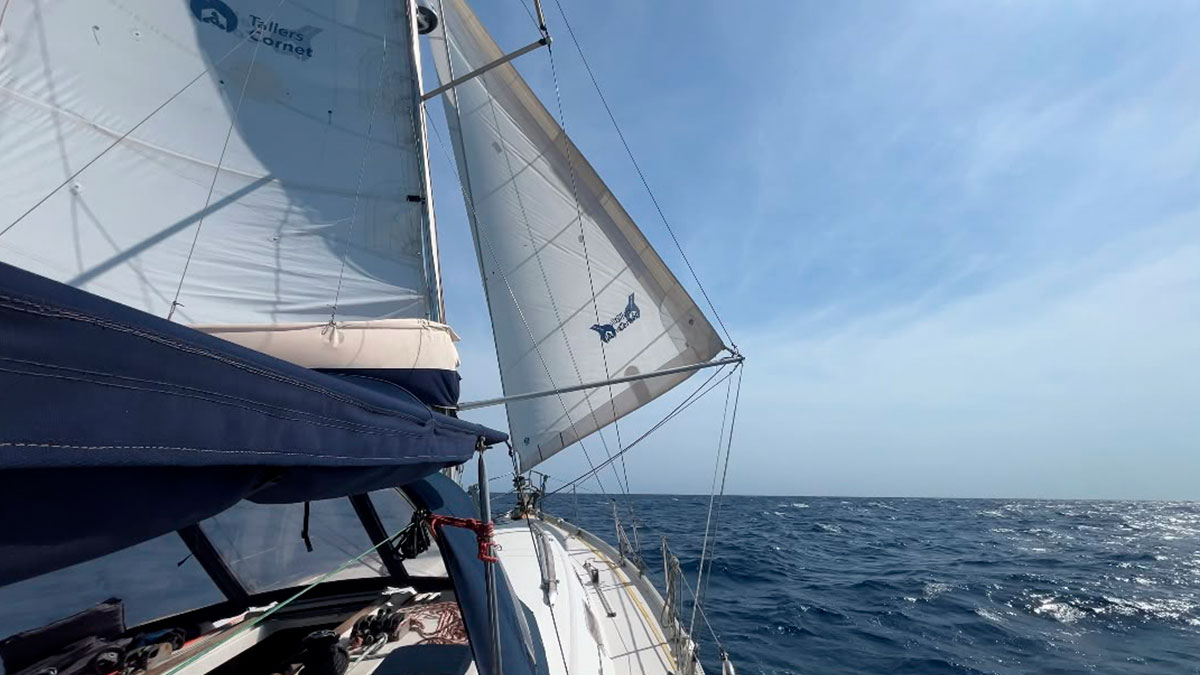
The wind is coming from the southeast, and for the first few miles—until 2:00 p.m.—we’re sailing close-hauled and tacking. The Sofía is heeling over severely, and life on board is impossible. In the afternoon, the wind shifts, and we’re able to set a direct course for Richards Bay, South Africa. The current should be in our favor, but it isn’t until nighttime that it turns in our favor, and we’re sailing at 7–8 knots. The sky is full of stars, and the moon is following us from astern. I try to sleep in 30-minute intervals, but I have a hard time resting—perhaps because it’s the first night.
It’s a fairly clear dawn, and I set the jibs: the mainsail on the starboard side and the genoa on the port side, furled. Now the Sofía is flying. The wind has picked up to 20–25 knots, and the current keeps pushing us along. We hit 10.5 knots while surfing a wave. You can really feel the acceleration—it’s like being in a regatta. I stay on deck watching us navigate through the waves. No luck with the fishing, but I bake some bread for dinner.
At night, the sky begins to cloud over and the wind dies down to 5 knots. I start the engine, and it begins to rain. I make sure all the hatches are closed and that there are no leaks. Even though the wind has died down, we’re sailing at 5–6 knots thanks to the current. All night long, the deck of the Sofía is hosed down every 20 minutes by the heavy rain. I take the opportunity to put a couple of buckets on deck to collect rainwater.
Dawn is breaking, and we still have 50 miles to go. In just two hours, the wind picks up to 20 knots on the bow. The current, which had reversed at midnight, is now working against us. All of this forces us to return to tacking. Sailing directly into the wind, waves, and current, we make no headway. From dawn until 5:00 p.m., we have to tack, with all that entails: the boat listing, life on board impossible, physical and mental exhaustion, strain on the rigging and sails, and general discomfort.
With one hour to go before entering the harbor at Richards Bay, South Africa, the wind dies down. At 5:30 p.m., I dock at the South African customs pier.
Mission accomplished!


